


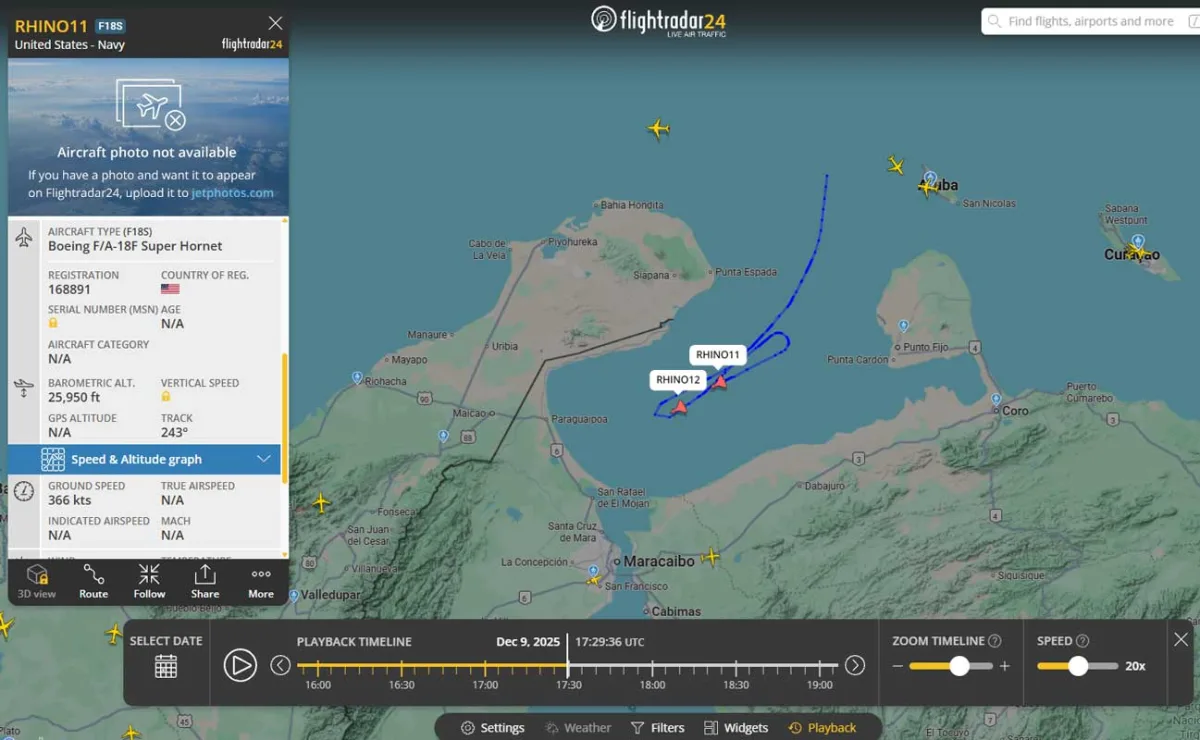

The tension between the United States and Venezuela takes a new leap forward. Tuesday, December 9, two US fighters F/A-18 Super Hornet, identified by the code names RHINO11 (leader) and RHINO12 (wingman), carried out an incursion into Venezuela's internal waters, surpassing not only the territorial limit of 12 nautical miles, but directly penetrating an area considered an integral part of the national territory.
An act that represents one of the most assertive moves made by Washington in recent years towards the regime of Nicolás Maduro.
The Route of the Super Hornet: Incursion Between Zulia and Falcón
According to data from air monitoring platforms like Flightradar24, the two F-18s flew over the waters between the states of Zulia and Falcón, in an area very close to Maracaibo, between the Paraguaná Peninsula and the Península de La Guajira.
The fighters performed several circuits over the area before heading north and, according to available traces, they reportedly turned off the transponders shortly after exiting, thus reducing the possibility of tracking by Venezuelan surveillance systems. They entered at 1:00 PM local time, corresponding to 6:00 PM in Italy (5:00 PM UTC), and remained within Venezuelan territory for over half an hour, making multiple loops in the same area before moving away.
A Threshold Never Before Crossed
Analysts consulted by the Colombian broadcaster NTN24 have pointed out that, until today, US aircraft had respected the territorial waters limit, remaining predominantly over international waters.
The operation on December 9 marks a clear change: for the first time, the United States has carried out an action that constitutes a true joint penetration into Venezuelan airspace and internal waters, considered an integral part of the sovereign territory.
A qualitative leap that could have a significant impact on the diplomatic and military dynamics between Washington and Caracas.
Strategic Area: Proximity to the “Rafael Urdaneta” Naval Base
The flyover occurred in the immediate vicinity of the naval base “Rafael Urdaneta”, the most important installation of the Venezuelan Navy in the state of Zulia, and the command of the Western Integral Defense Strategic Region.
The area is highly sensitive from a military point of view and hosts:
- coastal and river surveillance units,
- command and control centers,
- surveillance radars,
- coastal defense batteries.
The choice of the entry point, therefore, appears anything but random.
The Presence of the MQ-4C Triton: Reconnaissance and Intelligence
The incursion of the Super Hornets was preceded by the sighting, by the same monitoring platforms, of a US drone MQ-4C Triton, one of the most advanced ISR systems in the world.
Manufactured by Northrop Grumman, the Triton is designed for:
- long-range reconnaissance,
- high-altitude surveillance,
- collection of electromagnetic signals and information,
- identification of targets in vast maritime areas.
It is believed that, during its passage, the drone carried out telecommunications interception and radar mapping activities, providing useful information for the subsequent operation of the fighters.
A Political-Military Signal to Nicolas Maduro
This series of close aerial movements represents a clear signal of the increasing pressure of the United States on the regime of Nicolás Maduro, in an international context increasingly critical of the Venezuelan political situation.
The penetration into internal waters, a very rare act in US-Venezuela dynamics, appears as a direct message: Washington intends to raise the level of deterrence and monitoring, maintaining the ability to oversee and influence developments in the Caribbean area.
The crisis, already exacerbated by regional tensions, diplomatic pressures, and territorial disputes, thus seems to enter a new phase, more complex and potentially more unstable.



Comments
No comments yet. Be the first!