


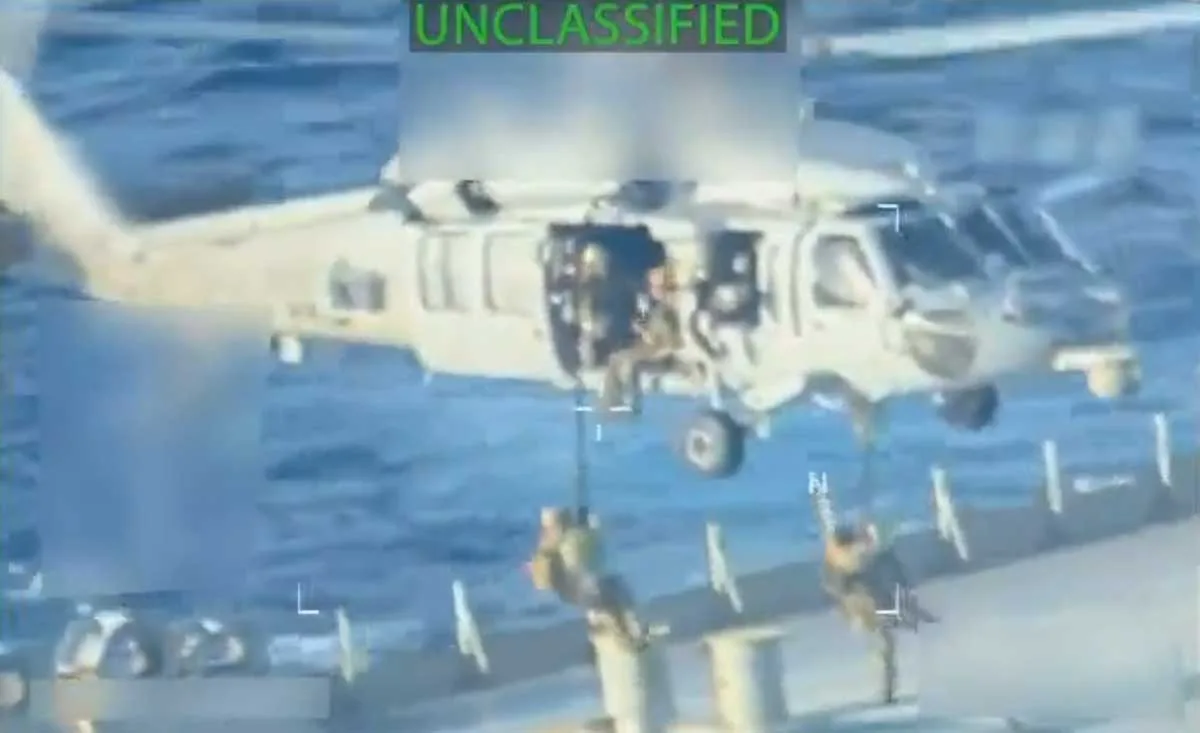

The crisis between the United States and Venezuela enters a completely new and more aggressive phase, marked by the shift from economic sanctions to direct operations at sea. According to today's report by Reuters, Washington has intercepted a third oil vessel off the Venezuelan coast, deemed subject to international sanctions.
It is no longer just about diplomatic pressures or financial measures: special units are boarding the tankers, seizing them in international waters with methods typical of high-risk military operations.
This is the latest step in an escalation that, in its “first phase”, targeted vessels linked to drug traffickers, then escalated with the entry of US F/A-18 fighters into Venezuelan territory. Now it consolidates at sea with an interdiction campaign that directly targets the economic heart of Caracas: oil.
Strategy Shift: Military Boardings Entrusted to Special Forces
The breaking point is represented by the nature of the operations. The images released show military helicopters, specialized units, and maritime interdiction procedures that resemble more a counter-terrorism operation than an international police action.
The change of pace was confirmed by the US Secretary of Security, Kristi Noem, who publicly claimed the seizure of an oil tanker last docked in Venezuela. The operation, conducted before dawn on December 20, 2025, saw the United States Coast Guard act with the direct support of the Department of Defense.
But the most significant data is the rapid progression of interventions: after an initial action attributed to US forces on December 10, 2025, the seizure confirmed by Noem on December 20, 2025 was followed, according to Reuters, by a new operation on December 21, 2025, when US officials reported the interception of a third oil vessel in waters near Venezuela. In other words: not isolated incidents, but an accelerating campaign, with a clear operational logic.
The political message was explicit: Venezuelan oil trafficking is considered by Washington a threat to regional security, accused of financing criminal networks and drug trafficking.
Today, the Federal Bureau of Investigation, Homeland Security Investigations, and the United States Coast Guard, with support from the Department of War, executed a seizure warrant for a crude oil tanker used to transport sanctioned oil from Venezuela and Iran. For multiple… pic.twitter.com/dNr0oAGl5x
— Attorney General Pamela Bondi (@AGPamBondi) December 10, 2025
The De Facto Naval “Blockade”
These actions follow President Donald Trump's announcement of a true “blockade” of sanctioned tankers entering and leaving Venezuela. Although not formally declared as such, the device deployed has all the characteristics of a selective maritime interdiction.
The repetition of interventions, a few hours apart from each other, outlines a precise picture: not sporadic initiatives, but rules of engagement and command chain already active, with a direct message to companies, intermediaries, and third states: those attempting to move cargoes connected to Caracas risk being stopped. In other words, the pressure is no longer just economic: it is maritime, visible, and coercive.

Caracas: “Attempted Overthrow”
On the opposite side, Venezuelan President Nicolás Maduro, deemed illegitimate by the White House, interprets these operations as a hostile act aimed at overthrowing the government and taking control of the country's energy resources.
According to Caracas, the increase in US military presence in the Caribbean Sea and the Pacific represents a direct threat to national sovereignty, a prelude to even more serious scenarios.

A Threshold Crossed
From a military and strategic point of view, the systematic boarding of tankers marks the crossing of a critical threshold. Maritime operations with special units indicate that the crisis is no longer confined to political rhetoric or sanctions, but has transformed into operational confrontation on the ground, or rather, at sea.
For the first time, the US-Venezuela crisis takes on the contours of a hybrid conflict, where economy, international law, and military force merge into a single strategy of pressure.
A new phase has begun. And, as often happens when special forces and clandestine operations come into play, the risk of escalation is now higher than ever.


Comments
No comments yet. Be the first!