


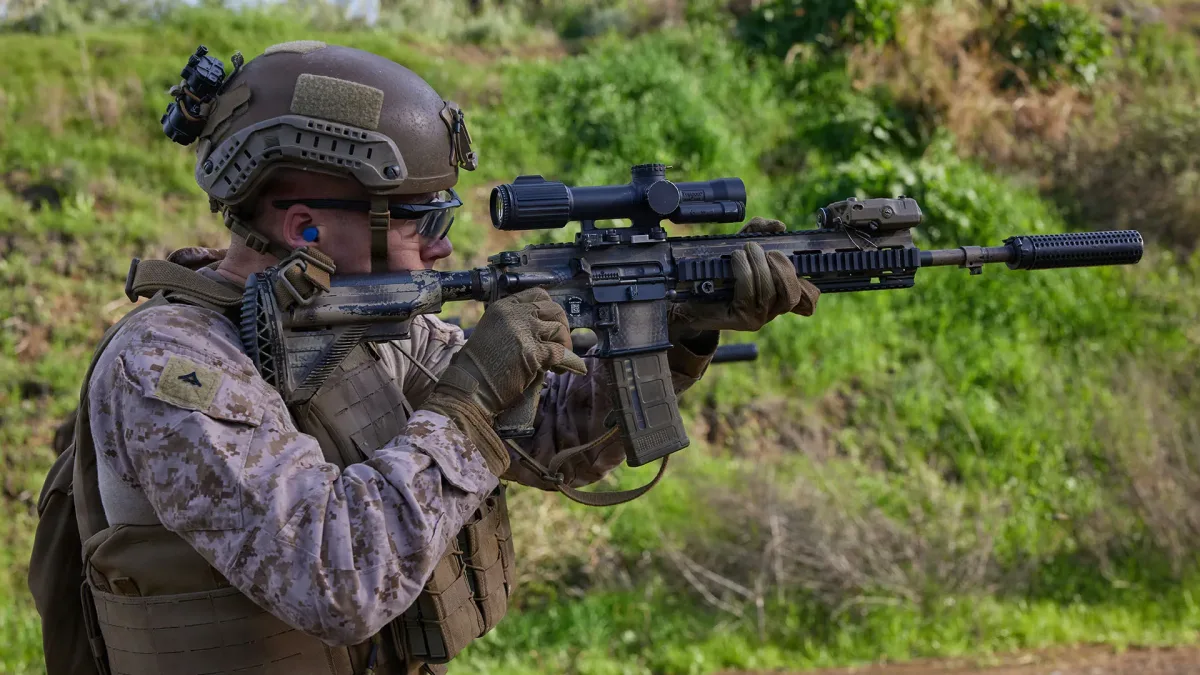

The United States Marine Corps has decided to retain the M27 Infantry Automatic Rifle (IAR) as the primary weapon for its close combat formations, forgoing the adoption of the Army's M7 for now, which is the centerpiece of the Next Generation Squad Weapon (NGSW) program. The confirmation came through a service spokesperson in statements released to Task & Purpose.
“The Marine Corps will retain the M27 for our close combat formations because it best aligns with the service's unique requirements, the amphibious doctrinal employment of weapons, and distinct modernization priorities, while ensuring seamless interoperability within the joint force and with coalition partners,” the spokesperson explained in an email.

Why the Marines are not switching to the M7
The official reasoning revolves around three key concepts:
- Specific “service” requirements: the Marines emphasize that their operational needs do not always coincide with those of the Army.
- Amphibious and expeditionary doctrine: the equipment must remain consistent with the typical employment of the Corps, often linked to landing operations, coastal environments, and “light” logistics.
- Different modernization priorities: the decision not to immediately converge on the M7 reflects internal planning that prioritizes systems deemed more aligned with their concept of employment.
This does not mean a definitive closure: the Marine Corps has specified that it will continue to observe the evolution of the M7 to guide potential future requirements.
“We will continue to monitor the development of the M7 [Next Generation Squad Weapon rifle] to inform future requirements,” the spokesperson added, reiterating that the evaluation of systems is continuous and based on expeditionary needs.
M27: from M249 replacement to extended “squad rifle”
The M27 IAR, based on a Heckler & Koch design, entered operational service with the Marines in Afghanistan in 2011. Initially born with the goal of replacing the M249 as a squad automatic weapon, over time it has expanded its role to become a standard element within rifle squads, consolidating as a central platform for close combat.
The Army's M7 and the caliber change
The M7 represents the Army's generational leap: a system built around a 6.8 mm ammunition, designed to ensure greater range and effectiveness compared to the widespread 5.56 mm used for decades in many components of the U.S. armed forces.
In the NGSW program, the Army is distributing M7 and the M250 machine gun to various categories of frontline personnel, including infantry, scouts, engineers, forward observers, combat medics, and special forces.
Supporting the new ammunition, an assessment attributed to Brig. Gen. Phil Kinniery (Infantry School/Maneuver Center of Excellence, Fort Benning, Georgia) reported that the 6.8 mm “stops the enemy with one shot” reducing the need to engage with multiple shots to achieve the same effect.

Debate: magazine capacity and responses from Army and Sig Sauer
Despite the start of distribution, the M7 has become the center of discussions on design aspects. A presentation by an Army officer at the Modern Day Marine in Washington, D.C., raised doubts about the 20-round magazine capacity, deemed potentially limiting in some combat scenarios.
The criticisms were dismissed by both the Army and the manufacturer Sig Sauer. Jason St. John, senior director of strategic products at the company, told Task & Purpose that a large team works daily on the system and that the company is “highly confident” in the weapon's robustness, safety, and performance.
A precedent in 2020: clarifications on the Marines' plans
The current position fits into a trajectory already emerged in the past. In May 2020, the Marine Corps Systems Command intervened to correct a statement that had generated confusion, as it implied that the Corps intended to replace the M27 under the NGSW program. The episode highlighted even then the Marines' caution in directly tying their modernization to the Army's choices.
What the decision means in practice
The decision keeps the Marines on a line of continuity: the M27 remains the reference for close combat units, while the Army continues with the transition to the M7/M250 and the 6.8 mm. In the short term, this implies:
- different approaches to light weapons modernization between services,
- distinct operational assessments (especially regarding the relationship between power, load, doctrine, and logistics),
- an open window for future convergences, but only after the M7 has matured further evidence in the field and in development cycles.




Comments
No comments yet. Be the first!