


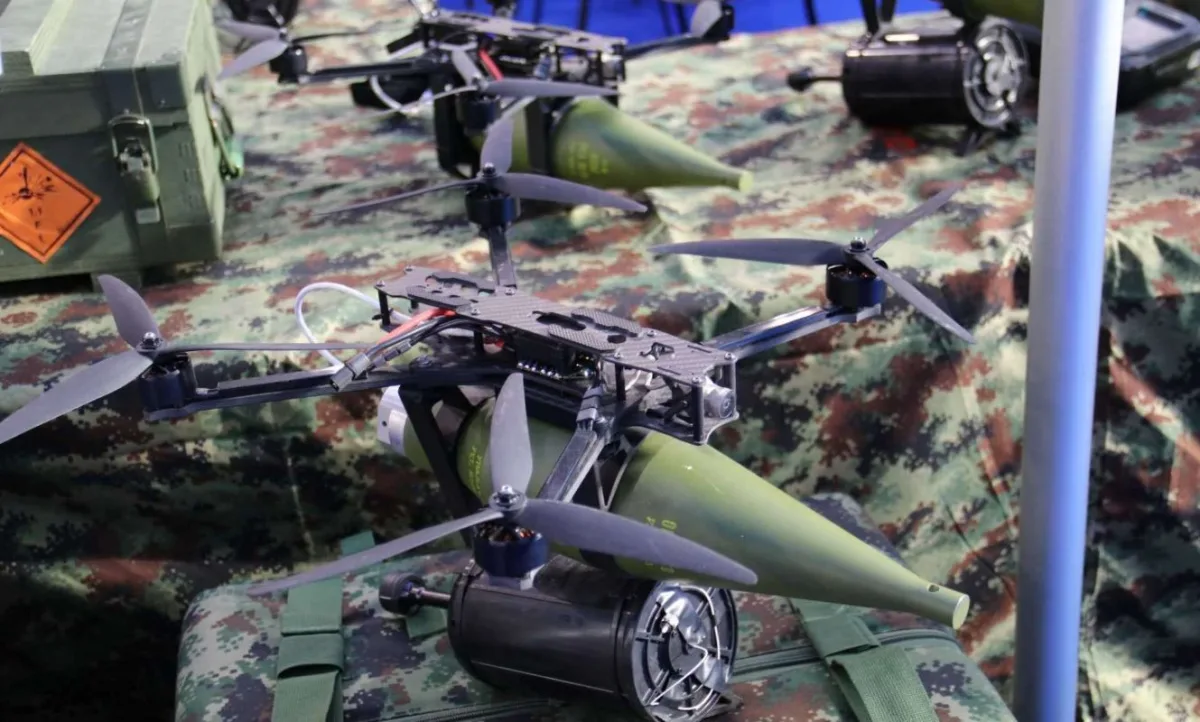

The Serbian defense is ready to enter a new industrial phase with the opening of a large facility dedicated to the production of military drones. President Aleksandar Vučić has indicated a precise timeframe – between late March and early April 2026 – explaining that Serbia will have a factory capable of producing advanced UAVs on a large scale, in collaboration with a foreign partner. The news has been picked up by European news agencies and international economic media, who agree on both the timing and the industrial, non-experimental nature of the project.
The political message accompanying the announcement is clear: Belgrade intends to build an autonomous and continuous production capacity, moving beyond the logic of small batches or prototypes. The conflicts of recent years have shown how unmanned systems are now central to military operations, from reconnaissance to precision strikes, and even battlefield saturation. In this context, investing in a national supply chain means reducing dependence on foreign countries and ensuring operational continuity in the event of prolonged crises.
The identity of the “foreign partner” has not been made public, but Serbia's approach in recent years suggests a pragmatic approach: integrating domestic industrial skills with mature foreign technologies. The declared goal of deploying tens of thousands of drones, including kamikaze ones, makes it clear that the future factory is designed to support high numbers and constant production rates, essential prerequisites for a military doctrine based on intensive UAV use.
From R&D to Series: the Role of VTI and the National Industry
The presidential announcement fits into an already initiated path. For some time, the Military Technical Institute (VTI) of the Ministry of Defense has been involved in the development of drones and loitering munitions, in collaboration with the national industry. Technical analyses and sector publications confirm that several Serbian systems have now surpassed the experimental phase, approaching full operational maturity.
Among these, the FPV drone family Komarac represents one of the most well-known examples: light loitering munitions, designed for direct attack and adaptable to various mission profiles. Alongside small-sized systems, Serbia has also developed more robust platforms, such as the Gavran 145, described in technical literature as a superior class loitering system, designed for armed surveillance and medium-range attack missions.

This portfolio highlights a precise choice: covering multiple operational segments, from economical and numerous drones to those with greater autonomy and payload. With the opening of a dedicated facility, Belgrade aims to transform these programs into a stable industrial capacity, capable of ensuring serial production, standardization, and rapid updates. It is a crucial step, as it marks the transition from the demonstrative phase to a logic of long-term military and industrial resilience.
Foreign Purchases, Diversification, and Regional Implications
Internal growth is accompanied by a carefully balanced foreign acquisition policy. The military parade on September 20, 2025, in Belgrade, analyzed by specialized press and research centers, clearly showed this approach: national systems deployed alongside imported platforms of high technological level. Among these, long-endurance drones and rocket artillery systems of Israeli manufacture, integrated into the process of modernizing the Serbian Armed Forces.

According to analyses published by international sector publications, these acquisitions are part of structured agreements with the Israeli industry, aimed at quickly filling specific operational gaps and accelerating training and doctrinal integration. Added to this is cooperation with China, often cited by European think tanks as an example of technological partnership in the field of drones and sensors, with direct impacts on reconnaissance and surveillance capabilities.
Overall, a coherent strategy emerges: buy abroad what is immediately available and tested, while building at home the capacity to mass-produce and quickly adapt systems to operational needs. In an area like the Balkans, where tensions have not disappeared and military competition remains a relevant factor, the future drone factory represents much more than an industrial investment. It is a signal of strategic ambition and a desire to position itself as a credible actor in contemporary technological warfare, with potential effects of deterrence and regional rebalancing in the medium term.



Comments
No comments yet. Be the first!