


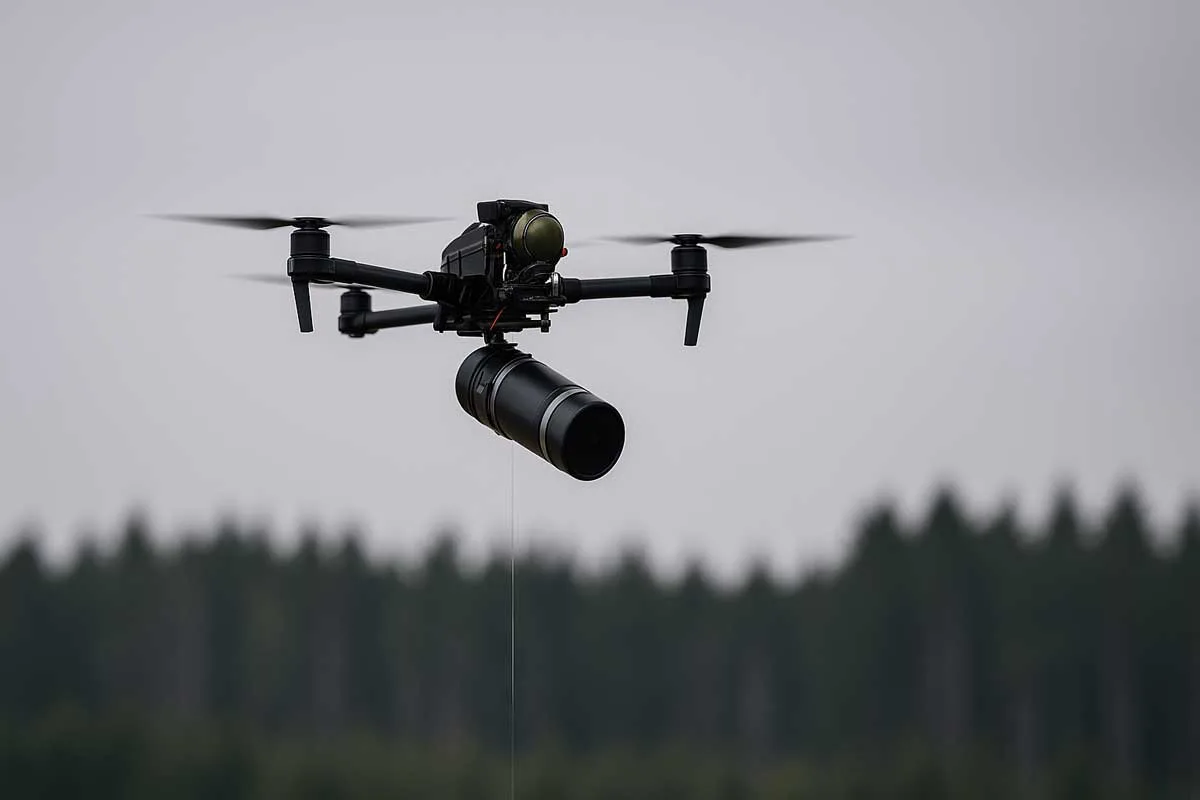

The Ukrainian company Fold is developing an FPV drone connected via fiber optic, with an operational range of up to 100 km. The solution eliminates the radio link — vulnerable to electronic countermeasures — and aims to ensure continuous control even in environments saturated with interference. Based on low-cost commercial quadcopters, the system can be configured to carry explosive charges suitable for neutralizing armored vehicles and infrastructure.
How it works
The drone replaces the RF link with a coil of fiber optic cable that maintains a direct and shielded connection between the operator and the platform. The absence of radio makes jammers ineffective and reduces the risk of signal loss during approach to the target. The downside is the physical management of the cable, which must unroll without impediments along the flight path.
From initial tests to the second generation
Fold has progressively extended the range: from the first prototypes of 5 km, it moved to 15 and 25 km, exploring versions of 40–50 km for medium-distance engagements. The second generation now aims for about 100 km, a leap that significantly expands the range of targets and mission profiles.
Operational advantages
- Immunity to jamming: no radio link to disrupt.
- Stable control: continuous FPV telemetry and video in complex EW environments.
- Low costs: platform derived from commercial FPVs, easily replaceable.
- Flexibility of use: from “one-way” reconnaissance to precision attack vector.
Limits and compromises
- Cable management: risk of entanglement with natural or man-made obstacles.
- Weight and bulk: the coil reduces useful payload and requires larger frames.
- Lower agility: maneuverability penalized compared to traditional FPVs.
- Kinetic countermeasures: close-range fire (e.g., rifles) remains a possible defense, albeit with variable and often fortuitous effectiveness.
What changes on the field
The extension to 100 km allows “beyond line” attacks on radars, logistics nodes, and high-value assets without exposing the operator to electronic countermeasures. For defenders, the emphasis shifts from EW counteraction to physical barriers, anti-drone nets, optical-acoustic surveillance, and interdiction fire. Laser systems or directed energy weapons, where available, become more relevant in the face of platforms not dependent on the radio link.
Testing and payload capacity
According to tests conducted in Ukraine on various fiber models from local manufacturers, operators are evaluating configurations capable of carrying warheads up to 3 kg, sufficient to damage vehicles and tactical structures. However, the increase in range requires careful planning of routes to reduce the risks of cable friction and mechanical loss.
The manufacturer's voice
“Today, war has changed. The range of 10–15 kilometers is often not enough to destroy large enemy targets,” explained Volodymyr, co-founder of Fold, in an interview with BUSINESS INSIDER.
The push towards anti-jam solutions is therefore set to continue, combining fiber drones with traditional FPV fleets and long-range vectors.
Prospects
In the coming months, the focus will be on cable reliability (resistance, friction, cuts), unrolling automation, frame optimization, and doctrinal integration with other systems (UAV ISR, artillery, loitering munitions). If confirmed in the field, fiber FPV platforms could redefine the balance between economical precision attack and defense, shifting the focus from electronic warfare to the physical protection of assets.



Comments
No comments yet. Be the first!