


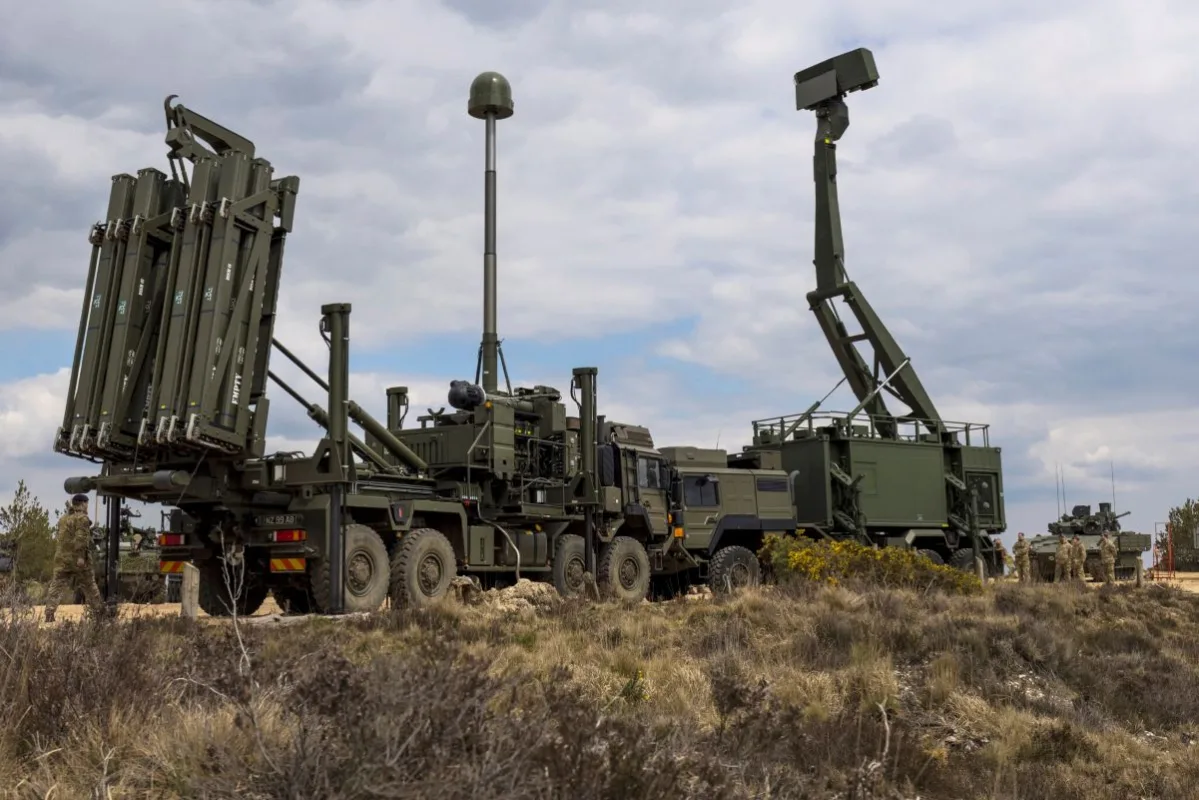

The United Kingdom's Ministry of Defence (MoD) announced on August 22, 2025, an investment of 118 million pounds (approximately 136 million euros) for the purchase of six new medium-range air defense missile systems, Land Ceptor, produced by MBDA. This is a significant expansion of the British Army's Sky Sabre capability, effectively doubling the number of systems currently available, increasing from seven to thirteen operational units.
The three-year order is not limited to the launchers alone but includes a complete support package: 12 ammunition transport vehicles, eight logistics vehicles, eight threat evaluation and weapon assignment systems, as well as spare parts and complementary equipment. The Ministry also highlighted the positive impact on employment, with about 140 jobs guaranteed, particularly at the MBDA plant in Bolton, Lancashire.
The core of the system is the CAMM (Common Anti-Air Modular Missile), designed to counter a wide range of threats, from supersonic fighters to precision-guided missiles and drones. Integrated with Saab's Giraffe Agile Multibeam (GAMB) radar and Rafael's SAMOC command center, the Sky Sabre represents the new generation of British ground-based air defenses, progressively replacing the Rapier missiles withdrawn from service.
During the NATO exercise “Formidable Shield,” held in May 2025 in the Outer Hebrides, the system was successfully tested in complex scenarios, demonstrating its ability to operate interoperably with the Alliance's integrated air and missile defense network. Another testing ground was between 2022 and 2024, when the UK deployed Sky Sabre units in Poland as part of the “Stifftail” mission, protecting NATO's eastern flank.
Official Statements and Strategic Implications
The Minister for the Armed Forces, Luke Pollard, welcomed the new order, emphasizing how it aligns with the Strategic Defense Review: «We are fulfilling the commitment to equip our armed forces with cutting-edge equipment. Doubling the deployable capacity of the Sky Sabre will strengthen the UK's air defenses, protect British forces abroad, and send a message of deterrence to our adversaries».

These words were confirmed by Lieutenant Colonel James Boutle, commander of the 16th Regiment Royal Artillery, who described the Sky Sabre as «a radical change» in British defensive capabilities, highlighting its extreme precision – “hitting a target the size of a tennis ball at supersonic speed” – and the ability to intercept up to 24 missiles simultaneously.
However, while the new acquisition represents a tangible reinforcement, it also highlights the overall limitation of British air defense. Even with the addition of the six Land Ceptor, the UK remains without a national ballistic missile defense network, with the Royal Navy as the only component capable of providing partial protection against this type of threat. Ground forces, on the other hand, can only offer localized defense, adequate to protect specific areas or contingents, but not sufficient to comprehensively cover the national territory.
To address these gaps, the MoD launched the Land Ground Based Air Defence (LGBAD) program in 2022, aiming to develop progressively more advanced capabilities over the decade. However, this initiative remains focused on a divisional level and will not translate, at least in the short term, into a national shield comparable to systems implemented by other countries.
Towards a New Era for British Air Defense: Challenges, Opportunities, and Strategic Vision
The topic of air defense is currently at the center of renewed political and strategic momentum in the UK, indicating the growing attention towards a sector considered increasingly crucial for national security. A report from the House of Commons Library, published on June 13, 2025, titled “UK Defense in 2025: Integrated Air and Missile Defense”, has stimulated a constructive debate, emphasizing the need to adapt the defense system to emerging threats and the rapid evolution of the air domain.
The analysis highlighted the urgency of acquiring increasingly advanced capabilities, paving the way for various project proposals. Some experts hope for the creation of a multi-layered system inspired by the Israeli Iron Dome, capable of providing extensive protection against rockets, missiles, and drones. Others propose more focused solutions, such as strengthening air defenses around urban centers and strategic infrastructures. Both options, though complex and challenging from a technological and financial standpoint, represent concrete opportunities to modernize defensive capabilities and stimulate national innovation in the defense sector.
In this context, the decision to double the capabilities of the Sky Sabre system represents a first concrete response, going beyond the emergency and fitting into a long-term vision. The acquisition of the new Land Ceptor strengthens the country's operational resilience and consolidates its role within NATO, offering a tangible contribution to Euro-Atlantic collective security.

Beyond the technical enhancement, this investment also opens up a broader strategic path. The UK is now in an ideal position to choose whether to continue with an incremental evolution of existing defenses or to embark on an ambitious plan for the creation of an integrated national shield. In either case, the growing awareness of new threats serves as an important catalyst for rapid, effective, and coordinated actions.
The current debate, therefore, is not a sign of weakness, but of strategic maturity. It offers the opportunity to build an innovative, sustainable air defense model consistent with 21st-century security objectives. The path taken with Sky Sabre demonstrates that the UK is ready to face these challenges with determination, turning them into opportunities for development, technological progress, and the consolidation of its operational sovereignty.






Comments
No comments yet. Be the first!