



The attack drone spots the enemy soldier in an open field in eastern Ukraine. It dives down. Only at the last second does the man realize the danger: he raises his hands, attempts a desperate escape while the onboard camera transmits the panic in real-time to the remote pilot. Then, the signal cuts off. A second video, filmed by a surveillance drone, confirms the outcome: the body lies motionless.
If until yesterday similar footage was destined to bounce around Telegram channels, today in the Ukrainian army they serve to accumulate ePoints. Welcome to the Army of Drones Bonus system, the government program managed by the Brave1 agency that has officially introduced video game logic into a real conflict.
The mechanism is cynical in its linearity: units in the field accumulate points for each enemy soldier neutralized or vehicle destroyed. These points are then redeemed in a state digital marketplace to obtain new drones, ammunition, and technological equipment. "The more you destroy, the more you receive," summarized Andrii Hrytseniuk, CEO of Brave1.
From Joypad to Military Joystick: gaming skill as an elite weapon
In this scenario, the figure of the traditional soldier is giving way to a new generation of fighters where the ability to play video games (the so-called gaming skill) has become a strategic military competence.
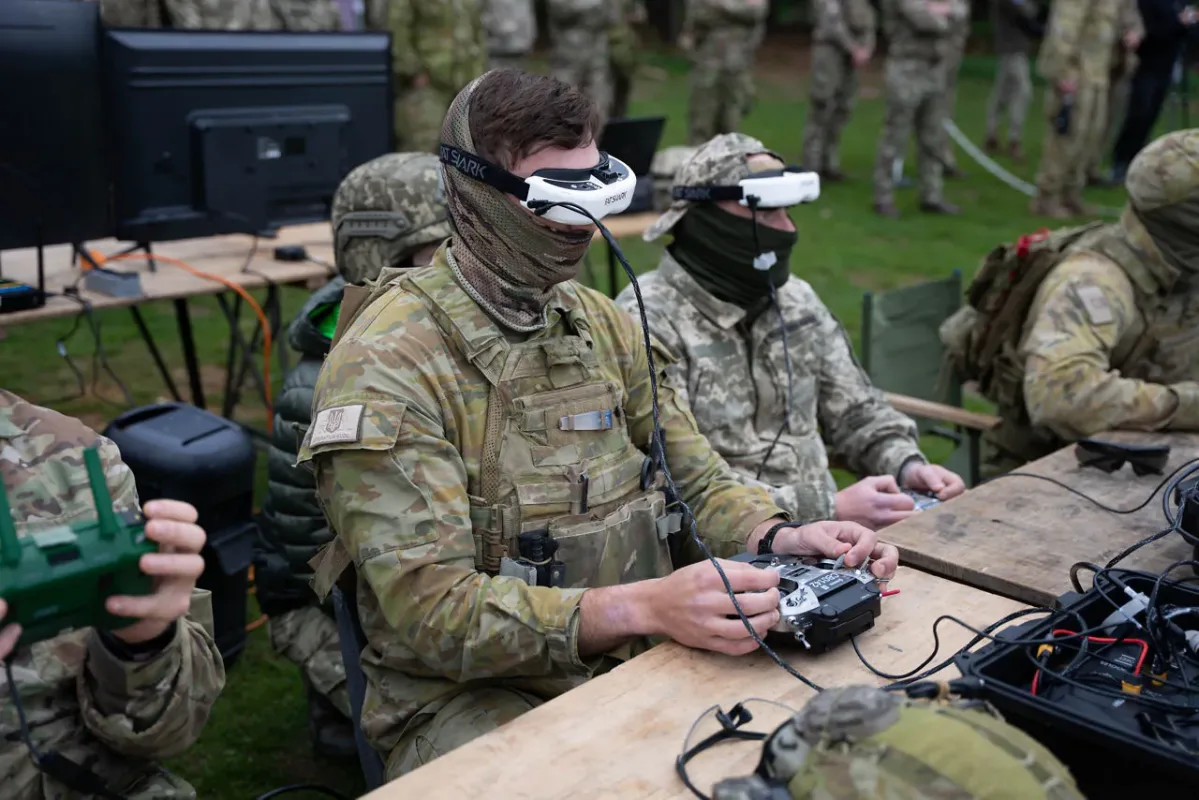
This is not a metaphor. Modern FPV (First-Person View) drones are piloted wearing augmented reality headsets and using controllers very similar to those of a PlayStation or Xbox. To excel in this type of war of attrition, traditional physical skills take a back seat to typically gaming skills:
- Hand-eye coordination and lightning-fast reflexes: Pilots must race drones at over 100 km/h between trees, trenches, and electronic warfare (EW) systems, where a millisecond delay makes the difference between hitting the target and failure.
- 3D Spatial Awareness: Just like in flight simulators or eSports titles, the pilot must instantly process a distorted perspective and mentally map a continuously moving hostile territory.
- Stress management and "Tunnel vision": Operating in a video stream that abruptly cuts off or under attack from enemy drones requires the same composure as professional gamers during high-level competitive tournaments.
This anthropological transition has redefined Kiev's strategic priorities. With the Russians pulling back heavy equipment to protect it, enemy infantry and opposing drone pilots have become primary targets. An infantryman yielded 12 points last year; today Russian drone pilots are worth double. The result? In the last month alone, Ukrainian drones have neutralized over 35,200 Russian soldiers, accelerating a war of attrition based on numbers.
A war without infantry: the first successes of pure technology
The culmination of this evolution was recently recorded. President Volodymyr Zelensky revealed that Ukrainian forces managed to storm and capture a Russian position using exclusively automated attack platforms and drones (both aerial and ground). Russian soldiers surrendered to robots.
"The operation was conducted without the use of infantry and with zero losses on our side," Zelensky stated.
| Target | Value in Points (ePoints System) |
| Enemy infantryman | 12 points (doubled in winter for severe/lethal targets) |
| Enemy drone pilot | Double Value (Compared to infantry) |
| Snipers / Anti-aircraft crews | Recently added (Classified Value) |
| Armored vehicles / EW systems | Maximum Value (Compared to logistics) |
The limits of "Gamification" and analysts' doubts
Despite Ukrainian enthusiasm for a system that is effectively slowing the Russian advance and crippling Moscow's mobilization capacity, international experts urge caution.
Michael Kofman, a military analyst at the Carnegie Endowment for International Peace, explained that the heart of the conflict has shifted to the ability of one faction's elite drone units to neutralize the other faction's drones. However, Kofman warns, "killing infantry alone will not be enough to win the war." Ukraine must restore structural superiority by coordinating drone brigades with traditional artillery to control the operational depth of the front.
There also remains the psychological and moral impact of a war turned into a prize catalog: a reality where the opponent's death is monetized through a digital dashboard, making the boundary between simulation software and real destruction dramatically invisible.






Comments
No comments yet. Be the first!