


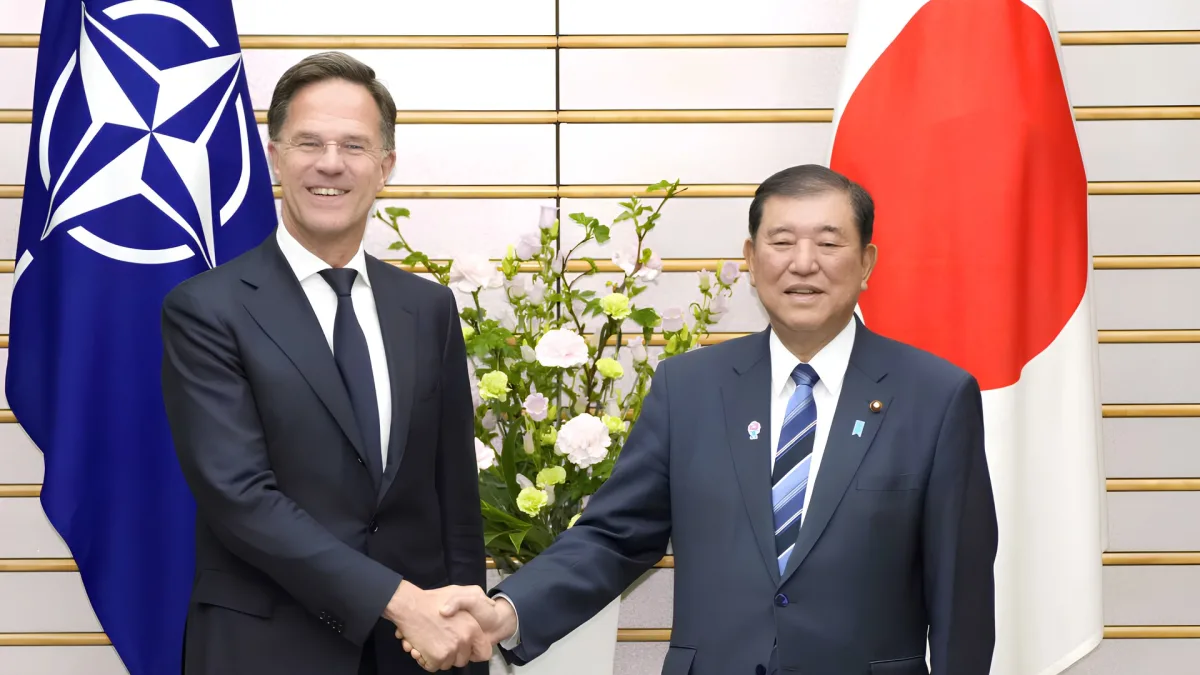

Tokyo, April 2025 – In a historical moment marked by geopolitical turbulence and a redefinition of global balances, NATO Secretary General Mark Rutte reiterated the need for a strengthened collaboration between the Atlantic Alliance and Japan. During his first official visit to Tokyo in his new role, Rutte met with Japanese Prime Minister Shigeru Ishiba and the Minister of Defense, emphasizing how security is now an indivisible concept between geographical regions once considered distinct.
“Our security is indivisible. What happens in Ukraine has a direct impact on the Indo-Pacific, just as tensions in East Asia affect the stability of the Euro-Atlantic area,” Rutte stated. In his view, the growing assertiveness of China and the military cooperation between Russia and North Korea pose challenges that no international actor can face alone. This is why NATO is intensifying its relations with partners like Japan, already an integral part of the Alliance's cooperation network in the Indo-Pacific.

Defense and Technology: Strategic Axes of Cooperation
During the meeting, Ishiba and Rutte agreed on the importance of developing new synergies in the defense industry. Japan, thanks to its advanced technological capabilities, can offer decisive contributions in areas such as artificial intelligence, drones, cybersecurity, and quantum technology. The development of dual-use technologies – military and civilian – represents one of the cornerstones of the agreement between the parties, in an integrated vision of national and international security.
“A stronger NATO will bring significant benefits to Japan,” Prime Minister Ishiba stated during the joint press conference, highlighting the “enormous potential” of cooperation in the defense sector. Japan's interest is not only strategic but also operational: Tokyo has expressed its willingness to participate in the NATO NSatu command based in Wiesbaden, Germany, which coordinates the supply of equipment and training to Ukrainian forces.

The Chinese Threat and Japan's New Role
One of the most delicate points that emerged during the talks concerns the growing Chinese influence in the region. Rutte sounded the alarm: “China continues to conduct destabilizing activities in the Indo-Pacific and is developing its military capabilities at an impressive pace.” According to the NATO Secretary General, Beijing already possesses a naval fleet superior to that of the United States and could have 1,000 nuclear warheads by 2030.
Ishiba and Rutte issued a joint statement in which they firmly condemn the military cooperation between Russia and North Korea, also denouncing the support provided by China to the Russian war industry. Both leaders reiterated their commitment to a “free and open” Indo-Pacific, based on respect for international law, opposing any unilateral attempt to change the status quo by force, in reference to disputes in the East and South China Seas.
Japan's New Defense Policy Orientation
The words of Rutte and Ishiba fit into a context of profound transformation of Japan's strategic posture. Historically linked to the United States by a mutual defense treaty, Japan is now expanding its network of international alliances. The revision of the national security strategy, adopted in 2023, has paved the way for strengthening military capabilities and greater international protagonism.
Confirming this trend is the recent visit of the Chief of Staff of the Italian Army, General of the Army Corps Carmine Masiello, to Japan. General Masiello participated in the multilateral exercise “New Year Jump 25”, held at “Camp Narashino” together with the 1st Airborne Brigade of the JGSDF, highlighting the value of interoperability between allied armed forces in key areas such as airborne operations, CBRN defense, and cybersecurity.
“Strategic dialogue and bilateral cooperation in the Defense sector are fundamental to facing common challenges. It is time to take the first step towards interoperability between our armies,” stated the Italian general.

An Increasingly Global NATO
Rutte's visit to Japan, the agreement for industrial cooperation, Tokyo's potential entry into NATO command structures, as well as the involvement of partners like Italy, mark an evolution of NATO towards an increasingly global alliance. The Indo-Pacific is now considered a central strategic quadrant not only for the world's economies but also for the balance of international security.
Rutte concluded his speech by reminding that “we cannot be naive towards China” and that the response to growing instability requires “a collective vision and a coordinated ability to act, in defense of shared values.”
The path for closer cooperation between Japan and NATO is now laid out. The challenge will be to translate principles into concrete actions, to ensure security and stability in a rapidly changing world.



Comments
No comments yet. Be the first!