


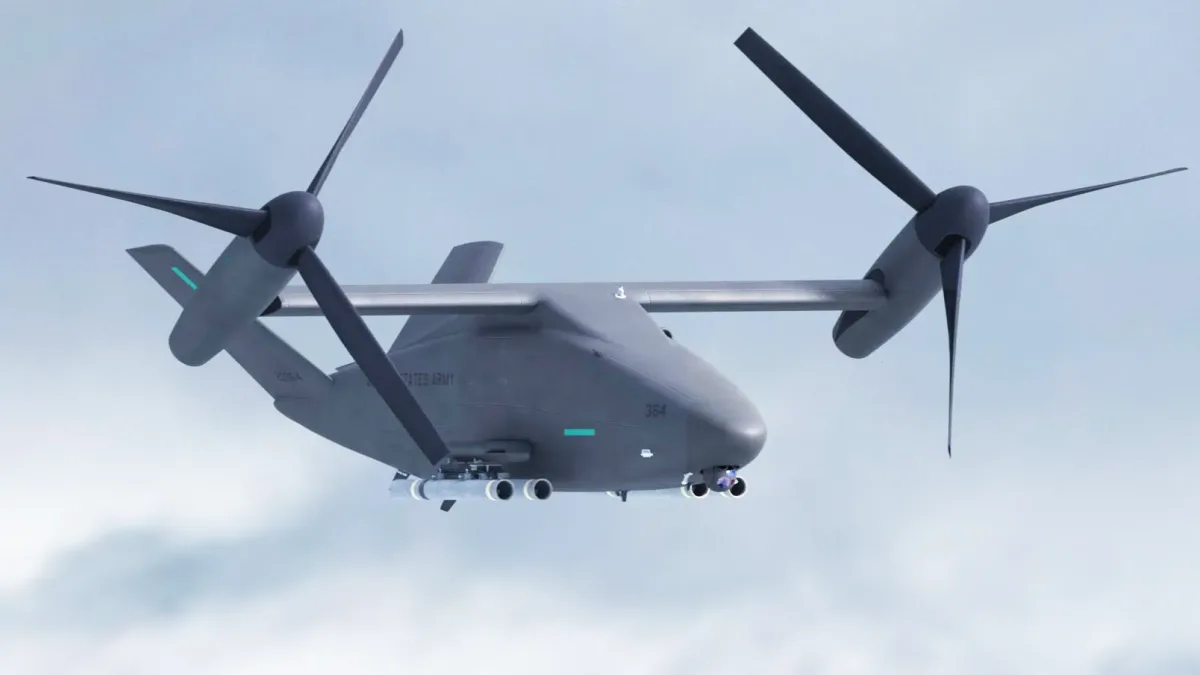

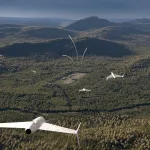
The United States Army may soon open the competition for a new generation of collaborative drones designed to accompany attack and transport helicopters: the Army's loyal wingman. A program in its embryonic stage, but with clear objectives: to develop an autonomous air support capability within a few years.
Allied drones for tactical superiority
During the annual conference of the Association of the United States Army (AUSA), Brigadier General Cain Baker, director of the Army Aviation Future Capabilities Directorate, explained that the service “is closely observing the results of experimentation to develop comprehensive requirements and potentially provide an operational capability in the next two years.”
The project is inspired by the Collaborative Combat Aircraft (CCA) programs already initiated by the Air Force, Navy, and Marines, which aim to employ large drones capable of flying alongside manned aircraft for attack, reconnaissance, and electronic warfare missions. The Army, traditionally focused on rotor platforms, had so far maintained a more cautious approach. However, the aviation command now considers the use of collaborative drones a key factor in expanding operational “mass” while reducing risks for crews.
“A CCA concept allows for increased power in the field while reducing the number of aviators needed for missions,” Baker explained, highlighting the collaboration with the US commands INDOPACOM and EUCOM to shape the requirement based on future combat scenarios.
From “launched effects” to loyal wingman
The Army has already gained experience with autonomous systems through the Launched Effects program, small and medium-sized drones that can be launched in flight or from ground stations, capable of providing intelligence, electronic disruption, or precision fire.
According to Major General Clair Gill, commander of the Army Aviation Center of Excellence, “the launched effects are already, in a sense, CCAs: systems that operate collaboratively, even autonomously, following instructions or commands from aerial or ground platforms.” However, Gill clarified that the Army's vision of the loyal wingman might diverge from that of the launched effects, favoring a more strategic and persistent role.

In 2024, the service commissioned a study to evaluate the available technologies in the UAV Group 4 class, the same as the MQ-1C Gray Eagle drone, but with vertical takeoff and landing (VTOL) or short takeoff and landing (STOL) capabilities. “The study provided us with a clear picture of the state of the art in terms of autonomy, range, speed, and payload,” commented Brigadier General David Phillips, head of the Program Executive Office for Aviation.
Towards a collaborative “rotary-wing” drone
The peculiarity of the Army project lies in the need to integrate drones with low-altitude platforms like the AH-64 Apache and the CH-47 Chinook, in night or complex environments. “A CCA linked to rotary-wing aircraft requires completely different behaviors and capabilities compared to those operating at 30,000 feet,” observed Baker. “It must be able to fly at 150 knots, 30 meters above the ground, and cooperate smoothly with human crews.”
To realize the vision, the Army will invite the industry to an experimentation event in 2026, built on the results of PEO Aviation studies. Potential key players include Boeing and Sikorsky, both already working on similar projects.
On October 14, Boeing presented the Collaborative Transformational Rotorcraft (CxR) concept, an autonomous tiltrotor designed to accompany the Apache on attack missions or support the Chinook in logistical transport. A few days earlier, Sikorsky unveiled the NOMAD family of multirole VTOL drones and the autonomous version of the UH-60L Black Hawk, named U-Hawk, intended for resupply and recovery operations.
With the Army's entry into the domain of loyal wingman, the United States is moving towards an inter-force convergence on autonomous collaborative warfare: a network of manned and unmanned aircraft capable of sharing sensors, missions, and decisions in real time. A revolution that, according to Baker, “is no longer science fiction, but a necessity to ensure survival and superiority in future conflicts.”


Comments
No comments yet. Be the first!