



“Don't be surprised if we start producing our own parts,” declared Lieutenant General Christopher Mohan, deputy commander of the Army Materiel Command. “I recognize that intellectual property belongs to the industry, but it's our fault for not purchasing it initially: an amateur mistake.”
The issue is indeed technological and contractual. Most weapon systems — from tanks to Black Hawks — incorporate third-party components for which the Pentagon does not possess the technical data. In case of failure or supply crisis, relying on these manufacturers can halt entire fleets. “We can't live like this,” Mohan added, “we need a model where we purchase only the rights for the part we need to print, not for the entire system.”

Simultaneously, the Army is experimenting with real “3D printing sprints”, aiming to produce 60 parts in 60 days. Already today, thanks to a containerized digital repository, soldiers can connect via tactical network, download approved CAD files, and print spare parts directly in the field, such as ventilation grilles or hatch handles.
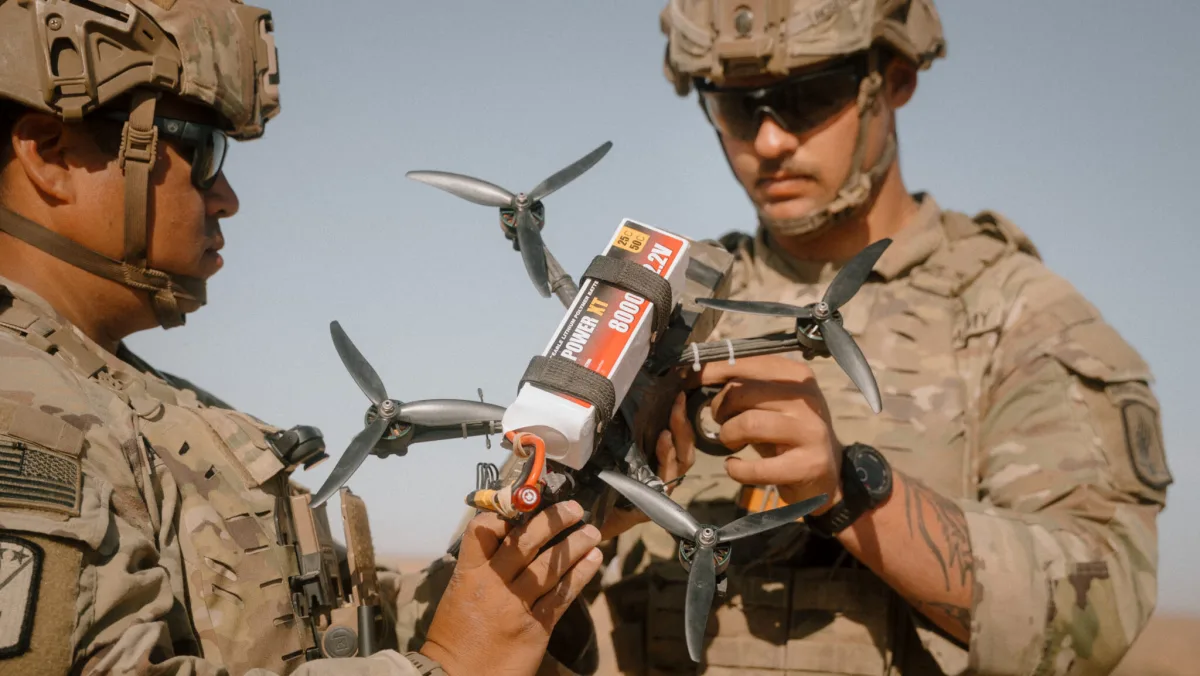
This push finds its convergence point with the field experiences of the 25th Infantry Division in Hawaii. In 2025, the “Lightning Labs” team developed and built in-house the FPV drone “Capstone”, integrating a detonation system created with EOD specialists. The result? An autonomous, cost-effective, and immediately operational system — capable, as Captain David Velasquez emphasized, of “putting lethal effects on the target, immediately.”
Towards a distributed industry
The two experiences — industrial and tactical — converge in the same direction: the digital autonomy of the armed force. General Dan Driscoll, Secretary of the Army, showcased at AUSA 2025 the result of this strategy: an external fin for a Black Hawk tank printed in 43 days, 300% stronger and 78% cheaper than the commercial version.
The challenge now is to manage a hybrid industrial ecosystem, where intellectual property coexists with operational necessity. For the industry, this means rethinking contracts in terms of “partial production rights”; for technology, it means strengthening the cybersecurity of print files, ensuring digital mechanical validations, and implementing certified blockchain systems to track every single printed component.
Conclusion
Military additive manufacturing is no longer a laboratory but a strategic infrastructure. With 3D printing, the US Army aims for decentralized, resilient, and technologically “sovereign” logistics. The future of procurement will no longer be a linear chain, but a network: distributed, intelligent, and increasingly autonomous.





Comments
No comments yet. Be the first!