


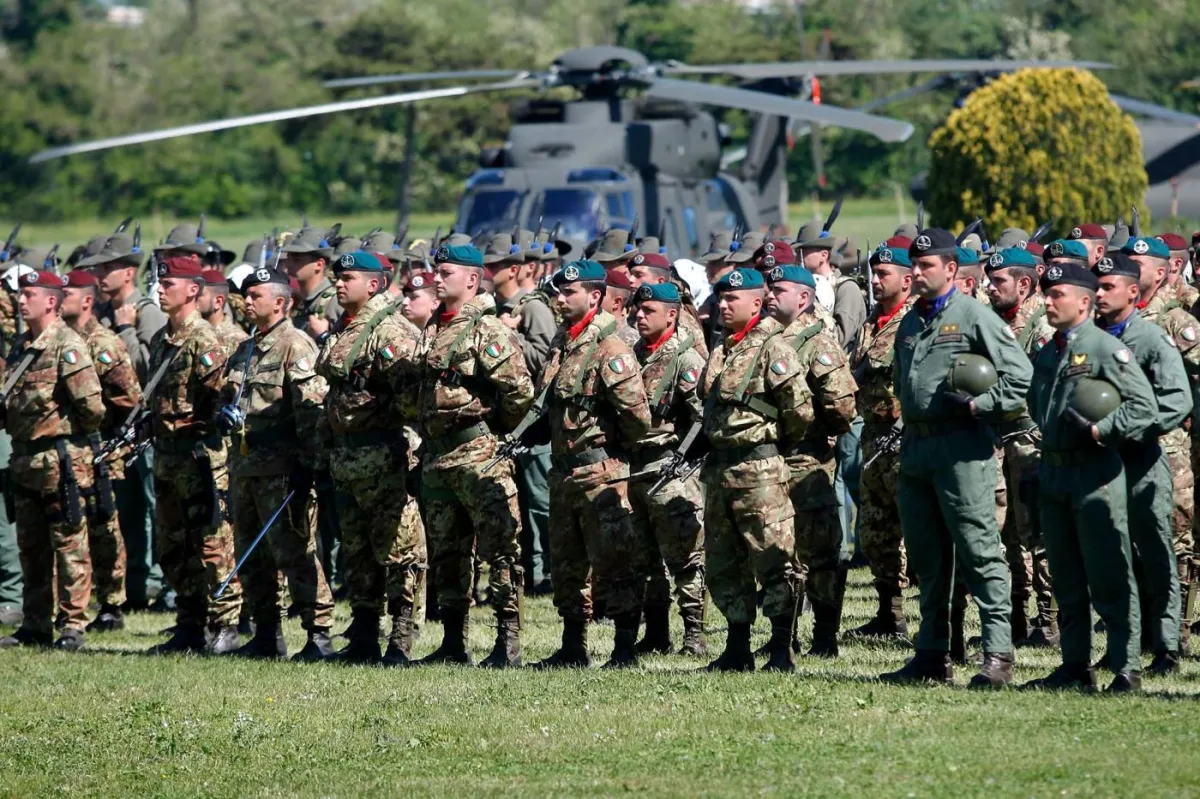

Italy is on the brink of a structural reform of Defense. Minister Guido Crosetto is preparing to send to Parliament, between January and February 2026, a bill aimed at surpassing law 244 – which set the personnel cap at 170,000 units – and paving the way for a model of “voluntary service” following the path of France and Germany, with 30-40 thousand more soldiers and a real Reserve of at least 10,000 people, including highly specialized civilians.
In the minister's plan, that year of voluntary service should also be a “second chance” for young people from difficult areas, an opportunity for redemption with a salary and training that can be used in civilian life. But the question remains: where to find the numbers to support this new model, in a country where – as General Leonardo Tricarico reminds us – “the military is one of the jobs Italians no longer want to do”?
Tricarico proposes a “flow decree also for the military” aimed at countries like Libya, Egypt, Somalia, arguing that those profiles would be useful in missions in Africa and in the most unstable theaters. However, the circulating objection is that massive recruitment from countries with a strong Muslim majority risks “increasing Islamization,” inside and outside the barracks.
Without slipping into identity slogans – and remembering that the Armed Forces are, and must remain secular – there is a different and more pragmatic path: decisively looking to the countries of Latin America, linked to Italy by history, blood, language, and, largely, by a common Christian matrix.

The Spanish Precedent: When Madrid Opened the Doors to Latin Americans
Spain has already experienced this debate. In the early 2000s, after the end of compulsory military service, Madrid faced the same problem that Rome has today: how to fill the barracks without lowering quality standards. The answer was a targeted “recruitment plan” that opened the armed forces to young people from Latin America; the first to arrive were Uruguayans and Argentinians, with military service as a fast track to Spanish citizenship.
Even today, the Spanish Army is an interesting laboratory: a significant portion of its personnel is made up of foreigners, and since 2002 Madrid has accepted enlistments from a long list of Latin American countries (Argentina, Colombia, Peru, Mexico, etc.) and from Equatorial Guinea, provided the candidates are of Hispanic origin.
Three elements make this model particularly interesting for Italy:
- Linguistic and Cultural Affinity
Spanish and Latin American Romance languages are very close to Italian; the Catholic and Christian tradition is prevalent, social codes are similar, the relationship with family and authority is not far from the Mediterranean one. - Path to Full Integration
In Spain, military service has been used as a lever for inclusion: training, discipline, language, common rules – and, in the end, citizenship for those who demonstrate attachment to the State. It's the logic: “first I train you as a soldier and citizen, then I recognize you as such.” - No “Religious War” in the Barracks
The issue is not framed as a clash of civilizations, but as intelligent management of migratory flows: if I need soldiers and I have a pool of culturally similar and motivated young people, why ignore it?
Italy, with a huge diaspora in Argentina, Brazil, Uruguay, Venezuela, and many other Latin American countries, even has an additional asset: millions of Italian descendants who often still cultivate a strong sentimental bond with the “country of their grandparents.”

The Alternative to Tricarico: More Latin America, Less Emergency
General Tricarico's proposal – dedicated flows to recruit from Libya, Egypt, Somalia – arises from operational needs (missions in Africa, cultural mediators, knowledge of the territory) that are real. But they are specific needs, they cannot become the cornerstone of a general recruitment reform.
For at least three reasons:
- Missions Change, the Army Remains
Training an entire “line” of recruits for a single operational theater risks making them less adaptable in the long term. The Army of the future must be able to operate from the Baltic to the Sahel, from the Eastern Mediterranean to cyberspace. - Integration and Internal Perception
It's not about stigmatizing any religious faith, but recognizing that Italian public opinion is already crossed by tensions on immigration. Recruitment perceived as “importing military labor” from countries in conflict or unstable risks fostering distrust, rather than strengthening the bond between people and Armed Forces. - Valuing Italy's “Historical Capital” in the World
Why not start where Italy is already “at home”? Latin America, but also Italian-descendant communities in other areas, young people who speak (or understand) Italian, who have Calabrian, Sicilian, Venetian, Piedmontese grandparents. They are the first natural candidates for a recruitment path with a view to citizenship.
The bottom line is simple: recruitment from abroad should not become a tool of cultural or religious engineering, but a choice of strategic common sense. And in this sense, Latin America offers a rare combination of cultural affinity, personal motivation, and gratitude towards the country that offers a career and citizenship opportunity.

Without Competitive Salaries, No Reform Will Work
However, there is one point on which Crosetto is perfectly right: it's not enough to change the rules, we must pay the military better.
Today, a non-executive Italian soldier starts with a salary that, net, often remains lower than that of colleagues in France and Germany for equivalent tasks and responsibilities. If we look beyond the border, the picture changes: in Germany, the average salary of a soldier is indicated around 2,500 euros per month, in France the average is just above 2,600 euros. These are values that place the armed forces of Berlin and Paris on a higher pay scale compared to the Italian ones.
In other words: if Italy wants to play in the same “league” as France and Germany, it cannot have a low-cost army. Neither for young Italians nor, much less, for potential foreign volunteers.
A credible model could be this:
- higher starting salaries, aligned at least to the mid-European range for equivalent tasks;
- clear and transparent allowances for risk, specialization, operational readiness;
- rapid career paths for those who demonstrate merit, with stable contracts and prospects at least comparable to those of the armed forces of Berlin and Paris.
Only in this way can the “pact” proposed by the minister – a year of life in the service of the country in exchange for training and a decent salary – be attractive to young Italians and to those Latin Americans who would see in Italy not only an employer but a possible homeland.
Recruiting from Latin America, but Offering Citizenship and Dignity
A possible “military flow decree” oriented towards Latin American countries would make sense only if inserted in a framework of full legal and social dignity:
- clear status from day one: not low-cost labor, but volunteers who choose to serve Italy with rights and duties in line with Italian colleagues;
- path to citizenship for those who complete a certain number of years of service without blemishes, following the Spanish model;
- serious investment in the Italian language and culture, because the first glue of an army is feeling part of the same national community, beyond the place of birth.
Thus, Italy would respond, pragmatically, to three urgencies: the crisis of internal vocations, the need to strengthen Defense in a Europe that must know how to protect itself even without the American umbrella, the orderly management of migratory flows to our country.

Conclusion: Less Fear, More Strategy
The real choice is between an improvised recruitment system, chasing emergencies, and a coherent project that:
- pays the military what they deserve,
- values the enormous pool of Italian descendants and culturally similar young Latin Americans,
- keeps the door open, but targeted, to strategic profiles from other areas of the world.
In this context, the line that looks to Latin America, following the Spanish model, appears more solid and sustainable than the one that relies mainly on fragile and unstable countries. Not out of fear of the other, but out of respect for our history, for operational efficiency and, above all, for consistency with the idea of an Army that truly reflects a strong, open, and self-aware national community.


Comments
No comments yet. Be the first!