


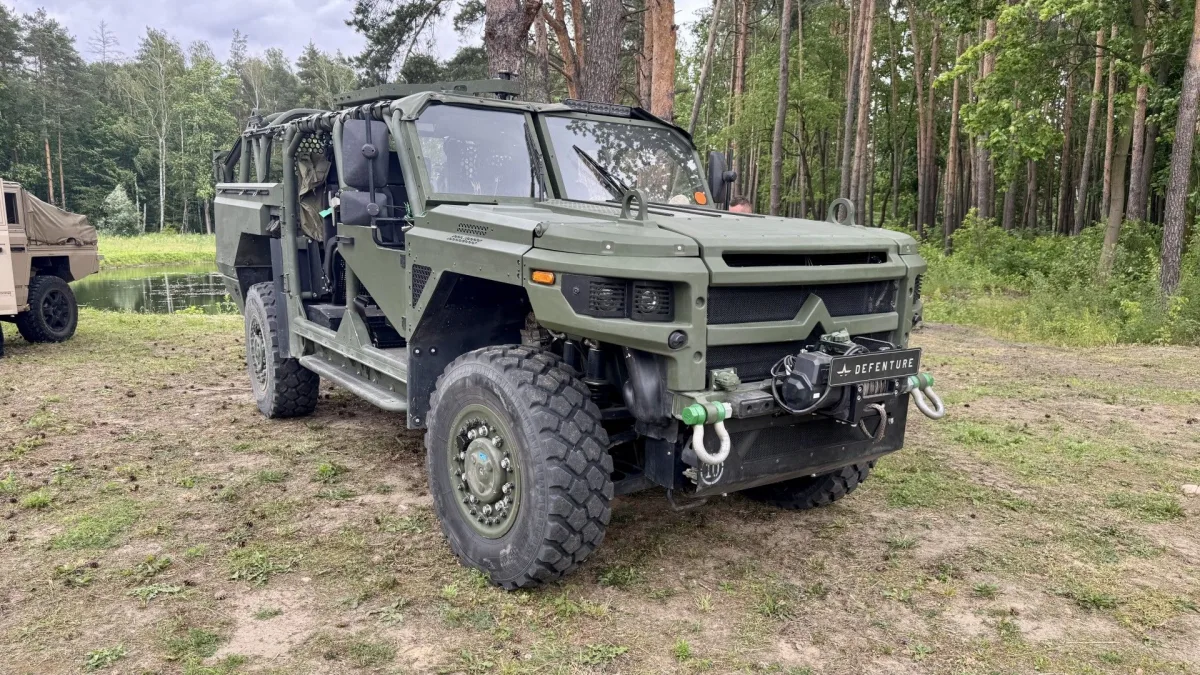

The typical missions of the Kommando Spezialkräfte (KSK) include deep operations against high-value military targets, such as the destruction of command and control nodes and systems. By their nature, these activities require training, organization, and equipment that cannot be replicated by conventional units: the teams must be able to operate in very different contexts and climates, from mountains to jungles, from the Arctic to the desert.
In this context, the Kommando Spezialkräfte (KSK), the special forces command of the German Army, can be deployed on the mandate of political and military leadership even outside the area. Mobility is therefore a decisive factor: if the mission can start anywhere and in any climate, the vehicles must be able to follow the team with the same flexibility, ensuring autonomy, load capacity, and adaptability.

The order to DEFENTURE: 49 AGF-2/UFK for the KSK, with an option for additional units
According to information published by DEFENTURE and reported by the industry press, the German parliament has approved an order for the supply of 49 battlefield mobile platforms in the AGF-2 and UFK configurations, intended for the KSK, with operational deployment expected to begin in 2027. The framework contract would also include an option for an additional 31 platforms.
The decision is described as a milestone after a development and testing program conducted in close cooperation with the KSK and the German federal agency responsible for procurement and technical aspects. A significant step concerns the experimentation: after the delivery of four test platforms in 2024, extensive tests would have been conducted in different environments and climates (high altitude, desert, Arctic, and jungle) to validate reliability on complex terrains and in extreme weather conditions.

Ready for modern warfare: Integrated C4ISR and system integration
DEFENTURE explicitly links the AGF-2/UFK variants to the needs of contemporary warfare. Among the key elements are cited integrated C4ISR capabilities (command, control, communications, intelligence, surveillance, and reconnaissance), along with optimized solutions for stowage and integration of essential mission equipment, including armaments and operator gear. On the front of armament and IT system integration, the company indicates collaborations with industry partners for the integration of primary and secondary weapons and for the overall IT architecture.
The “Mammoth” as a modular base: performance and key figures
The Mammoth is presented as a high-modularity multi-role tactical platform, designed for heavy-duty use and extreme environments, with high load capacity and predisposition for subsystem integration (including, in some configurations, modular ballistic protection). The declared specifications include:
- Total weight (GVW): 8,800 kg; payload up to 3,500 kg
- Four-wheel steering, 4x4 drive with reduction gears, independent suspension
- Unprepared fording up to 1,000 mm and ground clearance 366 mm
- Range indicated up to 800 km; maximum speed limited to 110 km/h
- Air transportability cited on various carriers (e.g., transport aircraft and helicopter platforms)
- Declared operational environmental range up to –40°C / +49°C (depending on profiles)

A piece in the acceleration of German defense procurement
The approval of the purchase for the KSK is part of a phase of strong push for investments and spending authorizations in Germany, with multi-year procurement packages that include individual equipment, vehicles, unmanned systems, and space capabilities. In this context, the special forces component tends to favor solutions that combine mobility, information network, and survivability.
If the goal of special forces is to be deployable quickly and in very different scenarios, the adoption of the new AGF-2/UFK platforms aims to:
- Strengthen tactical mobility on difficult terrains, with high loads and predisposition for mission-specific configurations.
- Bring on board the information dimension thanks to integrated C4ISR functions, central to operating in a connected and coordinated manner.
- Reduce introduction risks thanks to a long testing cycle, conducted in different climates and environments before entering service from 2027.
In summary, the order for 49 AGF-2/UFK platforms signals a clear direction: for units tasked with high-criticality missions, mobility is not just “transport”, but an integrated system that combines protection, logistics, and information network, consistent with the idea of a force deployable “anywhere and anytime”.




Comments
No comments yet. Be the first!