


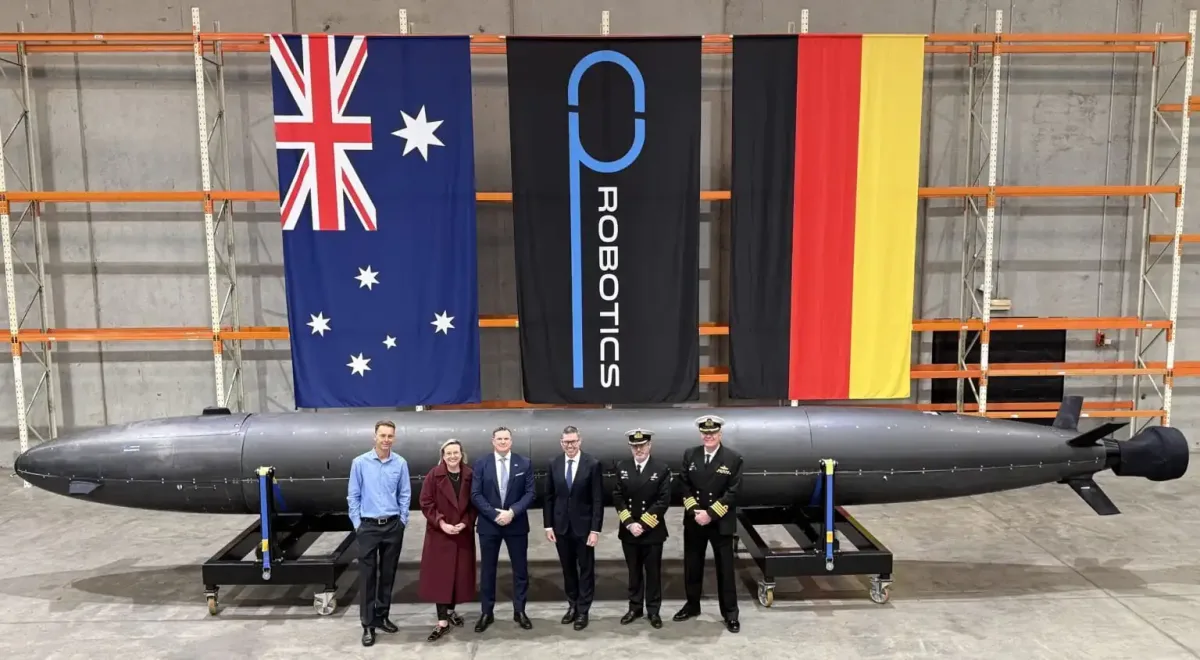

A new, significant chapter in the development of autonomous underwater weapon systems opens in Europe. C2 Robotics, an Australian company pioneering in the uncrewed systems sector, has announced – in collaboration with its European partner Eurobotics GmbH – the sale of the large Uncrewed Undersea Vehicle (LUUV - Large Uncrewed Undersea Vehicle) Speartooth to the Navy of the Federal Republic of Germany (Deutsche Marine).
The official announcement was supported in Melbourne by the Australian Minister for Defence Industry, Pat Conroy, highlighting the strategic value this platform is assuming not only for Australia (already officially included in Canberra's 2026 National Defence Strategy), but for the entire allied network. Indeed, in May 2026, the first units were also delivered to the US Navy for operational experimentation activities.
"Attritable" Logic and Critical Mass Below the Surface
The operational concept behind the Speartooth radically differs from traditional high-cost military UUVs. C2 Robotics designed this vehicle to generate a true "mass of forces" in the underwater domain at extremely low costs, making it effectively attritable (expendable in high-risk environments).
Built with extensive use of commercial components (COTS) to secure the supply chain even in times of crisis, the Speartooth is optimized for missions of:
- Intelligence, Surveillance, and Reconnaissance (ISR) long-range covert operations.
- Seabed Warfare (protection and monitoring of critical underwater infrastructure).
- Distributed attack operations and asymmetric warfare.
The multifunctional peculiarity: The Speartooth is equipped with upper hatches designed for the vertical launch of reconnaissance aerial drones (UAV) or loitering munitions (kamikaze) while the vehicle is at periscope depth, acting as a true underwater "pocket aircraft carrier".
Technical Characteristics and Performance
The architecture of the Speartooth is natively modular, allowing for rapid reconfiguration of the payload (payload agnostic) based on operator needs.
| Parameter | Technical Specification |
| Dimensions | Base length of 8 meters (extendable to 12 meters with additional modules); Width: 1 meter. |
| Displacement | Approximately 2,000 kg in the basic empty configuration. |
| Propulsion | Hybrid diesel-electric system with a lithium-ion battery pack of 40 kWh. |
| Performance | Cruising speed: 4 knots (max 6 knots); Range: up to 2,000 kilometers. |
| Logistics | Designed to be stored, transported, and launched directly from standard ISO containers, minimizing logistical footprint and infrastructure requirements. |
To survive and operate in A2/AD (anti-access/area denial) environments, the Speartooth does not rely on GPS signals. It uses high-precision inertial navigation systems that allow it to travel covertly for thousands of kilometers.
Additionally, it integrates the Blue Seeker by Thales multifrequency system, an advanced technology that detects and classifies surrounding noise sources, acting both as an anti-collision suite and a passive acoustic sensor. For communications and visual data collection, the vehicle employs a retractable digital periscope (optical and antenna). The Speartooth also has the capability to perform the so-called seabed resting: it can settle on the seabed in stealth mode, remaining on standby for long periods waiting to activate for the mission.
The Strategic Impact for Germany
The purchase by Berlin highlights the pressing need for NATO navies to protect European seabeds and maritime corridors (particularly in the Baltic Sea and the North Sea) from hybrid threats. Perfectly integrating with European autonomous surveillance plans, the Speartooth will provide the German Navy with scalable sea denial capability, freeing crewed units from routine high-risk patrol tasks.



Comments
No comments yet. Be the first!