


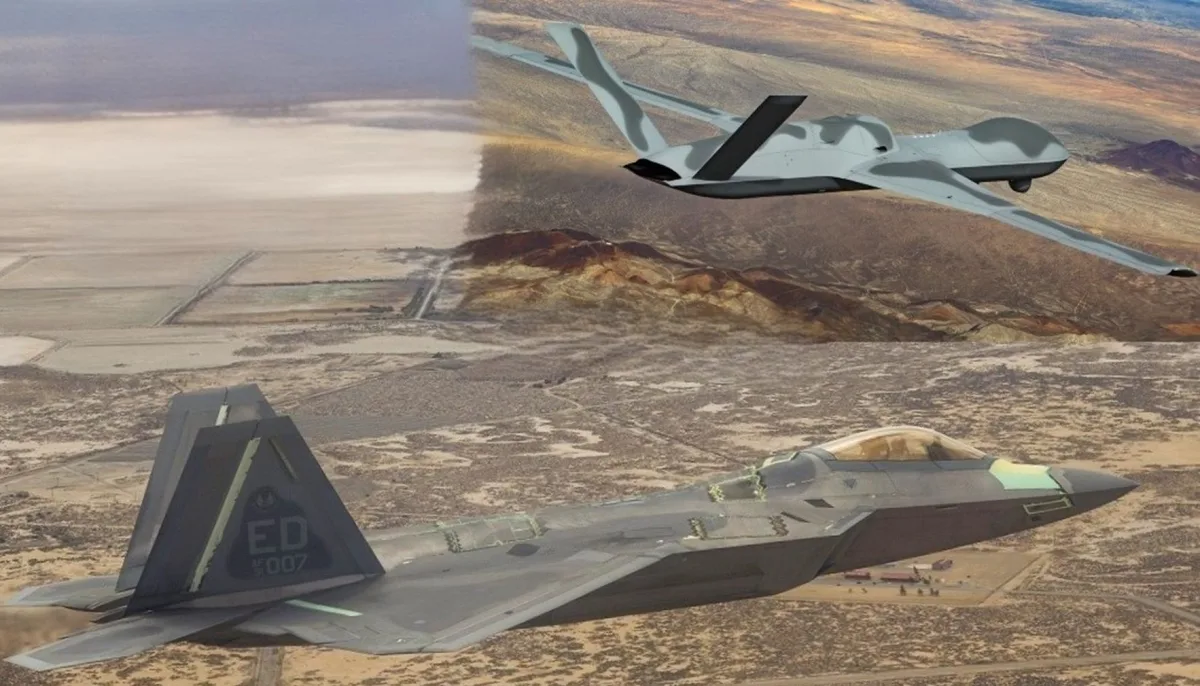

An F-22 Raptor of the US Air Force controlled an MQ-20 Avenger combat drone in flight directly from the cockpit during a simulated mission. The demonstration, internally funded by General Atomics, took place last October over the vast Nevada Test and Training Range (NTTR), one of the most sophisticated ranges in the world.
The announcement coincided with the opening of the Dubai Airshow, highlighting the importance of the result for the American defense industry. In addition to General Atomics, which produces the MQ-20, Lockheed Martin, the manufacturer of the F-22, and L3Harris, specialized in advanced communication systems, also participated.
According to reports, the F-22 pilot directed the drone for a “hypothetical” mission, commanding its flight profile and tactical conduct. The MQ-20 Avenger has long been used as an experimental platform to test onboard autonomy and concepts of “Collaborative Combat Aircraft” (CCA), or drones that operate as wingmen for piloted fighters. The declared goal of the US Air Force is precisely to transform the F-22 into the first in-flight “controller” of this new generation of unmanned aircraft.

Open Architecture and Tablet in the Cockpit: How Control Works
The core of the demonstration was the integration of a series of new and, above all, open and reusable technologies. On the communications front, the following were employed:
- the advanced BANSHEE datalink by L3Harris;
- the Pantera radios with software-defined technology (SDR);
- an open radio architecture developed by Lockheed Martin for the F-22.
Two identical SDR radios were installed: one in the MQ-20 Avenger drone and one in the F-22 Raptor. This created a continuous “end-to-end” link between the two aircraft, allowing the pilot to issue commands and receive information in real-time.
A central role was played by the GRACE (Government Reference Architecture Compute Environment) module, an open architecture system designed to simplify the integration of new software onboard the F-22. Through GRACE, it was possible to connect a tablet-based Pilot Vehicle Interface (PVI) to the mission system, mounted in the cockpit.
The pilot, therefore, controlled the drone using a touch interface, selecting commands, modifying the mission profile, and interacting with the MQ-20 without needing a dedicated console. It is a relatively quick solution to implement and ideal for experimentation, but it raises questions about the pilot's workload, especially in a single-seat fighter.
Several industry representatives, including Michael Atwood of General Atomics and John Clark of Lockheed Martin's Skunk Works division, have indeed pointed out how using a tablet in a complex operational environment is far from trivial: the pilot must manage the aircraft, its sensors and armaments, and also orchestrate one or more drones. For this reason, many consider these systems a starting point for operational experience, not the definitive solution.

Towards Human-Machine Cooperation in the Skies
The F-22/MQ-20 demonstration should be seen as part of a broader path with which the US Air Force is redefining the way to conceive air superiority. The concept of Collaborative Combat Aircraft aims to deploy, alongside a limited number of advanced piloted fighters, a “mass” of relatively inexpensive, autonomous, and partially expendable drones.
In this operational model, the pilot does not “remotely control” every single action of the drone, but:
- defines objectives, general trajectories, and rules of engagement;
- oversees critical decisions, particularly the use of weapons;
- leaves the unmanned platform to autonomously manage route, maneuvers, and sensor use within established limits.
The key is precisely intelligent autonomy: drones must be able to collaborate with the fighter, integrate into the formation, adapt to threats, and, at the same time, maintain significant human control over lethal decisions.
In this context, the MQ-20 Avenger acts as an “accelerator” of autonomy and CCA concepts: it allows testing in real scenarios the datalinks, human-machine interfaces, open architectures like GRACE, and distributed command logics. The fact that these tests are conducted with an iconic aircraft like the F-22 indicates the willingness to start the transition precisely from the most capable fighters, to then extend human-machine cooperation to the entire combat force.
If these programs are successful, future missions could see a single F-22 pilot or other next-generation fighters leading not only their aircraft but a small group of “wingman” drones, each with a specific tactical role: reconnaissance, electronic warfare, attack, swarm defense. The demonstration in the Nevada sky is one of the first concrete steps towards this new form of collaborative aerial warfare.






Comments
No comments yet. Be the first!