


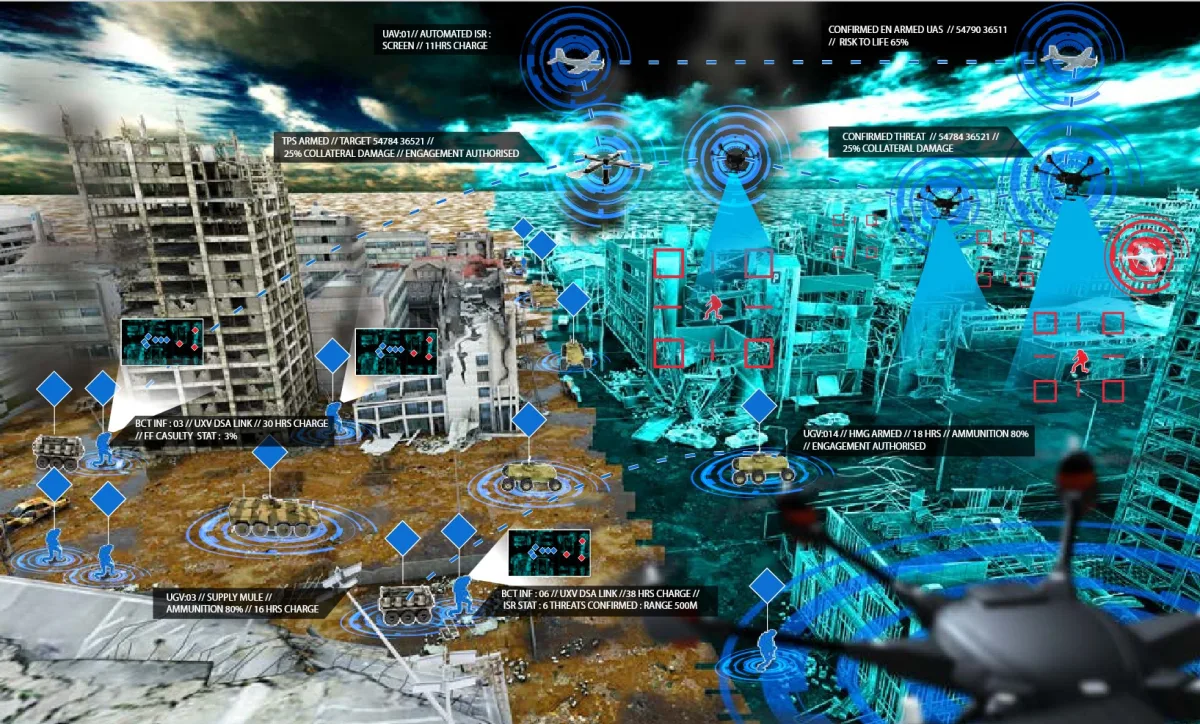

At the heart of the transformation of the British Army is a key challenge: how to maintain operational superiority in a rapidly evolving technological world.
Human-Machine Teams: the new operational challenge
The answer is called RAS – Robotics and Autonomous Systems, a strategic vision aimed at revolutionizing the entire concept of land force by 2035. In a global context marked by hybrid threats, high-intensity conflicts, and the spread of low-cost but highly effective technologies, the integration of robotic and autonomous systems represents an essential element to ensure reactivity, protection, and maneuverability.
The plan includes three fundamental stages: by 2025 a Light Brigade equipped with tactical RAS will be operational; by 2030 the systems will be fully integrated into medium-heavy brigade formations; by 2035 the transformation will be complete, with units at all levels capable of operating in synergy between humans and machines. In this model, technology does not replace the soldier but amplifies their capabilities, while simultaneously reducing direct exposure to battlefield dangers. All this will occur through a generational change in military culture, which must embrace innovation and quickly adapt to the pace of the digital revolution.

RAS: an integrated technological ecosystem
RAS is not just a set of robots, but an integrated system that includes hardware, software, algorithms, artificial intelligence, communication networks, and, most importantly, people. Each autonomous platform – both land and air – must be able to collaborate in real-time with other sensors, decision-makers, and effectors to optimize the operational response. Human-Machine Teams (HMT) evolve in three progressive stages: from enhanced teams, where the machine is a supervised tool, to integrated teams, where humans and RAS act in synergy, to supervised teams, where machines operate with a high degree of autonomy and human control is limited to critical cases.
This balance between technology and the human factor requires a profound cultural change, with soldiers equipped with advanced digital skills and able to trust the support provided by autonomous systems. Concrete examples are not lacking: already today, in logistics, reconnaissance, or mine neutralization operations, machines allow for faster times, reduced errors, and protection of human lives.
The success of RAS will also depend on the quality of the data and the digital architectures used: artificial intelligence is effective only if fed with precise, accessible, and real-time shared information. The British Army therefore foresees a significant investment in the so-called “digital backbone” of the force, with resilient networks, interoperability between platforms, and a strategic use of operational data.
Moreover, the management of autonomy will be modular: in some scenarios, machines will act under strict human control, in others they may operate with greater freedom, depending on the complexity of the mission and the operational context. Particular attention will be paid to training: the soldiers of the future will need to master digital tools, understand the limits of artificial intelligence, and develop new forms of leadership to guide hybrid human-machine teams.

Ethics, governance, and cultural transformation
But the transformation cannot disregard a robust ethical and regulatory framework. The use of lethal force, in fact, will always remain a human responsibility. The RAS strategy of the British Army is based on transparent governance, clear ethical principles, and strong interaction with industry, academia, and international allies. Technologies must be reliable, secure, and understandable, so that trust between man and machine is well-calibrated.
In parallel, defense will equip itself with a resilient digital infrastructure, capable of managing large data flows in real-time and ensuring interoperability between systems. The development logic will be flexible and continuous: research, experimentation, and implementation will occur in an integrated manner, reducing acquisition times and quickly adapting solutions to operational needs. In this framework, the soldier of the future will be at the center of a dynamic network, capable of acting in urban environments, congested spaces, and complex scenarios thanks to the intelligent support of RAS. The goal is twofold: to maintain military effectiveness and protect personnel, addressing asymmetric threats, conventional wars, and operations in the civilian sphere with cutting-edge tools.
The concept of “Human-Machine Teaming” will thus become a distinctive competence of the British armed forces, as important as shooting or traditional command. The change will not be only technological, but doctrinal, organizational, and cultural. A new mindset will be needed, capable of accepting experimental failure as part of progress and a flexible structure able to adapt to the rapid changes of the operational context. The British Army thus intends not only to adapt to the war of the future but to actively lead its transformation. With vision, investments, and determination, the RAS revolution is destined to become an operational reality within the next ten years.



Comments
No comments yet. Be the first!