


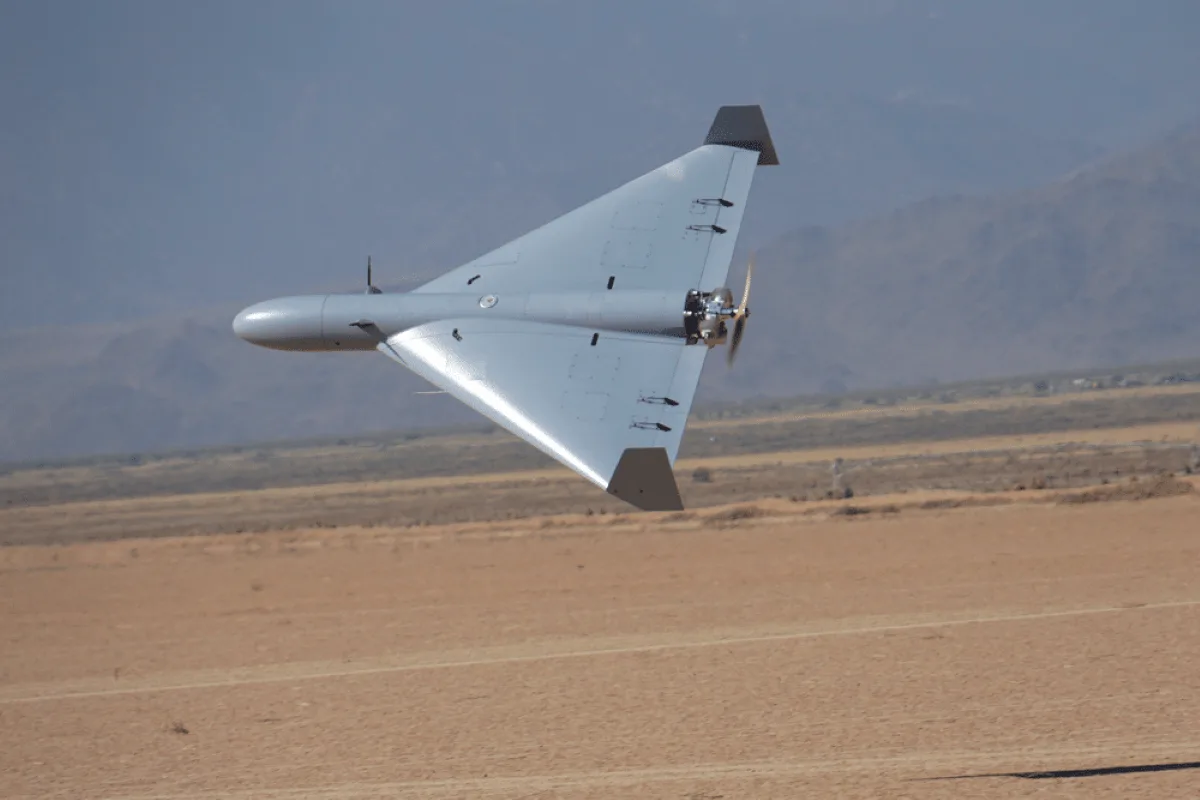

The Pentagon has begun deploying the new attack drone LUCAS (Low-Cost Uncrewed Combat Attack System) in the Middle East, marking the operational entry of a new generation of American kamikaze UAVs. The capability has been entrusted to a new dedicated unit, the Task Force Scorpion Strike (TFSS), now deployed at an undisclosed base in the CENTCOM area.
The LUCAS program is part of the broader US strategy to revitalize its superiority in the field of unmanned systems. In July 2025, the Department of Defense published the document “Unleashing US Military Drone Dominance”, which outlines goals and priorities to maintain technological and industrial leadership in the UAV sector. In the same month, a demonstration of the new LUCAS system was conducted in the presence of Pentagon leadership.
The project was developed by SpektreWorks, a company based in Arizona, in close collaboration with military specialists. According to released information, the concept stems from the systematic observation of the use of Iranian kamikaze drones Shahed-136 and their Russian equivalents Geran-2 on the Ukrainian and Middle Eastern fronts. The study of wreckage and recovered fragments has significantly contributed to the definition of the American project.
On December 3, the US Central Command (CENTCOM) officially announced the entry into service of LUCAS and the creation of the TFSS. According to sources cited by the US press, the unit comprises several dozen military personnel, specifically trained in conducting operations with attack UAVs. The number of assigned aircraft has not been disclosed, nor has the base of operations, but it is clear that the priority is the Middle Eastern theater and, in particular, strategic pressure on Iran.

LUCAS: the American Copy of the Shahed
The LUCAS drone is described as a fixed-wing, tailless aircraft, with a cylindrical fuselage of constant diameter and a delta wing with vertical tips: a configuration that closely resembles the Shahed-136. The dimensions appear similar: length over 3 meters and comparable wingspan, with a warhead weighing up to 18 kg, potentially expandable at the expense of fuel capacity.
The chosen engine is a Desert Aircraft DA-215 two-cylinder with 215 cc, with power up to about 13 HP and electronic injection. Combined with the lightweight airframe, it should allow speeds of around 180–200 km/h and a declared range of 5–6 hours, sufficient to hit targets deep beyond the launch line.

The system provides for various control configurations. In the basic version, LUCAS uses satellite and inertial navigation to follow a pre-programmed route and hit targets at predefined coordinates, like a classic low-cost cruise missile. However, specimens equipped with electro-optical sensors in the nose, presumably TV or IR, have already been shown for autonomous target search in a pre-assigned area or for engaging moving targets.
Some images reveal a flat surface on the tail interpreted as a possible satellite antenna: if confirmed, it would enable long-distance data links with the control station, allowing the operator to follow the mission in real-time and, in certain profiles, manually guide the aircraft towards the target.
The launch takes place from a rail via catapult or rocket booster, with the possibility of installation on land vehicles or, potentially, on naval platforms. LUCAS is primarily conceived as a one-way system, but the possibility of return and recovery missions, perhaps via parachute, is not excluded. The Pentagon particularly emphasizes the cost factor, with a declared figure of just 35 dollars per production UAV: a figure not verifiable, but indicative of the ambition to make the system extremely economical and expendable.

Operational and Strategic Implications in the Middle Eastern Theater
With LUCAS, the United States adds to an already vast arsenal of attack UAVs a system expressly designed as a low-cost kamikaze drone, modeled on Iranian and Russian experience. This step implicitly acknowledges the effectiveness shown by the Shahed and Geran in recent years, especially in the Ukrainian conflict, in terms of wearing down defenses and saturating adversary interception capabilities.
The choice to deploy the Task Force Scorpion Strike in the Middle East is not accidental. In the context of competition with Tehran, LUCAS becomes a tool of credible deterrence: a means capable of threatening critical infrastructure, bases, logistical nodes, and Iranian military assets from a distance, reducing the risk to US personnel. For now, the message is primarily political: the drones represent a potential threat, but not yet concretely employed in combat.
In a scenario of escalation, however, LUCAS could be used both en masse, to saturate defenses, and in combination with other assets – from conventional cruise missiles to traditional airstrikes – within multi-vector attack campaigns. Its relative simplicity and low cost make it an ideal candidate for high-intensity operations, where quantity becomes a multiplier of effectiveness.
It remains to be seen how effective this new capability will be against Iranian countermeasures, which in recent years have adapted precisely to the threat of drones and low-altitude missiles. The actual operational impact will depend not only on the system's performance but also on how it will be integrated into CENTCOM doctrines and the speed with which adversaries develop adequate technical and tactical responses.
For now, the deployment of LUCAS and the TFSS marks a symbolic but significant step: Washington also has its “American copy” of the Shahed, and the low-cost attack drone war enters a new phase, more crowded and potentially more unstable.



Comments (1)