


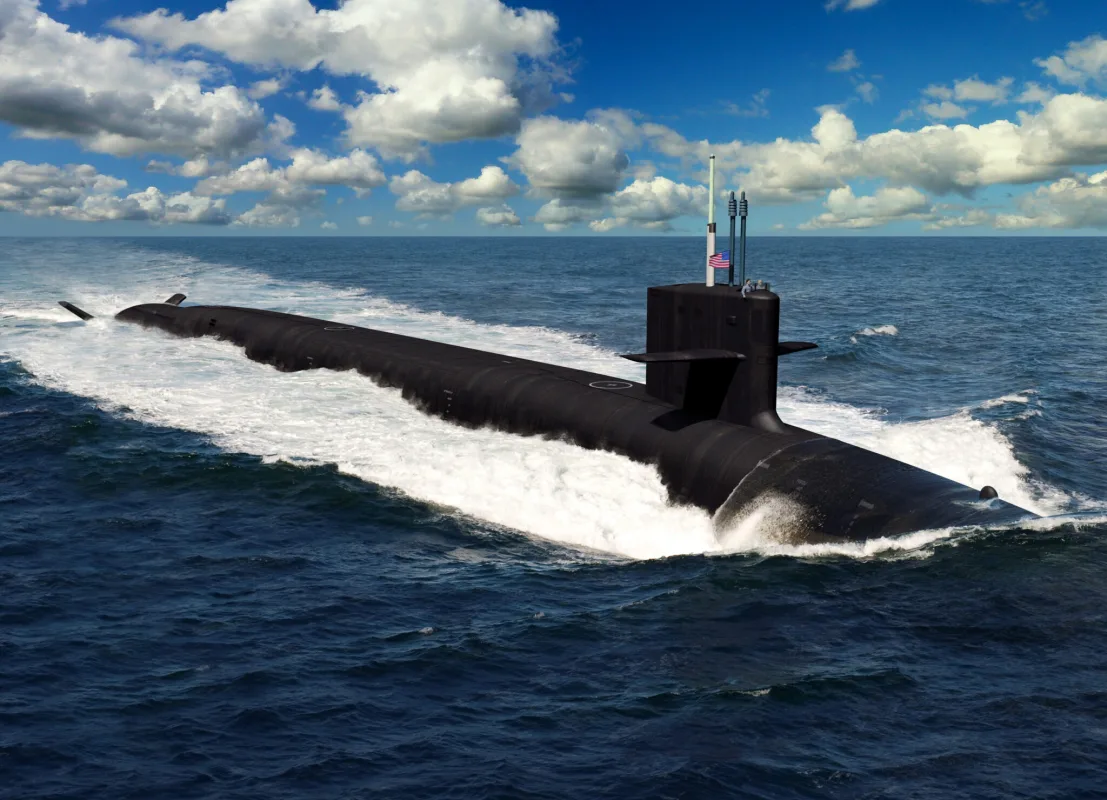

When it comes to underwater deterrence, the imagination often immediately turns to large “weapons” and their extreme scenarios. In reality, the heart of deterrence at sea is often much simpler to understand: being present without being found. A truly effective submarine is one that can remain on patrol for a long time, move freely, and be difficult to locate.
In this sense, the American Columbia class has become a benchmark, especially for its philosophy: silence, resilience, operational continuity.
The Key Point: Nuclear Propulsion as an “Enabler”
Here “nuclear” is meant in the most practical way: as propulsion technology. The underlying idea is that nuclear propulsion can change the operational profile because:
- it increases sea endurance and reduces some energy constraints typical of conventional platforms;
- offers more freedom of movement (less “obligated” routes and times);
- makes the “invisible presence” more credible, which is often the element that truly matters in underwater deterrence.
The Columbia is interesting precisely for how it tries to maximize availability and discretion over time (also with choices in propulsion architecture and lifecycle management).

The Italy–Germany Precedent: Already Concrete Underwater Cooperation
If today a more ambitious joint project is hypothesized, Italy and Germany would not start from scratch: there is a path of industrial and operational cooperation linked to the U-212A family (in Italy, Todaro class) and joint support mechanisms.
A useful example, often underestimated by the public, is cooperation on in-service support (Common In-Service Support), which demonstrates that collaboration is not just about “building” but also maintaining and operating a fleet over time.
On the industrial side, Fincantieri explicitly recalls the evolution of the U212A path in cooperation with TKMS, with measurable results in terms of units produced and delivered.
Why does it matter? Because a complex project does not live only on designs: it lives on supply chains, quality standards, testing, integration, maintenance, training. And here Italy–Germany already have a tested “method.”

Why Adding Japan Makes the Scenario More Credible
Japan is a natural player if the goal is to push on:
- reliability, design discipline, and attention to silence;
- industrial capacity and constructive continuity in the underwater domain (today on advanced conventional platforms).
In parallel, in Japan, there are public discussions (at various levels) on the future evolution of underwater capabilities, including hypotheses and debates on propulsion options.
Even without “deciding” everything immediately, the logic of a Germany–Italy–Japan partnership lies in bringing together three strong points: already cooperative European base (DE–IT) + industrial critical mass and underwater design culture (JP).
Why the Idea Becomes More Realistic Today: AUKUS Uncertainty (Australia)
There is also a factor that, in recent months, is increasingly entering analyses: the possibility that the United States may not be able or willing to sell to Australia the submarines planned in the “Pillar 1” component of AUKUS, due to industrial capacity reasons, operational priorities, and political constraints.
- A report from the Congressional Research Service updates the “issues for Congress” on the Virginia program and AUKUS Pillar 1, also putting alternatives and risks related to production capacity and US priorities on the table.
- In recent days, several articles have reported that the “zero deliveries” or reduced deliveries hypothesis has been discussed as a scenario in debates around the topic.
- Already in 2025, Reuters reported doubts and political pressures around the sale of nuclear-powered submarines to Australia within AUKUS.
If (even partially) these uncertainties were to materialize, it would become even more plausible—worldwide—that countries interested in advanced underwater capabilities would need to seek alternative partners and new industrial formulas, instead of relying on an “external supply.”

How a Germany–Italy–Japan Project Could Look (In Simple Words)
Without going into the detail of “what” it embarks or “how” it is employed (a topic we deliberately leave open here), a joint nuclear propulsion project would make sense if built on three clear choices:
- A common core
Shared standards on silence, reliability, quality, and testing. - Modular production and resilient supply chain
Each country contributes on blocks/systems where it is strongest, reducing bottlenecks and delay risks. - Design thought for decades
Scheduled maintenance, upgradability, and lifecycle management as part of the project, not as an “afterthought.”
Conclusion
The lesson of the Columbia, despite the differences in mission and context, is this: in the underwater domain, the winner is the one who can remain operational and invisible longer. In a world where large international programs can encounter obstacles (as is emerging in the AUKUS debate), the idea of an alternative path among Germany, Italy, and Japan—centered on nuclear propulsion and structured industrial cooperation—becomes a more “real” possibility than it seemed until recently.




Comments
No comments yet. Be the first!