


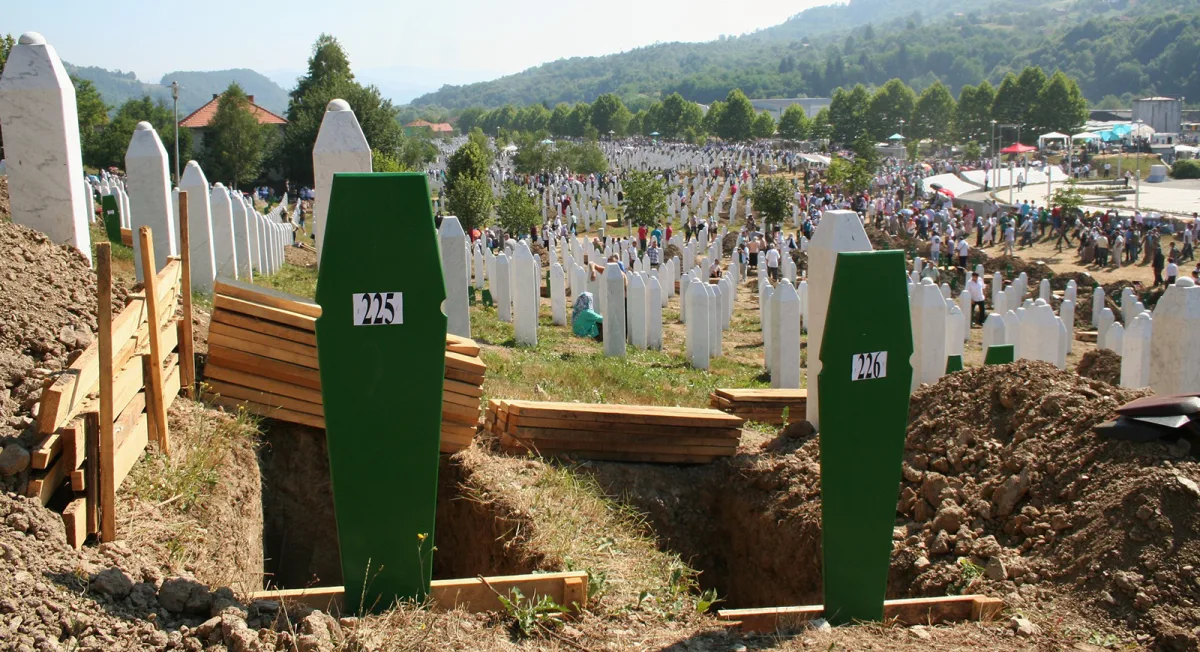

On July 11, 1995, in the Bosnian town of Srebrenica, designated by the United Nations as a “safe area,” one of the most atrocious crimes of post-war Europe took place: the systematic execution of about 8,000 Bosnian Muslim men and boys by Bosnian Serb forces. Thirty years later, that massacre continues to cast its shadow over Europe's conscience.
The Failure of the West
The international community knew. And did nothing. The Srebrenica massacre was the final result of three years of massacres, ethnic cleansing, sieges, and indifference. The Dutch blue helmets, about 400 men deployed to protect the enclave, were short on supplies and ammunition, hindered by Serbian blockades. The UN commands did not want—or did not know—how to believe that the attack would really happen. But it had already happened elsewhere: in Vlasenica, in Bratunac. There were precedents, culpably ignored.

Srebrenica was already crowded with refugees who had escaped the first pogroms of 1992. That city, theoretically inviolable, became the scene of a genocide carried out “in broad daylight and in secret,” as one of the few surviving witnesses wrote.
“Safe area”: A Broken Promise
The images that emerged in the following years are of overwhelming power. Bodies thrown into mass graves. Desperate women confronting impassive UN soldiers. Refugee children loaded onto trucks. The photos of Muslim prisoners in the camps of Trnopolje and Omarska, skeletal and annihilated, had already shocked Western public opinion in 1992. Yet, as journalist Ed Vulliamy pointed out, the outrage faded into a collective shrug.
President Clinton declared in 1994: “They have been killing each other there forever.” With a single sentence, America—and with it the West—washed its hands of Bosnia.
Ethnic Hatred as a Tool of Power
The war in Bosnia was also the triumph of the most brutal nationalism. Radovan Karadžić and Slobodan Milošević knew how to manipulate history and collective fears, portraying the Bosnian Muslims as the “returning Ottomans,” millennial enemies to be eradicated. Yugoslav coexistence dissolved in a few months, leaving room for an ethnic-based manhunt.
In Srebrenica, Muslim males were separated and executed, while women, children, and the elderly were deported. Some tried to flee into the woods but were intercepted and exterminated. In a warehouse in Kravica, over a thousand men were killed in a few hours.

The Long Journey of Memory
Only years later were the mass graves found. The remains, often dismembered, were exhumed and identified thanks to DNA. The pain, however, remains indelible. In Tuzla, in the eyes of widows and orphaned children, there was not only mourning but a mute anger against Europe and its inertia.
A symbolic image remains that of Ferida Osmanovic, a young mother who hanged herself in the woods after losing her husband. Her body was found near a UN base. Her face became an icon of despair and shame. It even forced US Vice President Al Gore to ask: “Why are we doing nothing?”
The Belated Awakening and an Imperfect Peace
Only after Srebrenica, and the subsequent massacre at the Sarajevo market, did the West move. The NATO bombings of September 1995 forced Milošević to the negotiating table. From here the Dayton Agreement was born. The war ended, but the peace left deep scars.
Srebrenica, paradoxically, was assigned to the Serbian Republic of Bosnia. The return of refugees was minimal. The truth, denied in Belgrade for decades, hindered any attempt at reconciliation.

Today, in the midst of a new war in Europe, the images of that time seem to resurface: destroyed cities, refugees, summary executions. Srebrenica is not just a chapter of the past, but a warning for the present. Nationalist hatred, as Ukraine demonstrates, is always ready to rise again, to devour everything in its path.
As Isaiah Berlin wrote, the 20th century was “the most terrible in history.” But nothing guarantees that the 21st will be different if we do not learn from tragedies like Srebrenica.






Comments
No comments yet. Be the first!