


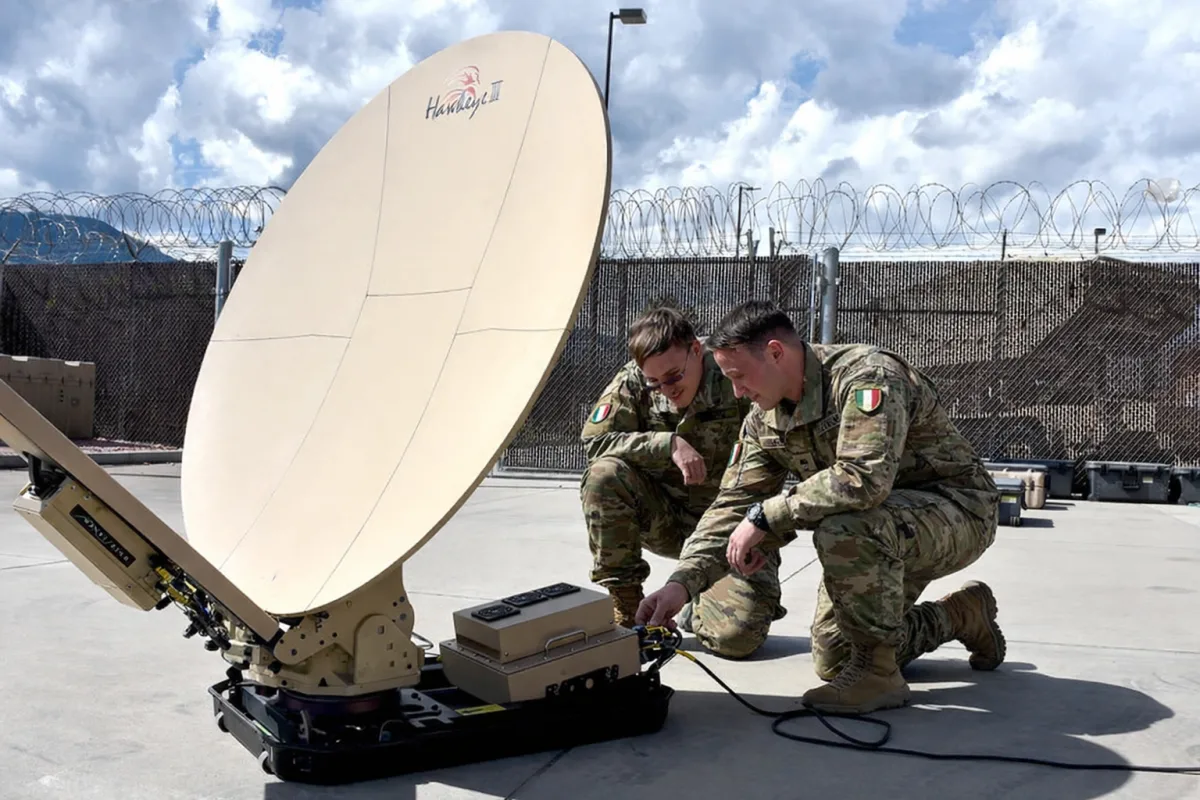

In the Italian public debate, when talking about “space” in a military context, the temptation is always the same: to consider it primarily an aeronautical, industrial, or – in perspective – “joint” affair, and thus something the Army can simply “receive” in the form of services (satellite communications, images, PNT/GNSS, alerts). It is an understandable temptation, but strategically dangerous.
Contemporary warfare – and even more so future warfare – is showing that space is not an “external technical support” to land maneuvers: it is an operational multiplier, a target, a competition ground, and a source of vulnerability. And if the land component does not develop organic competence to employ, protect, and contest space effects at the tactical-operational level, it inevitably ends up depending on others: in timing, priorities, rules of engagement, even in the language used to describe the battle.

The American Lesson: “In-House” Competence Without Duplicating Missions
A useful example comes from the United States. In an interview with Breaking Defense on February 6, 2026, Col. Felix Torres (SMDC Center of Excellence) clarified that the new professional sector of the US Army dedicated to space – aiming to cover about 1,000 positions – is not born to “invade” the perimeter of the Space Force. On the contrary: it is born because each Armed Force has specific needs and field effectiveness requires dedicated skills, even when there is a “specialist” service operating in the same domain. Torres is explicit: the task of the US Army is mainly in the tactical realm, on terrestrial effects (electronic warfare, tactical SATCOM, integration to support the maneuver), while the Space Force is more focused on orbital operations and satellite control.
The key point is not to “copy” the American model, but to grasp its logic: overlap does not mean duplication. In modern armed forces, capabilities that insist on the same domain can and must coexist if they respond to different needs and if they are integrated.
In Italy, Space is Already Recognized as an Operational Domain: Now Organizational Consequence is Needed
The Italian Defense does not start from scratch. The Ministry of Defense has formalized the multi-domain approach for years: the land component must be able to operate “in the five operational domains… land, air, maritime, cyber, and space,” planning coordinated and integrated actions.
In parallel, Italy has established the Space Operations Command (COS) (June 8, 2020), with the aim of enhancing national capacity in the space domain, protecting and defending assets, and integrating space services into operations. And, above all, the Defense is already training and experimenting with realistic scenarios: in the exercise Space Insider 23, the COS included space in the planning and conduct process even at the tactical level, including cases like jamming against SATCOM, collision risk management, and satellite support (ISR/SATCOM/PNT) linked to ground campaigns.
There is a passage in that report that deserves attention: coordination elements supporting the land component (Space Support Coordination Element) are also mentioned, and the need for “extreme synchronization” of cross-domain actions “from, to, and through Space” to amplify the effectiveness of traditional capabilities.
Translated: if the Army does not have a culture and a professional chain capable of understanding and governing that synchronization, someone else will do it in its place.

Why Space is an Indispensable Resource for Land Operations
For future land combat, space impacts directly and daily on at least four decisive functions:
- Resilient Command and Control: tactical SATCOM and beyond-line-of-sight; continuity of links in contested environments.
- PNT (Position, Navigation, Timing): not just “GPS,” but synchronization, fire, logistics, drones, C2 networks; and especially defense against spoofing/jamming.
- ISR and targeting: images and signals to discover, confirm, track, and engage; reduction of sensor-to-shooter times.
- Force protection and maneuver: situational awareness, early warning, prediction of overflight windows, mitigation of emissions and electromagnetic signature.
Each entry has a common denominator: it is not enough to “have access” to space services; they must be employed and protected in real-time at the level where the decision is made (brigade, battalion, task force), with personnel who speak the language of land maneuver.
The Risk of “Delegating”: Timing, Priorities, and Vulnerabilities
If space competence remains external to the land component, three recurring problems emerge:
- Priority asymmetry: those who manage the space domain respond (legitimately) to strategic/joint priorities; land maneuver has immediate tactical urgencies.
- Decision delay: without “bridge” personnel who understand requests, constraints, and opportunities, the chain lengthens and the useful window closes.
- Operational vulnerability: jamming, cyber, spoofing, counter-ISR: if the tactical level does not recognize weak signals and early indicators, degradation arrives “by surprise.”
Here the analogy with the US case is fitting: the US Army has defended the need for its own “space-centric” profession precisely because the Space Force “cannot do everything” and because service needs are specific.

What “Fully Committing” Means for the Italian Army
The goal is not to create a “duplicate” of the COS or the Air Force, nor to chase orbit or strategic space control. The goal is to make the land component competent and autonomous in the tactical-operational use of space effects, in full joint integration.
In concrete terms, it means investing in:
- A dedicated professional chain (tactical space specialists): resilient PNT, SATCOM, space ISR integration, counter-ISR, support to targeting and fires.
- “Space-enabled” planning and coordination teams within large units: to translate maneuver needs into effective requests and to adapt employment when space is degraded.
- Realistic training: exercises where space is contested (jamming, PNT loss, imagery degradation) as a “normal” condition, not an exception.
- Doctrine and procedures: TTP to operate in degraded space environment and to synchronize cross-domain effects with cyber and EW.
The COS would remain the operational interface and the joint framework of the domain, as already indicated in its institutional mission. But the Army would finally have the critical mass to exploit and defend those services where it matters most: in the mud, in the electromagnetic noise, in the decisive minute.
Conclusion: Space is Already in the Land Battle. The Question is “Who Governs It?”
The Italian Defense has already recognized space as an operational domain and is integrating it into exercises and planning processes, even at the tactical level. The next step is consistent and urgent: not to leave the space competence of the land component “in cultural outsourcing”.
The future of Land operations will be multi-domain by definition. And in that future, space will not reward those who “depend,” but those who know how to integrate, adapt, and fight even when satellite services are not guaranteed.


Comments
No comments yet. Be the first!