


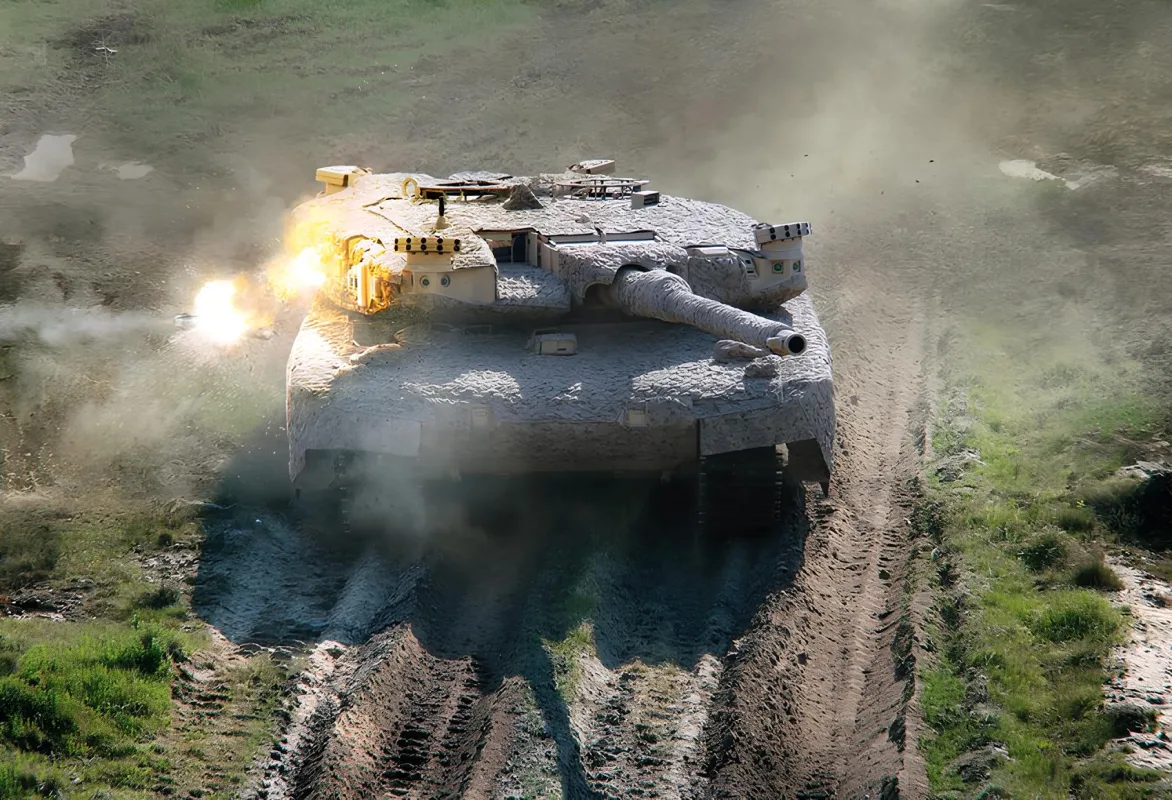

The war in Ukraine has challenged one of the certainties of European land doctrine: the tank, on its own, is no longer the dominant force on the battlefield. FPV drones, loitering munitions, and anti-tank missiles have shown how quickly a heavy vehicle can become vulnerable when threats come simultaneously from multiple directions and, above all, from above. In this scenario, tank protection can no longer be seen only as “armor thickness”: it must become a complex system of sensors, countermeasures, and real-time reaction capabilities.
Hence the growing attention in Europe towards Active Protection Systems (APS), those “kits” (or integrated architectures) capable of detecting and neutralizing incoming threats before they hit the vehicle.

Trophy: Why It Has Become a Benchmark
Among the most sought-after APS internationally today is Trophy, developed by Israel's Rafael. Trophy is a “hard-kill” system: it uses radar and countermeasures to detect incoming anti-tank missiles and rockets and engage them at close range, reducing the likelihood of impact. Its appeal to European countries lies in three factors:
- Industrial maturity and rapid integration: it is a product already widely adopted and with a consolidated integration path.
- Operational credentials: it is perceived as a “proven” system in real scenarios, a factor that weighs heavily when seeking an immediate response.
- Evolution against top threats: Rafael has announced updates aimed at improving capabilities against top-attack threats and drone-related threats, which are at the heart of the transformation observed in Ukraine.
Against this backdrop, several European countries have decided to equip the new Leopard 2A8 with Trophy: a signal of pragmatism, aimed at reducing modernization times and technological risk.

The European Bottleneck: Not Just Technology, but Industrial Capability
The push towards APS like Trophy coexists with a structural problem: the production and integration of complex systems require industrial capability and robust supply chains. In many cases, the technology exists, but deliveries occur over multi-year horizons. This results in a typically European tension: strategic urgency today and industrial capability that grows more slowly.
This issue is one of the key points of contemporary debate: modernizing does not only mean “deciding what to buy,” but making sustainable a supply chain that produces, integrates, trains, and maintains over time systems that are increasingly software-centric and sensitive to threat evolution.
The Second Path: New Platforms with “Native” Active Protection
Parallel to the retrofit/upgrade path, a second path is emerging: designing next-generation tanks where APS is not an accessory to be added, but a “native” element of the architecture.
An example often cited in the European debate is the Rheinmetall Panther KF51, which is presented with a survival suite that includes concepts of active protection (family StrikeShield/ADS), systems to counter top attacks (TAPS – Top Attack Protection System), and obscuration/countermeasure solutions like ROSY. The idea, in this case, is to integrate sensors, effectors, and digital threat management from the outset into the overall vehicle design, instead of adapting a tank born in an era when the “top” risk was less pervasive.
In Italy, this approach intertwines with the industrial evolution of the land sector: the joint venture Leonardo–Rheinmetall has been announced with the aim of developing armored capabilities and combat vehicles in a framework of heavy component renewal.

The Real Test: Saturation and “Economic” Threats
The most difficult point — and often less discussed — is not just “if the APS intercepts a missile,” but how it holds up when the threat is massive, economic, and repeated. The war has shown an attack model based on saturation:
- FPV drones and loitering munitions arriving from unpredictable angles,
- multiple attacks to stress sensors and effectors,
- degraded electromagnetic environment (jamming, interference, electronic warfare).
In this context, effective protection tends to become multi-layered: hard-kill + soft-kill (disturbance, deception, smoke), signature management (thermal/electromagnetic), integration with unit anti-drone defenses, and, above all, a network of sensors and command that allows the tank not to be “alone.”
Conclusion: Tank Defense Becomes a Low-Altitude Anti-Aircraft Discipline
The general direction now seems clear: the tank remains central for firepower and shock, but its survival increasingly depends on the ability to operate within a protection ecosystem that resembles a “tactical” low-altitude anti-aircraft defense.
For Europe, this means choosing between two complementary logics:
- mature solutions rapidly integrable (like Trophy) to reduce time and risk;
- new platforms designed with integrated APS to structurally address the top-attack threat and drone warfare.
In both cases, the decisive variable is not just the quality of the individual system, but the combination of industry, training, doctrine, and integration with unit anti-drone defenses: because today, what “comes from the air” is often what decides survival on the ground.



Comments
No comments yet. Be the first!