


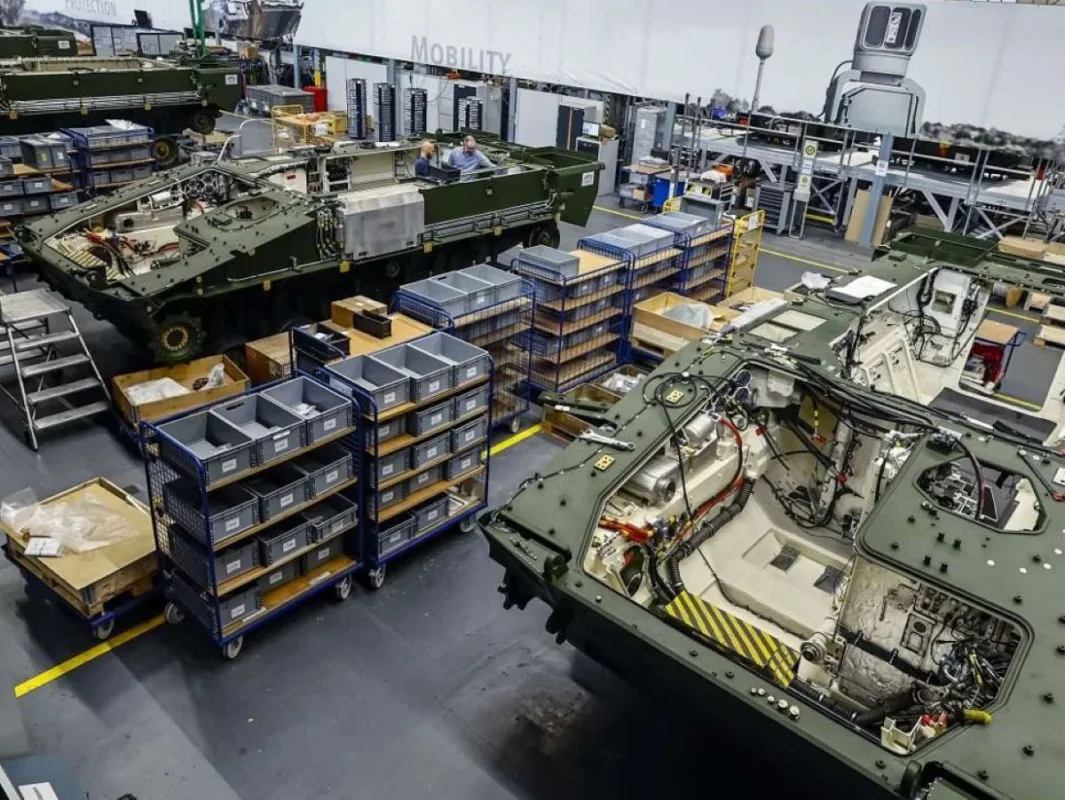

In Germany, defense spending is producing structural effects that go far beyond the military sector. The extraordinary fund of 500 billion euros allocated for defense and infrastructure is already impacting the shape of the national manufacturing system, triggering a large-scale productive reconversion. It's not yet about measuring the direct impact on GDP, but observing how the program is reorienting skills, investments, and industrial capabilities.
According to data collected from international financial sources, about 500 companies have already joined the Svi Connect platform, promoted by the federal government to facilitate the entry of SMEs into the supply chains of major defense contractors, including Rheinmetall. Estimates indicate that the number could rise to 1,000 companies by 2026. A particularly relevant fact is that over 90 percent of these companies have no previous experience in the military sector.
These are predominantly SMEs with fewer than 100 employees, coming from the metalworking, precision mechanics, and ICT technologies sectors, interested in becoming suppliers of components, advanced materials, and high-tech services. In this context, defense spending assumes the role of an industrial policy lever, capable of guiding a structural transformation of the German production system.
At the same time, the budget of the Ministry of Defense is expanding significantly: by 2026 it exceeds 108 billion euros, with a growth trajectory that could bring allocations to about 150 billion by the end of the decade, bringing Germany closer to NATO objectives. A dynamic that confirms how rearmament is now an integral part of the national economic strategy.
From Automotive to Defense, an Industrial Paradigm Shift
One of the most significant aspects of this transformation concerns the automotive sector, historically a pillar of German manufacturing and today under pressure due to the electric transition, Asian competition, and the slowdown in European demand. In this context, defense emerges as an alternative production outlet, capable of absorbing excess industrial capacity and skilled labor.

It is no coincidence that the leaders of Volkswagen have recently declared that they are considering the reconversion of some plants towards military production. This is an emblematic signal of a paradigm shift: the defense industry is no longer perceived as a niche sector, but as an area capable of ensuring production continuity, technological innovation, and employment stability.
This orientation is also reinforced by financial dynamics. European defense stocks have recorded sustained growth in recent years, fueled by rearmament expectations linked to growing geopolitical tensions. In the German case, however, the ability to transform expectations into concrete industrial choices is striking, with the state playing an active role in coordinating supply chains.
Many analysts identify the German fiscal package as one of the main drivers of the expected European growth for 2026. But the deeper impact could manifest in the medium term, through the strengthening of Germany as a manufacturing and technological hub of European defense.
The Impact on Italy: Opportunities and Systemic Risks
The transformation of the German production system raises significant questions for Italy, whose manufacturing fabric is historically integrated with the German one through complex subcontracting chains, especially in the Center-North. On one hand, the ongoing reconversion could open new opportunities for Italian companies already embedded in the mechanics and advanced materials supply chains. On the other hand, there is the risk that Berlin may choose to internalize part of the productions, reducing the space for foreign suppliers.

Unlike Germany, Italy currently lacks an industrial reconversion plan of equal scale and strategic clarity. The national defense sector remains competitive and technologically advanced, but suffers from a structural fragmentation that penalizes SMEs in particular and from a limited capacity to coordinate industrial policy with defense policy.
In recent years, however, there are signs of a progressive change of pace. The increase in defense allocations and participation in European and international industrial programs offer significant development opportunities. The central challenge will be to transform the growth in military spending into an industrial multiplier, capable of supporting manufacturing and accompanying the transition of sectors in difficulty, such as automotive.
The German case demonstrates that defense can become a decisive lever of industrial policy. For Italy, the question is not only whether to follow this path, but how to do it, avoiding passively undergoing a transformation decided elsewhere and maintaining an active and competitive role in the new European industrial framework.





Comments
No comments yet. Be the first!