




The British Ministry of Defence has drawn a clear line on the future of land warfare. With the publication of the Strategic Review, the United Kingdom's army has officially embraced the "Recce-Strike" (Reconnaissance-Strike) doctrine, marking one of the most significant conceptual changes since the end of the Cold War.
As highlighted by Colonel Hamish de Bretton-Gordon – former commander of the 1st Royal Tank Regiment and author of the upcoming book Tank Command – in the Daily Telegraph, this shift acknowledges the brutal lessons of the conflict in Ukraine, where the integration of drones, sensors, and precision strikes has radically redefined the parameters of modern combat.
The 80/20 Revolution: Farewell to the Past
The assessment by the British Ministry of Defence is as bold as it is realistic: lethality on future battlefields will be determined about 80% by drones and autonomous systems, and only 20% by traditional armored platforms and artillery.
The facts in Ukraine are clear. Kyiv's forces, despite a chronic shortage of ammunition, have become masters in this new form of warfare, surpassing most NATO countries in the practical understanding of modern conflict. The lesson for London is immediate: those who detect, identify, and destroy the target in the shortest possible time, survive.
"Defense cannot become the sacrifice of an internal political war. In a time of increasing global instability, any distracted government risks jeopardizing the nation's security."
— Col. Hamish de Bretton-Gordon
What is the "Recce-Strike" Ecosystem?
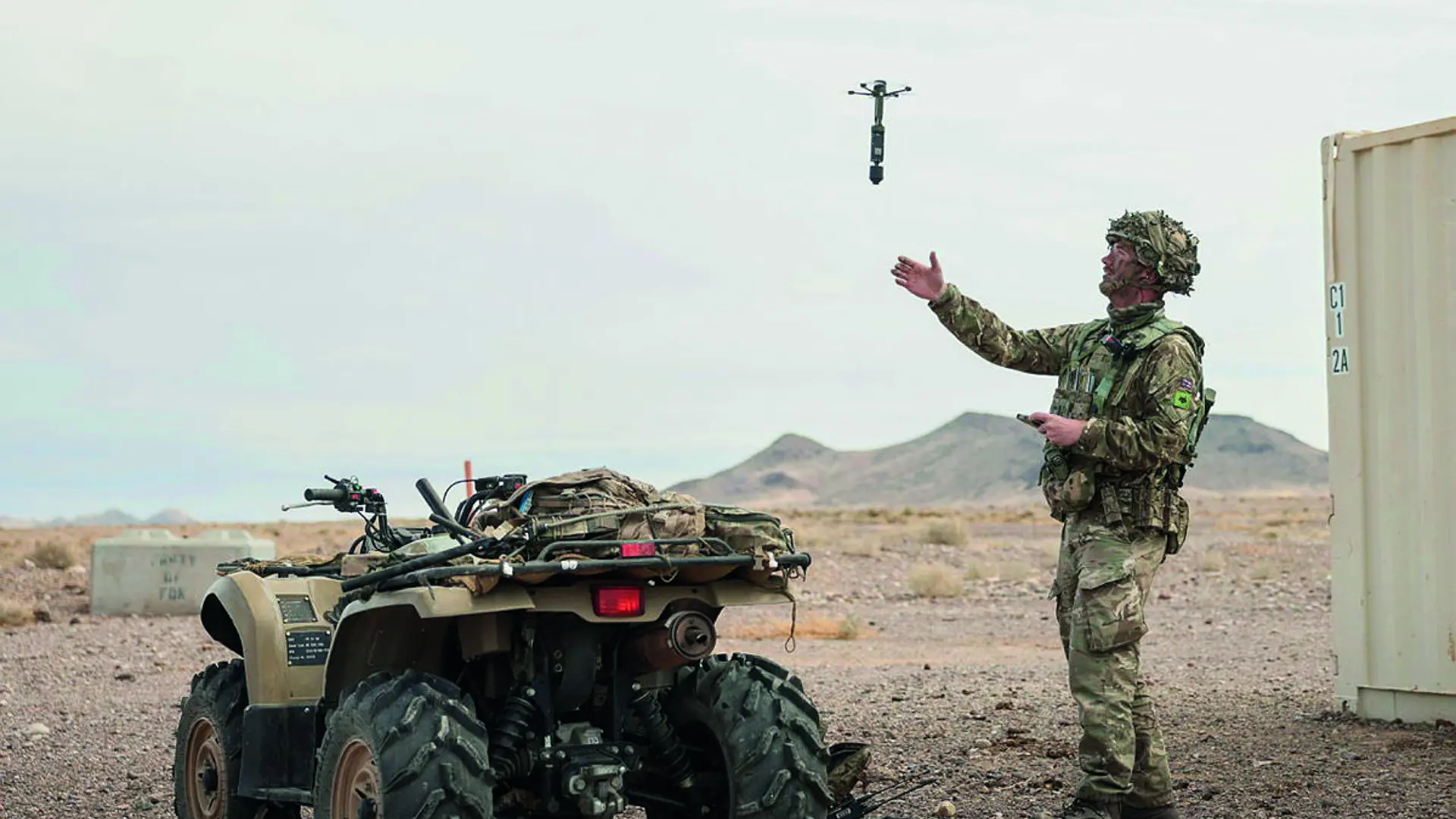
The concept behind Recce-Strike is deceptively simple in theory but revolutionary in practice. It is a single digital ecosystem that integrates surveillance, reconnaissance, and strike to reduce the traditional "kill chain" to a few minutes, if not seconds.
The doctrine is articulated on three fundamental components:
- Rapid Targeting: Drastic reduction of the time between detection and destruction of the target thanks to decision-making processes assisted by Artificial Intelligence (AI).
- Persistent Surveillance: Constant monitoring of the battle space through drones, sensors, and electronic warfare. In this context, the criticized reconnaissance vehicle Ajax becomes crucial: it is not just a scouting vehicle, but the true "digital nerve center" of the army.
- Long-Range Fire: Ability to strike enemy formations in depth, well beyond the front line, combining advanced artillery, missiles, and loitering munitions.
The Pillars of the New British Land Force
To give substance to this vision, the United Kingdom is assembling a trio of digitally integrated platforms:
1. The RCH 155 Howitzer
The announcement of the acquisition of 72 new 155 mm self-propelled howitzers RCH 155, mounted on Boxer chassis, represents a fundamental breakthrough. The contract worth nearly 1 billion pounds provides for production in the UK, ensuring sovereign industrial resilience. This system can fire up to 8 rounds per minute at a distance of 70 kilometers, operating even in remote or non-autonomous mode.
2. The Ajax Vehicle
Despite historical criticisms related to its development, the Ajax is being reassessed as a central hub for data collection and distribution in the field.
3. The Challenger 3 Tank
It will be the first main battle tank of the British army entirely digital, a formidable platform to ensure survival and lethality in high-intensity contexts.

The Challenges: The Time Factor and Westminster's Unknowns
Despite the conceptual excellence, de Bretton-Gordon raises a serious alarm: time is against the West. The goal of making these capabilities fully operational by the end of the decade may prove too slow compared to the pace of global military innovation and geopolitical threats.
Moreover, the integration of complex systems like Ajax, RCH 155, and Challenger 3 will require massive efforts in terms of logistics, training, and doctrine. Challenges that can be overcome, but only if the Treasury guarantees stable funding and political leaders maintain high attention.
The greatest danger remains Westminster's internal politics. With the specter of political instability or possible ideological drifts within Labour should Keir Starmer lose control of the party, the risk that defense spending is sacrificed in favor of welfare and social spending is real.
Conclusions
Faced with an aggressive Russia, an increasingly assertive China, and ongoing flare-ups in the Middle East, cutting funds to the armed forces would, according to the Telegraph analysis, be an imprudent act.
National security remains the precondition for any other public policy: without it, debates on health or welfare budgets lose their meaning. History, after all, teaches that freedom and stability thrive only if a nation possesses the real will and capability to defend itself.
Source: The Daily Telegraph (Analysis by Col. Hamish de Bretton-Gordon)




Comments
No comments yet. Be the first!