


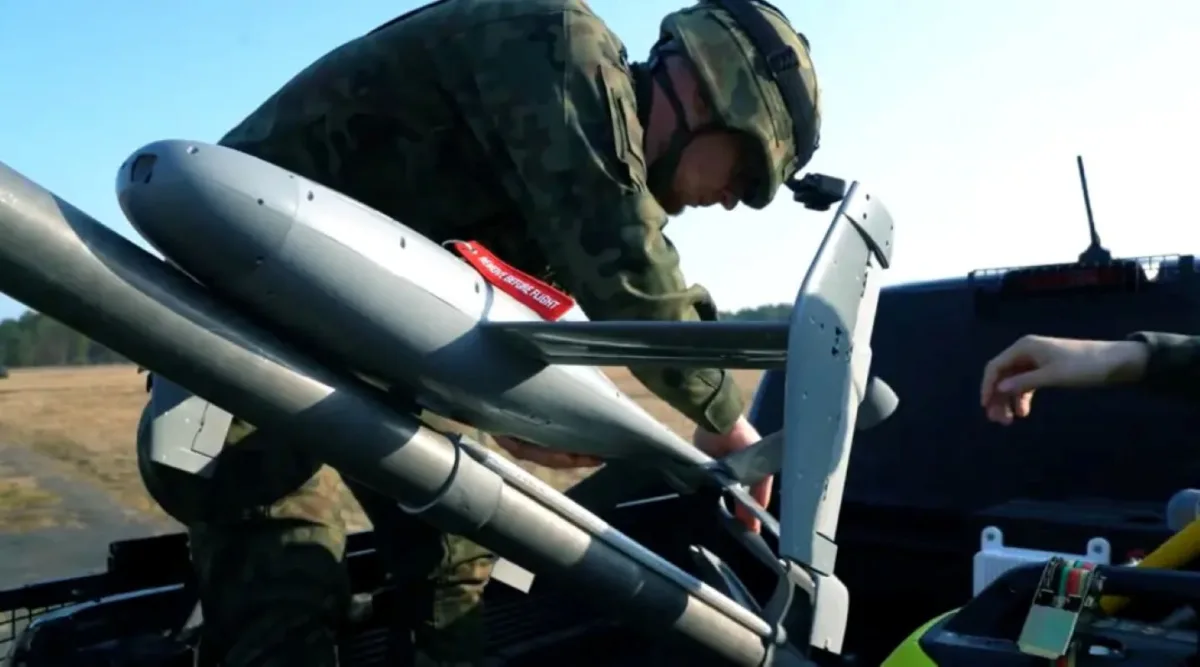

The Polish armed forces have initiated personnel training on the AS-3 Merops anti-drone defense system. This was announced by the Polish General Staff, explaining that the program includes comprehensive preparation involving theory, operational simulations, and practical activities, with the aim of gradually bringing operators to full readiness.
The decision comes in a rapidly evolving military context. The increasing spread of low-cost attack drones is forcing many countries to rethink their air defenses. In recent years, the use of platforms like the Iranian Shahed-136 has shown how relatively simple and inexpensive systems can still create serious problems, especially when launched in large numbers.
The issue is primarily economic. To shoot down low-cost drones, anti-aircraft missiles that are much more expensive are often used, with a cost-result ratio that is increasingly unsustainable. Poland also faced this scenario: in September 2025, when Russian drones entered its airspace, AIM-120 AMRAAM missiles were employed, which can have a unit cost between one and two million dollars, depending on the version and contract.

How the Merops System Works
To respond to this threat with a more flexible and less costly solution, Warsaw has focused on the Merops system, developed by the Californian company Project Eagle. According to reports, the system has already been successfully used in Ukraine.
The Merops consists of a ground control station, a launcher, and an interceptor drone called Surveyor-Interceptor-UAS. The latter is designed to detect, pursue, and neutralize hostile drones through a small explosive charge. The interceptor can reach a maximum speed of about 280 km/h and can operate both autonomously and under remote control.
One of the most important elements of the system is the target detection and engagement capability. Detection and the final interception phase occur through optical and infrared sensors, supported by artificial intelligence-based image analysis systems. This should allow the Merops to operate effectively even in environments disrupted by electronic countermeasures or GPS interference, a condition increasingly common in modern operational theaters.
Poland, which acquired the system in 2025, has integrated it into its anti-aircraft units on off-road vehicles. Each vehicle hosts the ground station, the interceptor drone launcher, and a target detection radar, creating a mobile solution that is quick to deploy and suitable for the protection of units and infrastructure.

The Next Steps of the Polish Program
According to the Polish armed forces, the training on the AS-3 Merops has been organized in multiple phases, to accompany operators from initial training to full operational deployment. The goal is to build a concrete capability against a threat that, in recent years, has become increasingly significant in contemporary conflicts.
The next step will be the certification of units with live ammunition, scheduled between May and June 2026 at the Polish Air Force range in Ustka. The exercises will serve to verify personnel readiness in conditions close to reality and to field-test the system's operational procedures.
Warsaw also emphasized that the training program was developed based on lessons learned from recent conflicts, with particular attention to the experience gained in Ukraine and the Middle East. In the commissioning of the Merops, both the technical data provided by the manufacturer and the observations collected in the field and feedback from operators with direct experience were considered.
The start of training on the AS-3 Merops system thus confirms Poland's intention to strengthen its drone countermeasures capabilities with more mobile, specific, and sustainable tools compared to traditional missile systems. In a scenario where low-cost unmanned aircraft have taken on an increasingly central role, equipping with dedicated solutions is now an operational necessity.



Comments
No comments yet. Be the first!