



The Oreshnik has entered the European debate after its first combat use on November 21, 2024 against Dnipro. Various open-source reconstructions describe it as an IRBM class weapon and associate it with a possible multiple payload (multiple re-entries/warheads), a detail that makes interception much more complex.
The question “which missiles can intercept it?” does not have a “list” answer: the complete technical data is not public, and there are no confirmed interceptions against Oreshnik. What can be done is to understand in which phase of the flight an engagement can be attempted and why some interceptors are more suitable than others.
The phases of a ballistic missile trajectory (and where it can be intercepted)
A ballistic missile follows fairly standard phases: boost, post-boost (final maneuvers of the “bus” and possible release of warheads/decoys), midcourse (longest segment, often in “near space”/space), terminal (re-entry and descent towards the target).
- Boost-phase: intercepting while the engines are thrusting is the “ideal” solution because it neutralizes the vector before it releases the payload, but it requires sensors and interceptors very close to the launch point.
- Post-boost/separation: if the threat is multi-object, release can occur here; after separation, the defender must manage multiple targets (and potential decoys).
- Midcourse (exo-atmospheric): it is the “strategic shield” window for MRBM/IRBM, as it allows engagements at very high altitude or in space with hit-to-kill interceptors; theoretically, it is also the most suitable window to reduce the risk of “multiplication” of targets.
- Terminal: it is the last belt, closest to the target; speeds are very high and, if there are multiple re-entries, the pressure on radars and interceptor stocks increases significantly.

The most suitable interceptors and why
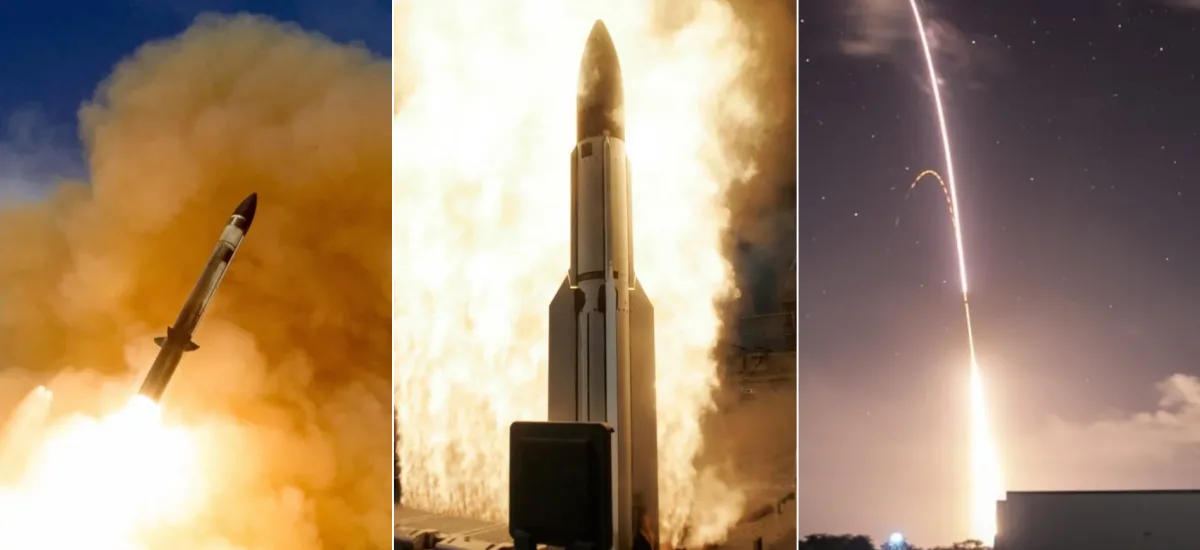
SM-3 (especially Block IIA). It is the “high layer” interceptor of the Aegis/Aegis Ashore architecture for midcourse/exo-atmospheric engagements against ballistic threats up to the MRBM/IRBM class: for an Oreshnik-type profile, the idea is to hit “high” with hit-to-kill, maximizing the probability of neutralizing the threat when it is still more “manageable”. Manufacturers: Raytheon/RTX (United States); for Block IIA co-development/co-production with Mitsubishi Heavy Industries (Japan).
Arrow-3. It is an explicitly “upper tier” system, designed for exo-atmospheric interceptions: thus, to recall the logic, it aims to stop ballistic threats at very high altitude, where the engagement is more consistent with the anti-IRBM requirement and the goal of reducing the complexity associated with multiple payloads. Manufacturers: Israel Aerospace Industries – IAI (Israel); industrial partner Boeing (United States).
THAAD. It is a hit-to-kill designed primarily for the high-altitude terminal phase (with capabilities between the end of the atmosphere and “near space”): it can be an important layer in a layered defense, but compared to SM-3/Arrow-3, it operates closer to the final phase, where a possible payload separation can make engagement more challenging. Manufacturer: Lockheed Martin (United States).
Patriot (PAC-3 MSE / GEM-T). It is a very widespread point defense and can contribute in terminal against some ballistic threats, but it is not designed as a “high layer” anti-IRBM: it is more of a last belt to protect specific assets/areas with narrower engagement windows. Supply chain: PAC-3 MSE interceptor by Lockheed Martin (United States); system components and radar historically linked to Raytheon/RTX (United States).
SAMP/T – Aster 30 (including evolutions like Block 1NT). It is a key European component for air defense and some ballistic threats, but remains more “terminal/endo-atmospheric” compared to pure exo-atmospheric interceptors: useful as an additional layer, less “specialist” for midcourse anti-IRBM. Manufacturers: eurosam (France/Italy) as prime contractor; with MBDA (multinational European group) and Thales (France) in the industrial perimeter.
SM-6. It is a multi-role missile with ballistic defense capabilities also in the terminal phase in some profiles (not a pure midcourse like SM-3): it can contribute in Aegis architectures especially as a terminal layer, but it is not normally the first choice if the goal is an anti-IRBM “high up”. Manufacturer: Raytheon/RTX (United States).

Who can be considered “ready” today in Europe (and with which systems)
On paper, the most consistent candidates with a complex IRBM profile remain Arrow-3 and SM-3, because they operate in the “high layer” (midcourse/exo-atmospheric). But looking at what is already present and declared operational/deployed in Europe, the picture narrows: Germany (with Arrow-3) and Romania and Poland with SM-3 through the Aegis Ashore land sites.



Comments
No comments yet. Be the first!