


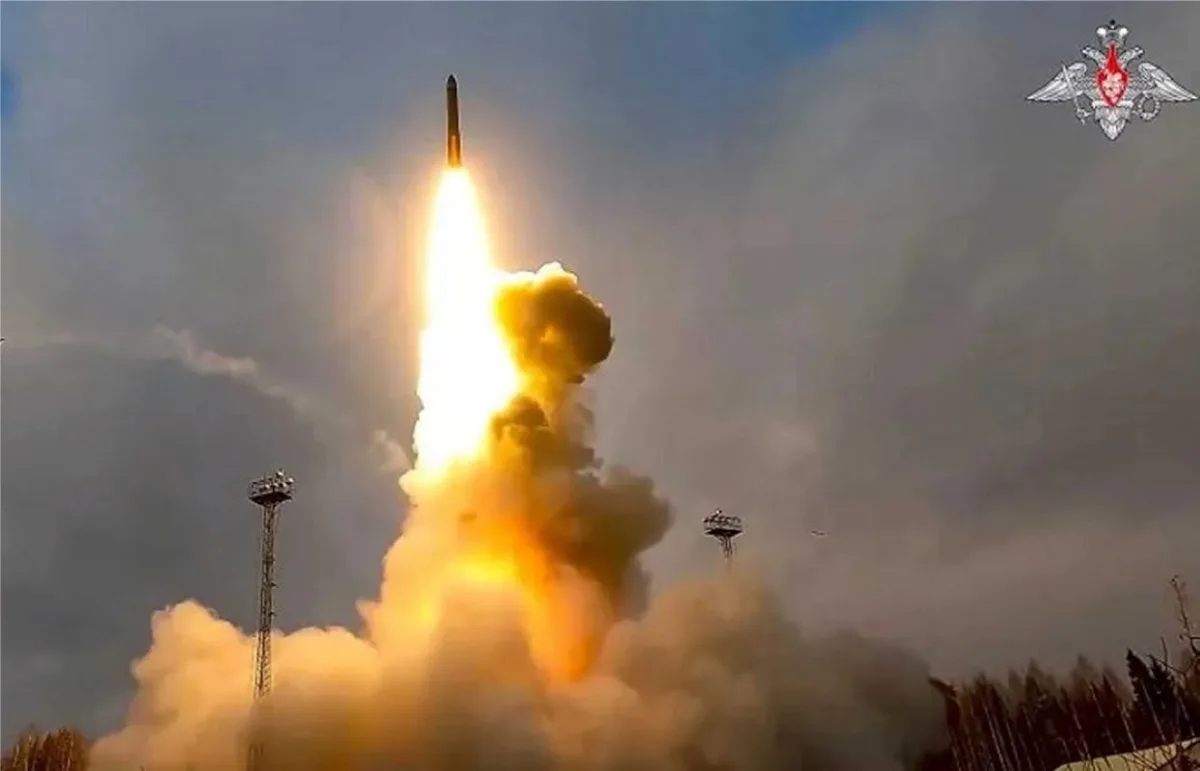

At the end of December 2025, Russia and Belarus showcased the operational deployment of the Russian missile system Oreshnik on Belarusian territory, presenting it as a “combat-ready” and dual-capable asset (usable with conventional or nuclear warheads). This does not automatically imply that nuclear warheads are physically present in Belarus: the launch component can be “nuclear-capable” even without the warheads being on site.
From a strategic standpoint, the “advanced” deployment compresses decision-making times, increases pressure on NATO's eastern flank, and enhances the credibility of a short-notice threat towards Europe. Analyses based on commercial satellite images have indicated a former airbase in eastern Belarus (Krichev area) as a possible reference area, where elements consistent with missile infrastructure have rapidly appeared.

What is the Oreshnik (and why “hypersonic” should be interpreted)
Oreshnik is described in many accounts as an intermediate-range ballistic missile (IRBM). The term “hypersonic” is somewhat misleading: ballistic missiles typically reach hypersonic speeds upon reentry. In the case of Oreshnik, Russian/Belarusian authorities have mentioned speeds around Mach 10; Ukrainian sources, after the first use, indicated very high speeds (in the order of tens of thousands of km/h upon reentry).
In parallel, another element has emerged in the Western media debate: according to an article by Sabrina Provenzani (“Oreshnik, Putin's missile developed thanks to the West”), the industrial supply chain necessary to produce high-precision components for the program still relies on technologies and CNC controls from Western and Japanese companies (including Siemens, Heidenhain, and Fanuc), despite sanctions and export controls.
A significant aspect, highlighted in Western analyses after the 2024 use, is the presence of a release section (“bus”) capable of distributing multiple reentry bodies (a strategic deterrence logic and potential saturation).
Range: 5,000 or 5,500 km?
There are two main values circulating regarding the range:
- up to 5,000 km, reported by Belarusian communications picked up by international agencies;
- up to 5,500 km, a recurring estimate in accounts that place it in the upper range of IRBMs and link it (technically or conceptually) to previous Russian programs.
Practically speaking, from Belarus, a range of 5,000–5,500 km means potential coverage of most of Europe, with flight times in some cases shorter than launches from more internal regions of the Russian Federation.

Trajectory: where it might be more vulnerable (in theory)
The typical profile of an IRBM is divided into three phases:
- Boost (initial acceleration): very short; intercepting here requires assets very close to the launch point.
- Midcourse (space/high altitude segment): this is the phase where, according to some analyses, the “bus” may theoretically be more exposed to an exo-atmospheric interception, if adequate sensors and interceptors exist.
- Terminal (reentry): very high speed; potential multiple bodies and associated objects complicate defense.
In the case of the demonstrative attack on November 21, 2024 on Dnipro, various accounts indicated the presence of multiple warheads without explosives (or “dummy”), with limited effects: a political-strategic signal rather than an attempt to maximize conventional damage.
Accuracy: many estimates, few verifiable data
The real accuracy is one of the least transparent points. Generally, the IRBM/strategic family prioritizes penetration and deterrence over conventional “surgery.” Various analyses (comparative and unofficial) suggest that accuracy could be in the order of tens or hundreds of meters CEP for similar or conceptually “related” systems: values adequate in a nuclear role (where the energy of the warhead is paramount), less decisive for hitting pinpoint targets with only conventional warheads.
Possible targets: categories, not “lists”
Talking about “targets” makes sense only for categories of strategic and military objectives that become more exposed when a mobile IRBM is deployed forward:
- air bases, depots, and logistical nodes;
- command and control centers and communication infrastructures;
- missile defense installations and sensors (for operational and symbolic value).
It is also in this context that the full operational capability of European sites linked to missile defense (like Aegis Ashore) becomes significant, frequently mentioned in public debate and deterrence narratives.

Interception: not “impossible,” but difficult and phase-dependent
Claims that Oreshnik is “impossible to intercept” should be read as a political message. From a technical standpoint, intercepting an IRBM is theoretically possible, but the difficulty increases due to:
- very high reentry speeds;
- possible use of multiple reentry bodies and/or associated objects (saturation and discrimination);
- the need for a complete chain of sensors → tracking → engagement → interceptors with adequate geographical coverage.
In Europe, the discussion revolves around the combination of existing capabilities (including Aegis Ashore components) and programs in development or acquisition (e.g., high-end systems like Arrow), as well as assessments that exo-atmospheric interception “in volume” remains primarily a U.S. strength.



Comments
No comments yet. Be the first!