


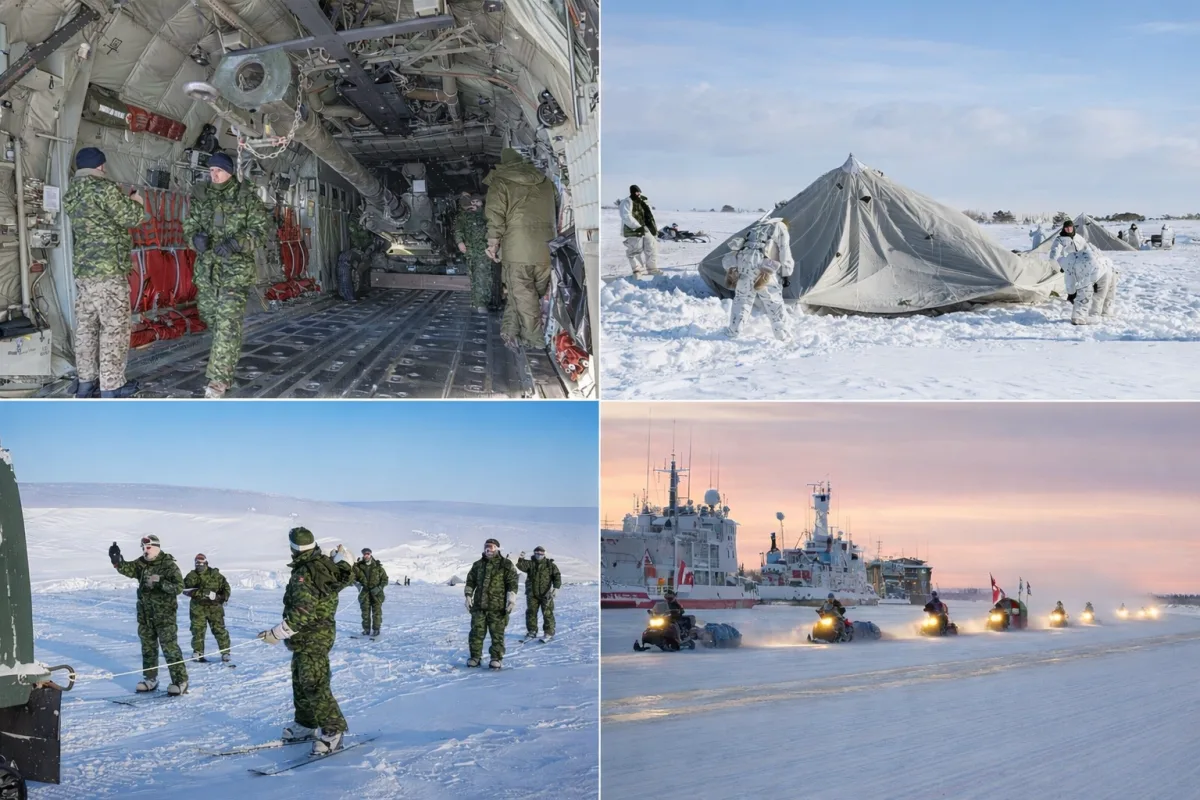

The Arctic is no longer a “blank spot on the map”: the melting ice extends the navigation window, makes resources and routes more accessible (primarily the Northwest Passage), and, above all, raises the line of contact between deterrence, surveillance, and competition among powers. In this context, Operation NANOOK-NUNALIVUT 2026 (Op NA-NU 26) takes place, the exercise with which Canada is showcasing – and practicing – its Arctic sovereignty.
Op NA-NU 26: Sovereignty as presence, logistics, and interoperability
According to the report published by the Western Sentinel (information platform of the Canadian Department of Defense), the 3rd Canadian Division has deployed about 750 military personnel and nearly 200 vehicles/equipment (including two M777 howitzers) in the Arctic theater for Op NA-NU 26. In total, up to 1,300 members of the Canadian Armed Forces participate along with allied personnel from the United States, Belgium, France, and Denmark: it is the largest CAF contribution to this specific iteration since the Op NANOOK series began (in 2007).

The operation takes place between February 14 and April 15, 2026 in the three Northern territories (Northwest Territories, Nunavut, Yukon), centered in the area of the Amundsen Gulf near Cambridge Bay. The idea is simple and very “Arctic”: if you want to defend and claim a vast space, you must know how to reach it, stay there, and coordinate with those who live there and those who support you. For this reason, Op NA-NU 26 combines long-distance movements, patrols, demonstrations, and tests in extreme conditions, maintaining the involvement of local communities and governments.
Among the most symbolic (and media “speaking”) details is the use of the 155 mm M777: according to the documentation cited in the article, it is the first time these artillery pieces are brought north of the 60th parallel and that a Canadian 155 mm system is fired so far north (Cambridge Bay is around 69°N, beyond the Arctic Circle). It's a way to say: we are not just “passing through,” we are verifying real deployment and employment capabilities even in the High North.

NANOOK: A Family of Operations to Cover a Gigantic Theater
Op NA-NU 26 is part of the Op NANOOK umbrella, an annual multi-domain series (land, air, sea, and increasingly cyber/space) involving the army, air force, navy, and Canadian Rangers. The stated goal is to assert sovereignty through “presence and surveillance”: presence and surveillance, the heart of deterrence in an environment where infrastructure and response times are everything.
A key element of this edition is also the “system” dimension: Joint Task Force (North), headquarters and land task forces, reservists, and Rangers. The long-range patrol (LRP) of the Rangers – about 4,500 km from the Yukon-Alaska border to Churchill (Manitoba), along sections linked to the Northwest Passage and Hudson Bay – reinforces the idea of sovereignty as continuity of control and inter-agency cooperation (with RCMP and Parks Canada).
The Canadian narrative of recent years is consistent: the Arctic is the natural “approach” to the continent and a place where physical geography (climate) and strategic geography (threats, technologies, competition) change together. The guideline is outlined in documents like “Our North, Strong and Free” and in official communications that speak of operating more persistently to detect, deter and defend against threats to Canada and North America.
This is where NORAD and the modernization of surveillance come into play: Canada is focusing on long-range radar and sensor systems (including the Arctic Over-the-Horizon Radar, with milestones and public analyses indicating a capability path towards the end of the decade).
From Canada to NATO: “Arctic Sentry” and the Growing Allied Posture in the High North
The increase in activity and attention is not only Canadian. In February 2026, NATO announced Arctic Sentry, a multi-domain activity to strengthen posture and presence in the “High North.” In parallel, specialized analyses and reports highlight how the Alliance is trying to make surveillance more continuous in a theater where Russia and new technologies (drones, sensors, electronic warfare) change the rules of engagement and surveillance.
Behind the image of convoys and artillery lies a less spectacular but decisive issue: infrastructure (ports, airports, communications, logistics) and the relationship with Northern populations. Security agencies also warn that the Arctic is a ground for informational and intelligence pressure, precisely because it is a rich and more accessible area.

And then there's the sea: icebreakers, patrol vessels, the ability to operate “four seasons.” In this sense, industrial and cooperative initiatives (such as programs related to icebreakers and shipbuilding chains among allies) also matter, because without hulls, maintenance, and support bases, sovereignty remains an abstract concept.
Op NA-NU 26 shows what it means today to “defend the Arctic”: not just training, but the ability for continuous presence, integration with allies (and frameworks like NATO and NORAD), and surveillance tools that reduce the distance effect. At the same time, the Arctic forces the integration of security and society: those living in the North are not the “background” of the operation, they are part of the problem and the solution. If global competition rises in latitude, sovereignty – Canadian and allied – is increasingly measured in kilometers traveled, sensors activated, real infrastructure, and cooperations that work when the thermometer drops below zero.


Comments
No comments yet. Be the first!