


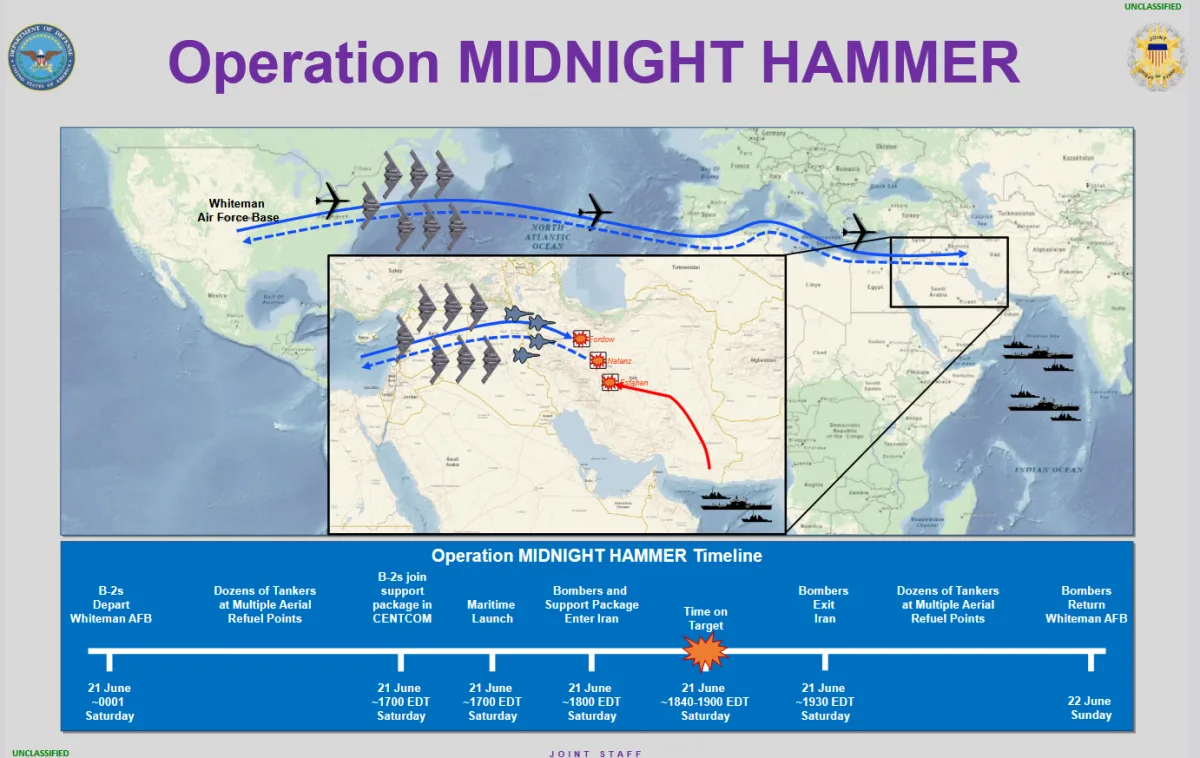

Washington, June 22, 2025 – In a surprise operation conducted with over 125 aircraft, a missile-launching submarine, and 30,000-pound bunker buster bombs, the United States launched a coordinated and unprecedented attack against three Iranian nuclear sites. The action, dubbed Operation Midnight Hammer, was described by the Pentagon as “an incredible and overwhelming success.”
Just hours after the bombings, Defense Secretary Pete Hegseth and Joint Chiefs of Staff Chairman General Dan Caine revealed the details of one of the most complex military missions ever conducted by the U.S. Central Command.
A precision operation planned for months
According to Caine, the attack began at midnight last Friday, when seven B-2 Spirit stealth bombers took off from Whiteman Air Force Base in Missouri, heading east with minimal communications. After 18 hours of flight, the bombers joined a support fleet composed of fourth and fifth-generation fighters, electronic warfare aircraft, and in-flight refuelers, executing a synchronized maneuver with extreme precision.

Simultaneously, a U.S. submarine in the Central Command area of responsibility launched over two dozen Tomahawk cruise missiles against strategic infrastructure at the Isfahan nuclear site. The action took place around 5:00 PM (Washington time), just before the B-2s entered Iranian airspace.
The role of the Massive Ordnance Penetrator
Once inside Iranian territory, U.S. aircraft used sophisticated deception tactics, including the use of high-speed decoys to confuse Iranian radar and air defenses. Escort fighters “cleared” the air corridor of any threats, allowing the operational core to strike deep.
The highlight of the operation was the operational use, for the first time in history, of the GBU-57 Massive Ordnance Penetrator (MOP), a 30,000-pound penetrating bomb capable of penetrating deeply bunkered structures. Two MOPs were dropped by the lead B-2 on the Fordo site, followed by an additional 12 bombs against multiple targets between Fordo and Natanz.
After the bombings, the Tomahawk missiles hit selected targets at the Isfahan site, completing the attack profile. General Caine confirmed that no U.S. aircraft were intercepted or hit and that the entire mission took place without Iranian forces being able to react.

Reactions and future scenarios
Congress was informed immediately after the aircraft were out of danger. The White House spokesperson stated that congressional leaders, including Sen. Chuck Schumer, were contacted before the operation. Only later was it possible to reach Representative Hakeem Jeffries.
Initial assessments speak of “extremely severe” damage inflicted on Iran's three main nuclear sites. According to the Pentagon, the success of the operation is the result of weeks of strategic positioning, detailed planning, and rigorous operational security measures.
“This was not a regime change operation,” Hegseth stated. However, President Donald Trump later wrote on Truth Social: “If the current Iranian regime cannot MAKE IRAN GREAT AGAIN, why shouldn't there be a regime change??? MIGA!!!”
Geopolitical implications
The action marks a turning point in U.S.-Iran relations, in a regional context already inflamed by the conflict between Israel and Tehran. The attack demonstrates the United States' unique ability to strike deeply underground nuclear infrastructure, while also reinforcing the political and military message directed at other international actors, such as Russia and China.
Now all eyes are on Tehran: the Iranian response could determine the escalation of a new conflict or the beginning of a long and unstable nuclear truce.



Comments
No comments yet. Be the first!