


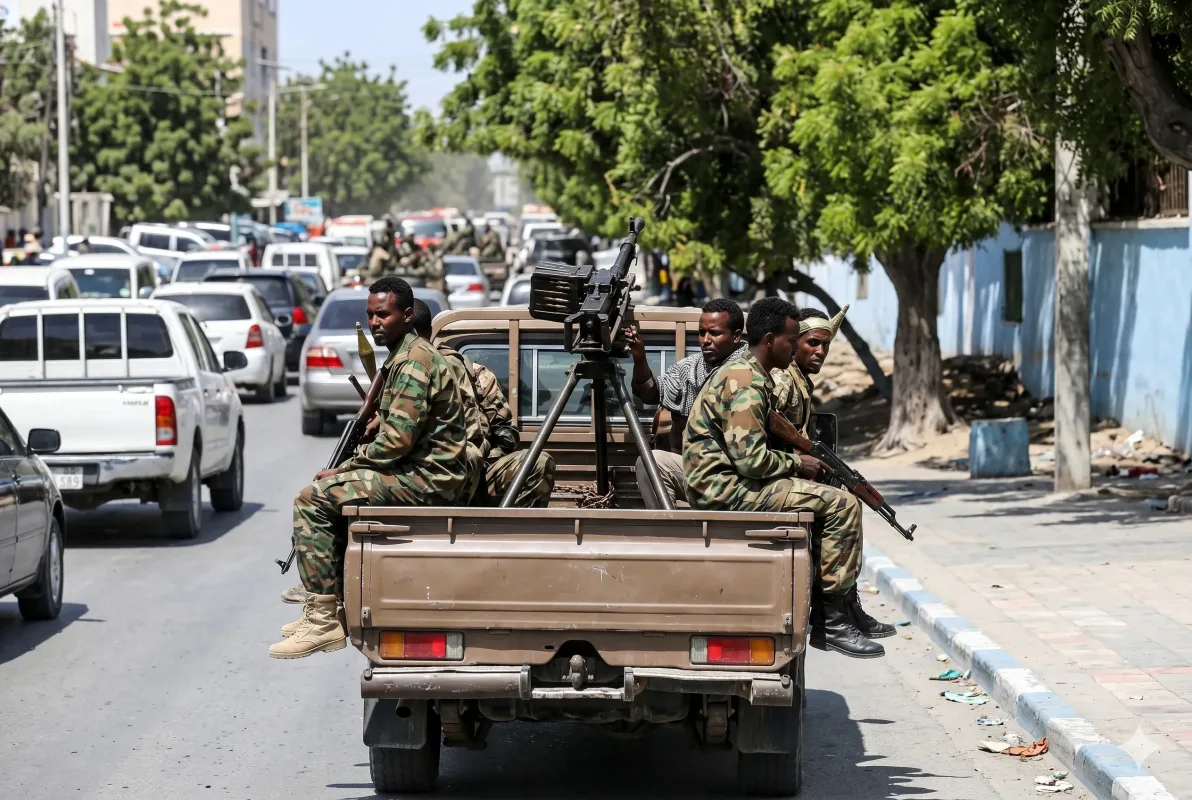

MOGADISHU — A bloody and tense Saturday in the city of Baidoa, in southern Somalia. Violent firefights erupted between government troops and militiamen loyal to a deposed regional leader, causing several casualties among fighters and civilians. The episode brings attention back to the institutional fragility of the African country, engaged in a difficult democratic transition just as intelligence and international contingents — including the Italian one — work to ensure a minimum of internal security.
The Battle for Baidoa
The fighting disrupted the neighborhoods of Baidoa, the capital of the South West State, when armed elements stormed in an attempt to take control of some strategic areas. According to military commander Hussein Ali, regular forces repelled the attack, counting on the ground the bodies of at least six assailants, described as "youth manipulated by politics." Local testimonies also report the death of at least two civilians, hit by stray bullets during the most intense phases of the shooting.
The spark of the conflict dates back to last March, when the federal army removed the former president of the regional state, Abdiaziz Hassan Mohamed Laftagareen. The latter had firmly opposed the constitutional reforms promoted by Somali President Hassan Sheikh Mohamud, which aim to extend the presidential mandate from four to five years and introduce direct universal suffrage for the election of parliamentarians, dismantling the old clientelistic system based on indirect selection by clans. Saturday's unrest erupted just as the city was preparing for the swearing-in of the members of the new regional legislature, elected last May 10.
Italy's Role: The MIADIT Mission and the Training of Somali Forces
The constant instability in key cities like Baidoa demonstrates how crucial international support is for the survival of the Somali state. In this geopolitical chessboard, Italy has played a leading role for years through bilateral and multilateral missions aimed at rebuilding local institutions.

The Italian Presence in Somalia
The cornerstone of Rome's commitment is the MIADIT Somalia (Italian Mission for the Training of Somali Police Forces), an initiative led by the Carabinieri. The main objective is to train and educate the personnel of the Somali Joint Police Force, providing them with skills in territorial control, counter-terrorism, and public order management. This is complemented by Italian participation in European Union missions, such as EUTM Somalia (for army training) and EUCAP Somalia (for strengthening maritime security capabilities).
Without this work of training and capacity building (development of institutional capacities), the Somali army and police would not have the resources to curb the backlash of deposed regional leaders nor to contain the pervasive threat of Al-Shabaab, the jihadist group that still controls large portions of the country.
A Fragile and Divided Democracy
Somalia's path towards fully democratic elections remains uphill. President Mohamud's official mandate expired last May 15 without political forces reaching a definitive agreement on the modalities of the next general consultations.
While the central government declares that the country is in a "transition period," the reality on the ground shows a nation deeply divided between the modernizing pushes of Mogadishu and the resistance of local clans, ready to take up arms rather than lose their historical influence and autonomy.


Comments (1)