


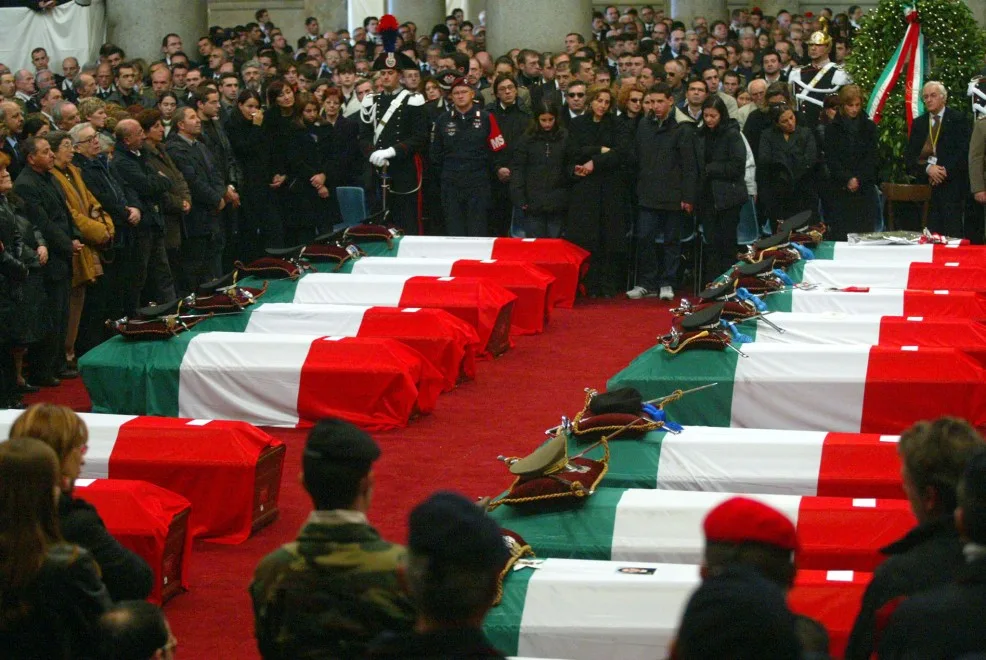

Twenty-two years later, Italy gathers in remembrance of the Nassiriya massacre, the most severe attack suffered by our contingents abroad since the end of the Second World War. It was November 12, 2003, at 10:40 local time, 08:40 in Italy, when a tanker truck loaded with explosives was detonated in front of the entrance to the “Maestrale” base of the MSU (Multinational Specialized Unit) of the Carabinieri in the town center of Nassiriya. The shock wave, followed by the explosion of the ammunition depot, caused 28 victims: 19 Italians and 9 Iraqis, in addition to dozens of injured.
On that morning, Appuntato Andrea Filippa, on guard at the main gate, managed to neutralize the two attackers: the vehicle did not penetrate inside the barracks and exploded at the gate, preventing an even more catastrophic outcome. The first aid came from the Carabinieri themselves, the newly formed Iraqi police, and the city's civilians.

The operational context
The Command of the Italian Joint Task Force (IJTF) operated about 7 km from Nassiriya, at the “White Horse” base, not far from the U.S. command in Tallil. The MSU/IRAQ, composed of Italian Carabinieri and Romanian Gendarmerie (with the addition, from the end of November 2003, of 120 men from the Portuguese Republican National Guard), was stationed at two bases in the city center:
- Maestrale (known as Animal House), headquarters of the maneuver unit;
- Libeccio, where the MSU Battalion and the MSU/IRAQ Regiment Command were located.
The choice to remain in contact with the population — unlike the Army, which was more secluded for security reasons — was dictated by the stability policing mandate of the MSU.
The attack and its consequences
The explosion reduced Maestrale to a skeleton of concrete and also damaged the nearby Libeccio base. Among those involved were the crew of director Stefano Rolla, in the city to shoot a drama about the reconstruction entrusted to the Italians, and Army soldiers escorting them.
Two months later, the Carabinieri Regiment also left Libeccio, moving to Camp Mittica at the former airport of Tallil, 7 km from Nassiriya.
The Italian victims
Carabinieri
- Giovanni Cavallaro, Second Lieutenant
- Filippo Merlino, Second Lieutenant
- Enzo Fregosi, Warrant Officer
- Massimiliano Bruno, Chief Warrant Officer
- Alfio Ragazzi, Chief Warrant Officer
- Alfonso Trincone, Chief Warrant Officer
- Daniele Ghione, Chief Warrant Officer
- Giuseppe Coletta, Brigadier
- Ivan Ghitti, Brigadier
- Domenico Intravaia, Deputy Brigadier
- Andrea Filippa, Appuntato
- Horacio Majorana, Appuntato
Italian Army
- Massimo Ficuciello, Captain
- Silvio Olla, Chief Warrant Officer
- Alessandro Carrisi, First Corporal Major
- Emanuele Ferraro, Chief Corporal Major Chosen
- Pietro Petrucci, Corporal Major
Civilians
- Marco Beci, International Aid Worker
- Stefano Rolla, Director
The Fallen came from various territorial and mobile units of the Carabinieri (including 13th Carabinieri “Friuli Venezia Giulia” and 7th Carabinieri “Trentino-Alto Adige”) and from Army units (Regiment Lagunari “Serenissima”, Brigade Folgore, 66th Airborne Infantry Regiment “Trieste”, Savoia Cavalleria, Regiment Trasimeno, soldiers from the Brigade “Sassari” escorting the crew and 3 from the 6th Transport Regiment of the Projection Logistics Brigade escorting aid worker Beci).

Italy's farewell
The chapel of rest was set up at the Sacrario delle Bandiere del Vittoriano, where a long pilgrimage of citizens took place. The State funerals, held on November 18, 2003 in the Basilica of St. Paul Outside the Walls and officiated by Cardinal Camillo Ruini, saw the presence of the highest state authorities and a moved popular participation estimated at about 50,000 people. On this occasion, a national day of mourning was declared.
Memory and significance
Nassiriya is wound and memory. It is the symbol of the price paid by those who work for security, stability, and reconstruction in complex contexts, with tasks ranging from territorial control to proximity policing, from civilian protection to support for local institutions.
Twenty-two years later, the duty of remembrance joins the commitment to transmit the values that those military and civilians embodied: courage, professionalism, responsibility, service.



Comments
No comments yet. Be the first!