


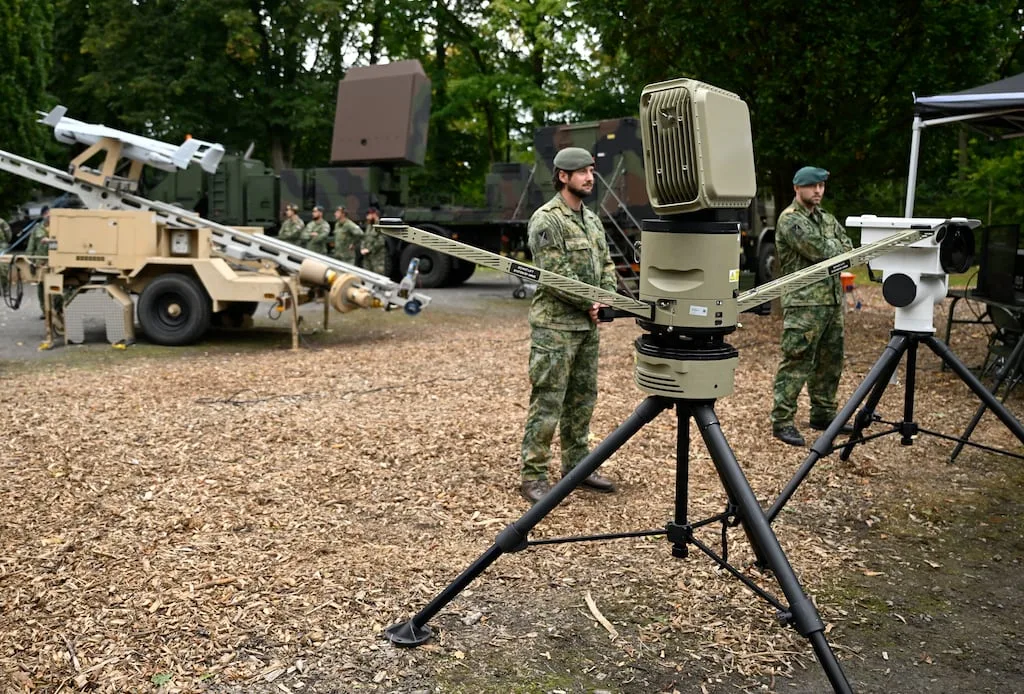

Faced with the exponential growth of the drone threat on the battlefield, the Netherlands has announced the creation of a new mobile anti-drone system by assembling components already available on the market. This is a temporary but necessary solution, designed to protect infantry units until the arrival of the more advanced Rheinmetall Skyranger 30, whose deliveries will only begin in 2028.
An urgent need: bridging the C-UAS gap
According to the Secretary of State for Defense, Gijs Tuinman, the Dutch Army needs rapidly deployable C-UAS capabilities in response to a threat now widespread on modern fronts. In a letter addressed to Parliament, Tuinman emphasized that the new systems are part of an additional spending plan ranging from 1 to 2.5 billion euros dedicated to anti-drone countermeasures.
The decision comes as drones in Ukraine are now responsible for most frontline losses, prompting European armed forces to seek emergency solutions while awaiting more sophisticated platforms. France, for example, has recently created the Proteus system, a hybrid solution obtained by mounting a 20 mm anti-aircraft gun from the 1970s on a 4×4 truck from the 1980s.
A system “stitched” with ready-to-use components
The new Dutch system will be built using various existing military components:
- Wheeled armored vehicles
- Remote-controlled weapon stations (RCWS)
- Combat management systems
- Dedicated ammunition
The Ministry of Defense has stated that, for now, details on numbers, timelines, or suppliers will not be disclosed for operational security reasons. However, it is confirmed that new systems will be purchased and the choice of the company responsible for integration is still ongoing.
The Netherlands has already ordered 22 Skyranger 30, which will enter service from 2028. The new “hybrid” anti-drone systems will remain operational even after the arrival of the Rheinmetall anti-aircraft guns.
Unknown drones in European skies: a growing phenomenon
The announcement comes at a delicate time: incidents of unidentified drones are increasing across Europe. In recent months, Romania, Poland, and several other NATO countries have reported incursions attributed – directly or indirectly – to Russia.
Over the weekend, the Netherlands also detected unknown drones over the Volkel airbase and Eindhoven airport.
Tuinman described these incidents as “worrying developments,” highlighting the need to accelerate the adoption of specific defense systems.
A broad strategy: radars, armed vehicles, and interceptor drones
In addition to the mobile anti-drone system, the Netherlands will invest in:
- IRIS radars for drone detection
- Off-road patrol vehicles with integrated RCWS turret
- Portable and vehicle-mounted C-UAS systems
- Interceptor drones to neutralize aerial threats
Simultaneously, the Royal Netherlands Navy will receive new “hard-kill” C-UAS systems: a capability currently lacking, as ships almost exclusively have “soft-kill” countermeasures (such as jamming) or expensive and limited kinetic weapons (missiles).
According to Dutch Defense, the future naval system will need to position itself between close-range small-caliber defense and long-range missiles, filling a critical gap in protection against medium-range drones. The planned investment ranges from 250 million to 1 billion euros, with further details expected in the spring of 2026.
Conclusion
The Dutch initiative confirms an increasingly evident reality: Europe is racing against time to protect troops and infrastructure from a threat growing faster than the available technological solutions.
The creation of a mobile anti-drone system “assembled” with existing components is not just a temporary measure, but a signal of the speed with which European armies must adapt to a battlefield dominated by small, economical, and pervasive threats.



Comments
No comments yet. Be the first!