


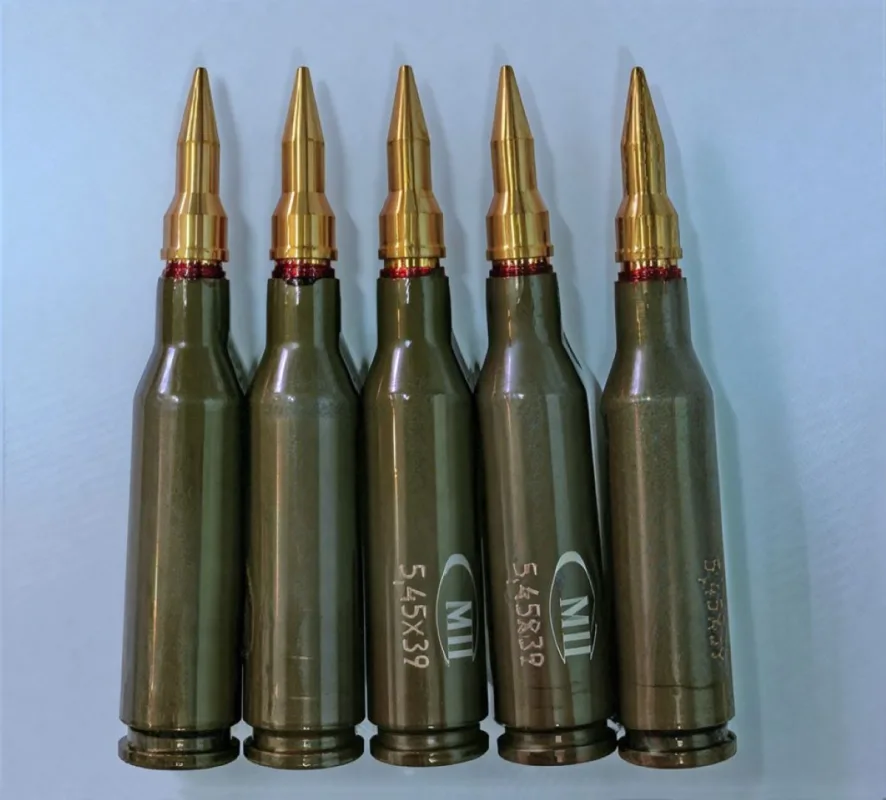

The Russian state conglomerate Rostec has announced the imminent introduction of a new type of anti-drone ammunition intended for infantry units engaged in the field. These are the Mnogotochie cartridges, developed by the holding High Precision Systems, specifically designed to counter small low-altitude Fpv drones, now central to the dynamics of modern combat.
Unlike the improvised solutions adopted so far — often based on smoothbore weapons or adapted buckshot ammunition for assault rifles — the new ammunition is created with a clear objective: to provide soldiers with an organic, immediately available option compatible with standard service weapons, such as the Ak series rifles and Pkm machine guns.
The technological core of these cartridges is the “Triplex” construction: three bullets housed in sequence in the same casing that exit the barrel together and then separate a few meters from the muzzle. This scheme significantly increases the probability of intercepting the target, without compromising the ability to use sound suppressors, a detail far from secondary in close operations.
In a context where Fpv drones are used both for reconnaissance and direct attacks against infantry, the ability to react in a few seconds can make the difference. For this reason, Rostec emphasizes that the Mnogotochie do not require modifications to weapons or changes in training procedures, an essential requirement in light of the operational pace and logistical constraints weighing on deployed units.
From American Experiments to the Russian Solution
The concept of “duplex” and “triplex” ammunition is not new. Already in the 1950s, experiments were conducted in the United States aimed at increasing the probability of hitting the target in close combat. The first cartridges, made in .30-06 Springfield calibers and later 7.62×51, aimed to compensate for shooting inaccuracy under stress through the multiplication of bullets per single shot.

Despite technically interesting results, those programs were shelved, also due to the evolution of operational doctrines and the introduction of new weapon systems. Today, more than seventy years later, Moscow resumes that conceptual line, adapting it to a radically different scenario dominated by cheap drones, widespread sensors, and sudden threats from above.
The Mnogotochie family includes two main variants: the Sc 226 in 5.45×39 caliber and the Sc 228 in 7.62×54. According to the manufacturer, both guarantee an effective range of up to 300 meters, a value significantly higher than previous solutions based on buckshot for assault rifles, which were limited to around 100 meters. This means being able to engage an Fpv before it enters its optimal attack window, expanding the infantry's reaction margin.
Tactical Impact and Operational Advantages
On the operational level, the introduction of the Mnogotochie offers a concrete advantage: the soldier can carry these munitions in a dedicated magazine, ready for use as soon as an aerial threat is detected. A quick replacement is sufficient to switch from standard ammunition to anti-drone, without having to resort to a separate pump-action rifle or additional equipment.
The result is a reduction in individual load while preserving the primary configuration of the weapon. In other words, the anti-Fpv capability is directly integrated into the ordinary equipment of the infantryman, without altering its basic operability.

From a doctrinal point of view, this choice reflects an increasingly evident trend: bringing drone defense back to the squad and platoon level, integrating it into light weapons rather than delegating it exclusively to specialized systems. The Mnogotochie thus represent a pragmatic response to an asymmetric threat, exploiting a technologically simple but tactically targeted solution.
It now remains to assess the actual effectiveness in the field and the speed of large-scale distribution. The signal, however, appears clear: in contemporary warfare, even the individual infantryman must be able to counter the dominance of drones, and any solution that increases their survival immediately assumes a strategic value.



Comments
No comments yet. Be the first!