


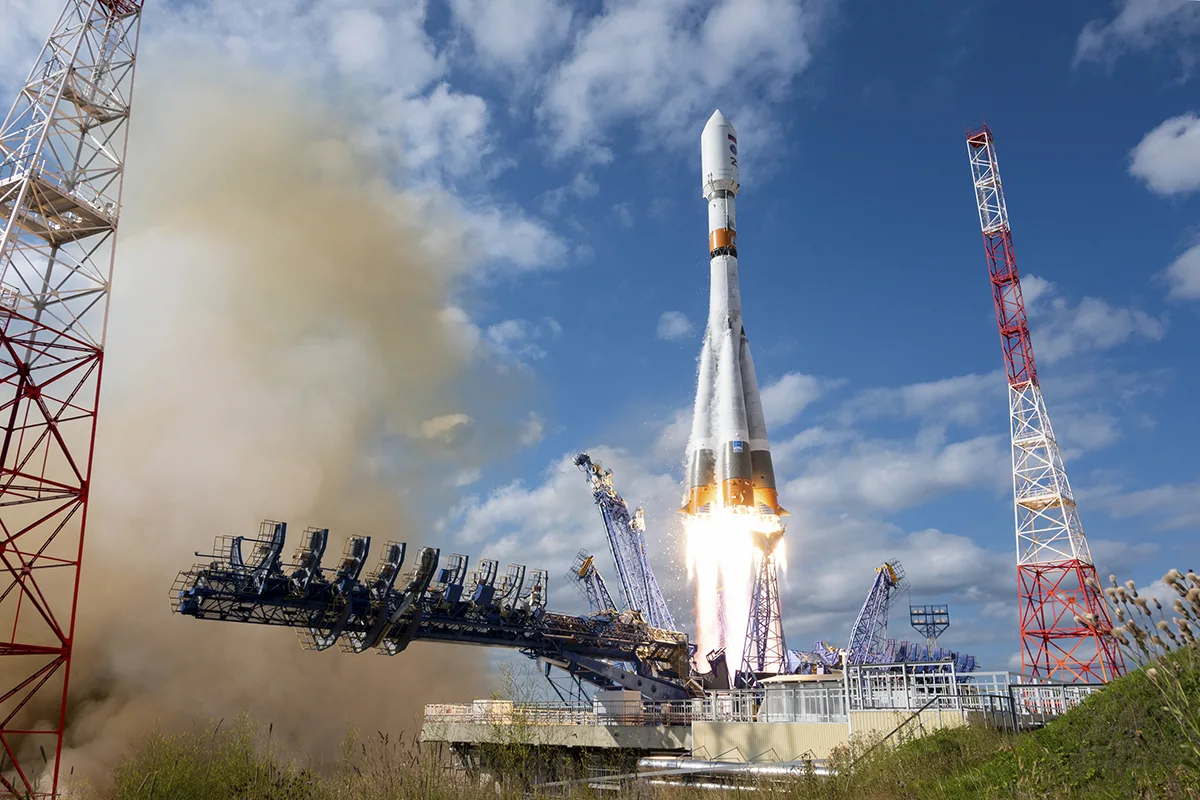

March 23, 2026 marks a turning point for Russian technological autonomy. With the launch of 16 satellites by Bureau 1440, the Kremlin accelerates the Rassvet project, aiming to break the Western monopoly on broadband communications in low Earth orbit (LEO).
The "old" but tireless Soyuz 2 (the Zemiorka of Soviet school) has once again confirmed its reliability. Launched from the Plesetsk cosmodrome last Monday, the rocket successfully placed 16 communication satellites belonging to the Russian company Bureau 1440 into orbit. This was not a routine launch, but the official transition from the experimental phase to the operational phase of the Rassvet (Dawn) program.

The Goal: A Sovereign Infrastructure
The Rassvet project represents Russia's response to the dominance of SpaceX. Although the numerical gap with Starlink — which now boasts over 10,000 assets in orbit — remains vast, Moscow's move has a distinctly strategic significance.
In a context of international isolation and sanctions, Russia needs a communication infrastructure that is:
- Independent: Unlinked from Western suppliers.
- Resilient: Capable of providing broadband coverage across the vast territory of the Federation.
- Dual: Usable for both the civilian economy ("Data Economy") and for security and defense purposes.
The Kremlin is sparing no expense to regain lost ground. The federal budget includes an allocation of 102.8 billion rubles (about 1.14 billion euros), supported by massive private investments exceeding 300 billion rubles.

Program Numbers:
- Target 2027: Start of commercial operations with the first 250 satellites.
- Target 2035: Completion of the constellation with over 900 satellites in low Earth orbit.
The Military Dimension: The Lesson from Ukraine
Russia's urgency to deploy its own LEO network stems directly from lessons learned on the battlefield. The role of Starlink in the Ukrainian conflict has shown how low-latency satellite constellations are not just commercial tools, but decisive assets for real-time command and control (C2), drone guidance, and the resilience of tactical communications.
With the successful launch on March 23, Russia attempts to reclaim the technological primacy that, since the days of Sputnik 1, seemed to have faded due to chronic budget shortages and post-Soviet management issues.
The competition for low Earth orbit is no longer just about the USA and Russia. While China accelerates its own "G60" and "Guowang" programs, and Europe consolidates the OneWeb network (about 630 satellites), the global defense sector watches closely. Whoever dominates orbital connectivity holds, in fact, the keys to power projection in the 21st century.
Moscow is back in the game, but the challenge against Elon Musk's industrial efficiency and Beijing's production capacity has just begun.



Comments
No comments yet. Be the first!