


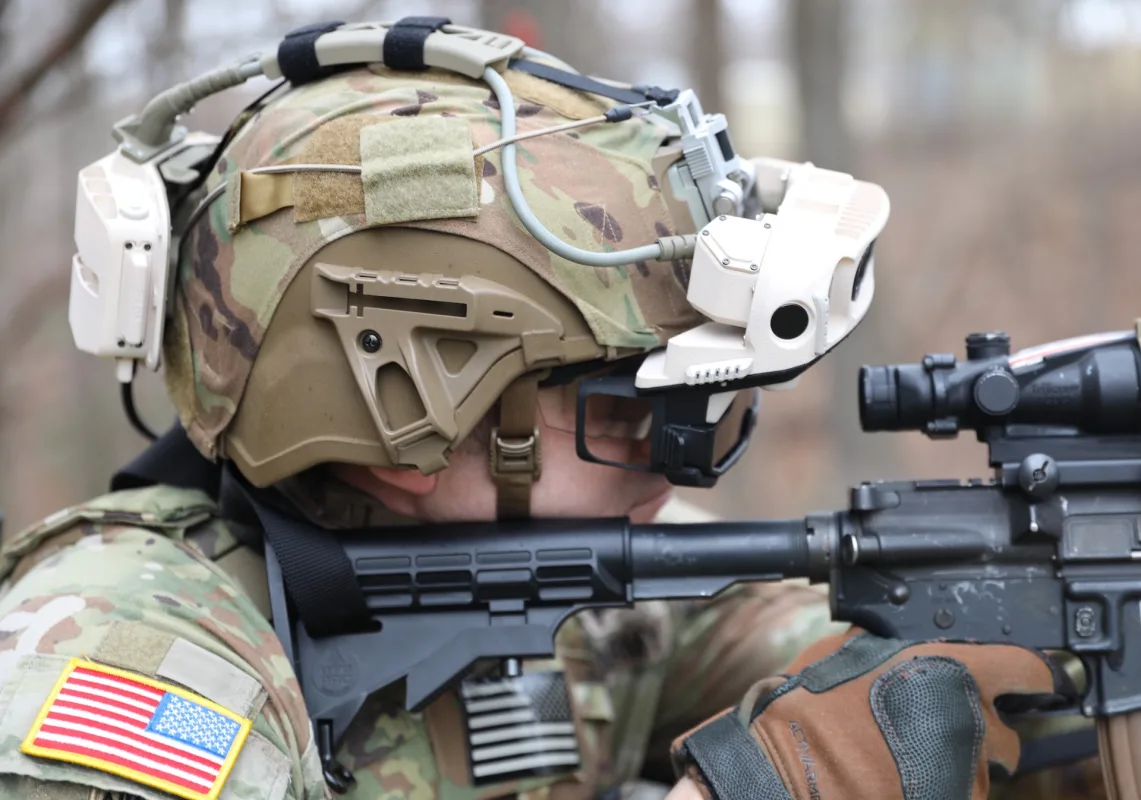

A futuristic helmet for the battlefield. This is the goal of the partnership between Meta – the giant led by Mark Zuckerberg – and Anduril Industries, the company founded by Palmer Luckey, already creator of Oculus Rift. A revolutionary agreement aiming to merge augmented reality (AR), virtual reality (VR), and artificial intelligence (AI) into a single cutting-edge military operating system, giving life to the EagleEye program.
The return of Luckey with Meta: from Oculus to defense
Palmer Luckey, ousted from Facebook in 2017, now returns as a strategic partner in an operation that could redefine the boundaries of technological warfare. According to the Wall Street Journal (WSJ), Anduril and Meta have already submitted a joint proposal for a $100 million contract with the United States Department of Defense. This initiative is part of a broader $22 billion plan aimed at providing wearable headsets for American soldiers.

The goal? To transform the visual and cognitive experience on the field, providing military personnel with a “digital layer” that enhances situational awareness, allows detection of threats invisible to the naked eye, and interacts with autonomous systems without diverting attention from the real environment.
EagleEye: an AI-powered military headset
The EagleEye system, officially announced on Anduril's website (Anduril.com), is an AR/VR helmet equipped with advanced sensors, artificial intelligence capabilities, and extended reality tools. The device is designed to merge real images with digital data in real-time: enemy movement patterns, drone tracking, assisted navigation, facial recognition.
Anduril's Lattice software platform, already used to coordinate autonomous systems on land, air, and sea, will be integrated with Meta's Llama AI models, creating a single cognitive interface for the military operator. Meta, for its part, will also provide technologies developed by its Reality Labs, including biometric sensors and advanced eye-tracking systems.
A self-funded project to reduce costs for the Pentagon
One of the most significant aspects of this partnership is that the program has been entirely funded with private capital, without direct government support. This strategic choice allows for accelerated technological development, reducing time and costs for potential future adoption by the armed forces.

According to Anduril, the EagleEye project can be rapidly implemented without the typical delays of public contracts. Moreover, its modular nature will allow adaptation to different operational scenarios: from special forces to peacekeeping missions, to training in simulated reality.
The takeover in the IVAS program: Microsoft passes the baton
But the collaboration with Meta is not the only front on which Anduril is advancing. In February 2025, the company took over the ambitious IVAS (Integrated Visual Augmentation System) program of the U.S. Army, previously entrusted to Microsoft (Reuters).
Anduril will now oversee the development, production, and delivery timelines of the AR/VR headsets for U.S. units. Microsoft will continue to provide cloud support through Azure, but Anduril will define the technological evolution of the platform.
This move represents a paradigm shift: while companies like Microsoft show signs of slowing down in the transition to military defense, more agile entities like Anduril are positioning themselves to become the true protagonists of the digital warfare future.

A network of tech alliances for informational supremacy
Anduril is not limited to collaborating with Meta. It is also forging strategic alliances with OpenAI, Palantir Technologies, Oracle, and other leading players in the tech sector. Together, these companies aim to create a digital defense ecosystem where AI, sensors, headsets, and autonomous systems work in synergy.
In particular, they are at the center of projects like the “Golden Dome”, a new architecture for integrated missile defense, combining predictive capabilities, radar, and AI to react in real-time to aerial threats. Again, the goal is to provide scalable and interoperable solutions at contained costs.
Towards digital warfare: between computational power and augmented perception
The armed forces of the future will not rely solely on firepower, but on informational and sensory supremacy. Headsets like EagleEye will allow anticipating the enemy, synchronizing operations between humans and drones, minimizing collateral damage, and optimizing resources on the field.
Meta, through its collaboration with Anduril, thus fully enters the defense sector, transforming its investments in augmented reality from mere consumer technology to a strategic military tool.
According to spokespersons from both companies, the goal is clear: to equip soldiers with “superhuman” capabilities, not to replace humans, but to enhance their potential in increasingly complex and multidimensional contexts.



Comments
No comments yet. Be the first!