



The United States Marine Corps has published MARADMIN 424/25, marking the official start of the integration of the Maven Smart System (MSS) across the Force. The document follows the signing of an enterprise contract with Palantir Technologies, which guarantees unlimited access to the system through the classified network SIPRnet (Impact Level-6), the most secure in the American military environment.
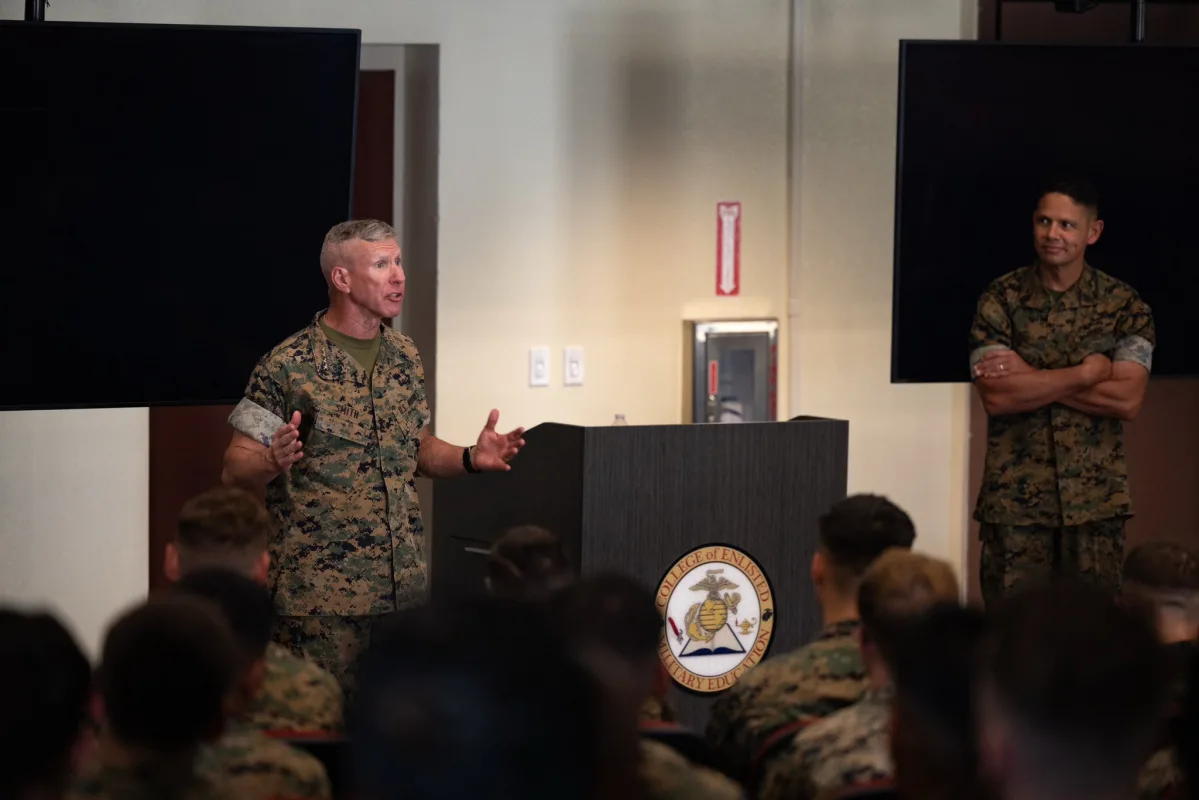
The Commandant of the Marine Corps, General Eric M. Smith, emphasized the significance of the change during his visit to the Marine Corps Tactical Systems Support Activity (MCTSSA) at Camp Pendleton, where Project Dynamis coordinates the testing and trials of the system.
The Maven Smart System is an artificial intelligence-based command and control platform, designed to unify sensors, data streams, and fire capabilities in real-time. The system represents the technological cornerstone of the CJADC2 (Combined Joint All-Domain Command and Control) concept, the digital architecture with which the Pentagon aims to connect land, air, naval, and space forces into a single operational network.
Project Dynamis: Accelerating the Adoption of Maven
The directive provides that access to MSS be extended to Headquarters Marine Corps, Marine Forces Pacific, Marine Forces Command, Marine Special Operations Command, and all subordinate units. The Marine Forces Reserve will be integrated at a later stage.
The Project Dynamis Cross-Functional Team will coordinate the deployment of the platform at various operational levels, ensuring compatibility with MAGTF (Marine Air-Ground Task Force) systems and the joint ecosystem. The goal is to provide theater commands with a Battle Management Command and Control (BMC2) capability based on fused, geolocated, and real-time updated data.

Within the platform, tools like Foundry, Gaia, Target Workbench, Maverick, and LogX enable geospatial visualization and collaborative mission planning, integrating data from land, naval, and air sensors.
The first operational evaluations — conducted by the three Marine Expeditionary Forces (MEF I, II, and III) — will conclude by the end of fiscal year 2025. The results will guide the definition of best practices and interoperability models with the unified American commands INDOPACOM, CENTCOM, and EUCOM, which already adopt the Maven system.
Implications for NATO and Reflections for Europe
The large-scale adoption of the Maven Smart System by the Marine Corps confirms the centrality of artificial intelligence in multidomain warfare. MSS acts as a catalyst for CJADC2 integration, the same logic underpinning NATO's digital transformation and European projects of Federated Mission Networking and Multidomain Operations.
In the transatlantic context, Palantir's system represents a testing ground for interoperability between U.S. command architectures and European allies, who are themselves developing similar solutions — from the cloud infrastructure of the EUROSIM program to the AI situational awareness platforms adopted in Germany and the United Kingdom.
For Italy, the evolution of the Maven program is a clear signal: the digital transformation of the operational domain is no longer a technological option, but a strategic necessity. The ability to fuse real-time information from sensors, drones, radar systems, and land platforms will be decisive in maintaining decision-making and tactical advantage in an increasingly connected global scenario.






Comments
No comments yet. Be the first!