


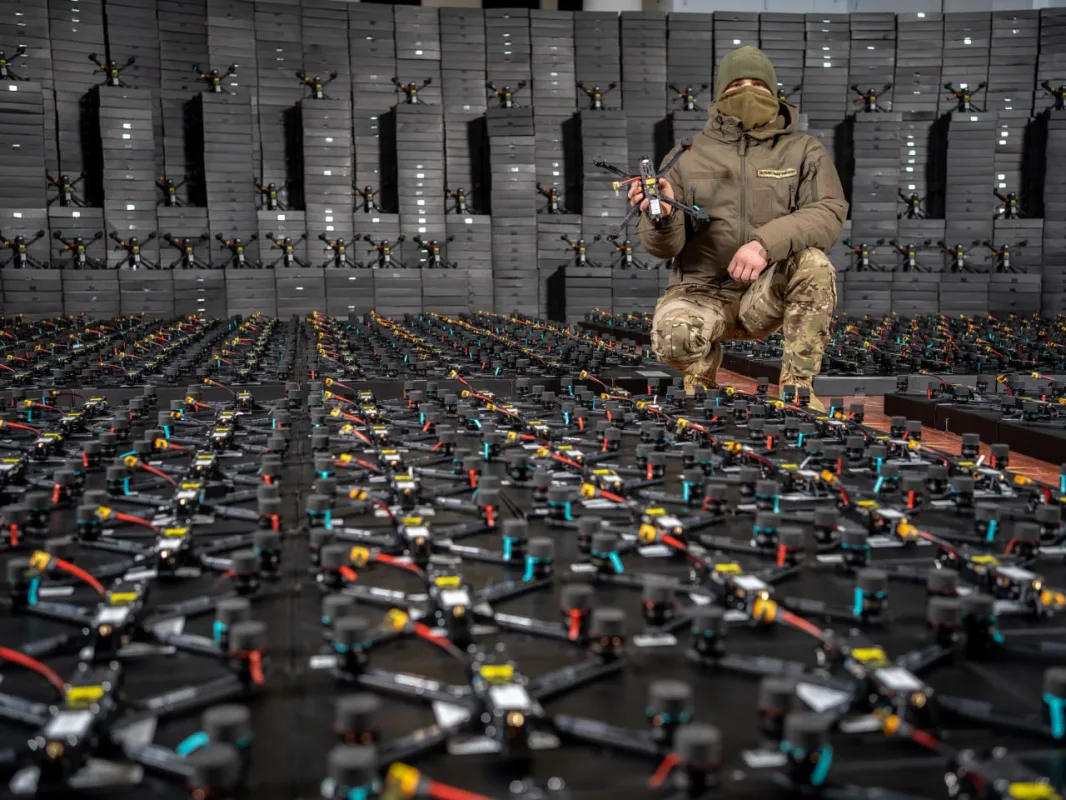

The massive use of unmanned systems by Ukraine marks a pivotal shift in the conduct of contemporary military operations. Drones – in their aerial, naval, and terrestrial variants – are no longer accessory tools, but the beating heart of the new war doctrine. The recent Operation Pavutyna, conducted deep within Russian territory on June 1, 2025, represents the culmination of a transformation that began at the dawn of the Russian invasion and is now fully deployed in the Eurasian strategic theater.
Expanding Production and Operational Capacity
Operation Pavutyna is just the highest point – so far – of an impressive industrial and technological growth. In 2025, Ukraine plans to produce 30,000 long-range drones, and in the first months of the year alone, over 200,000 UAVs per month have been delivered to the armed forces. The capabilities range from reconnaissance drones to FPV attack aircraft, to autonomous naval and terrestrial systems.
The success of the attack also demonstrates the maturity achieved by the Ukrainian UAV sector, where over 500 companies operate in the field, with more than 240 projects certified by the Ministry of Defense. The conflict has drastically compressed development cycles: a drone can be designed, tested, and sent on a mission in a few weeks.

Strategic Capabilities and Operational Depth
Throughout 2024, Ukraine reached a qualitative breakthrough: drones were successfully used in 377 attacks on Russian territory, hitting military targets and strategic infrastructures such as refineries, airports, and defense industries, even at distances exceeding 1,500 km. Exemplary was the attack on the Russian naval base in Kaspiysk, in the Caspian Flotilla, on November 6, 2024.
The new models, such as the Liutyi (capable of over 1,000 km range) and the Rubaka (decoy drone), are often used in tandem to saturate Russian air defenses. The effectiveness of these operations has had significant economic impacts: Russia's oil refining capacity has fallen to the lowest levels in the last 12 years.
The Ukrainian UAV portfolio is rapidly evolving. Some iconic models include:
- Leleka-100 (Deviro): resistant to electronic warfare, up to 4 hours of flight;
- Shark and Shark-M (Ukrspecsystems): up to 420 km range and 7 hours of autonomy;
- PD-2: capable of carrying explosives and conducting reconnaissance;
- Valkyrie: stealth model for tactical reconnaissance;
- Bober (UKRJET): used in attacks on Moscow and Russian refineries;
- UAV conversions from civilian light aircraft like the A-22 Foxbat, with loads up to 250 kg.
A distinctive feature of the Ukrainian model is the ability to test new drones in real-time on the battlefield and update them very quickly. The certification cycle today can last less than a month.
FPV, Interceptor Drones, and UGV: New Frontiers
In 2025, the use of interceptor drones is also growing: models capable of hitting Russian UAVs in flight at speeds up to 280-300 km/h, equipped with automatic targeting systems based on artificial vision. In some cases, rudimentary methods – like sticks thrown at propellers – prove effective and much cheaper than anti-aircraft missiles.
On the terrestrial front, Ukraine aims to expand unmanned ground vehicles (UGV) for supply, medical evacuation, mine clearance, and armed support tasks. Already in November 2024, 100 UGVs were tested in collaboration with the Brave1 technology platform.

A Doctrine in Transformation
The conflict in Ukraine demonstrates that unmanned systems are no longer a secondary support but a pillar of modern military strategy. The speed at which countermeasures emerge renders many systems obsolete within a few months: those who can adapt quickly and innovate technologically gain a decisive advantage.
Upcoming developments will include:
- Greater autonomy and endurance of drones;
- Integration of artificial intelligence;
- More secure communications resistant to electronic warfare;
- Interoperability between aerial, terrestrial, and naval platforms;
- Increasing involvement of international technology partners.
Conclusions
Ukraine is now at the forefront of drone development and military use. In a scenario where technological cycles shorten and threats evolve daily, the Ukrainian experience represents a hybrid model of civil-military innovation, with global implications.
The massive and sophisticated use of unmanned systems is destined to grow even after the war, becoming a stable part of the military doctrines of global powers, as a key element of decisional and operational superiority on the 21st-century battlefield.



Comments
No comments yet. Be the first!