


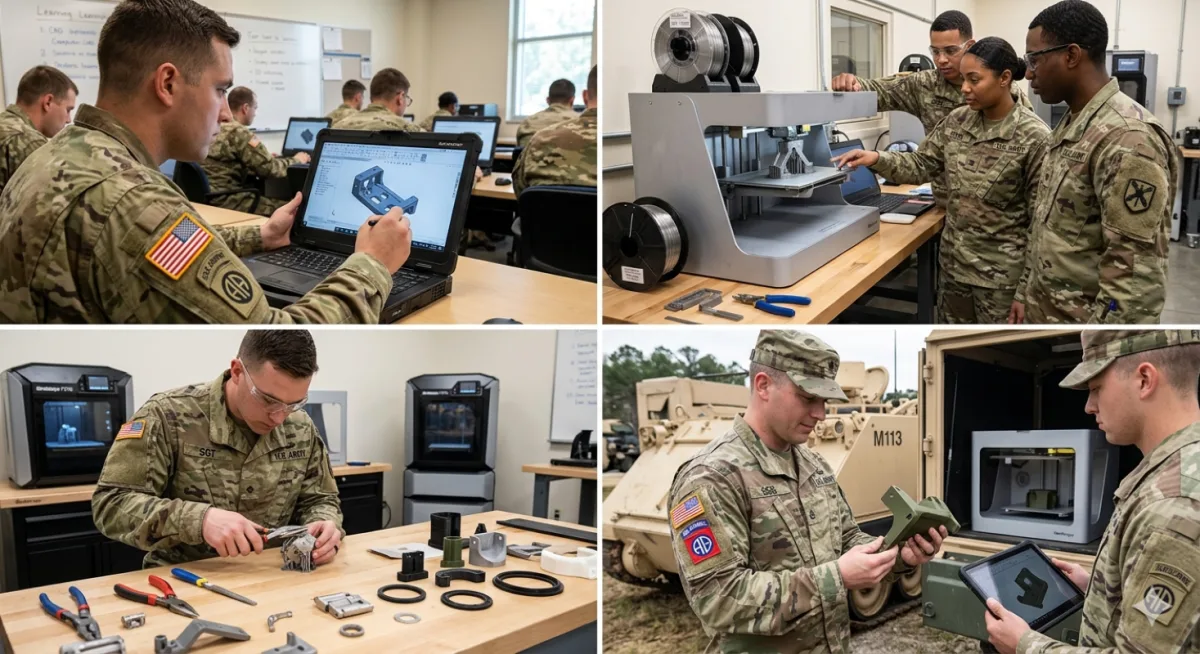

Not just 3D printers, but a new logistical paradigm. Through the "Basic Additive Manufacturing Course," the U.S. Army is transforming its units into autonomous production centers, reducing dependency on global supply chains and increasing operational readiness.
The U.S. Army is decisively accelerating on additive manufacturing (AM). What was once considered a laboratory technology for rapid prototyping is now a pillar of military modernization. The heart of this transformation lies not only in the machines but in the skills: the Basic Additive Manufacturing Course is the key initiative to transfer these capabilities directly into the hands of soldiers on the front lines.

From Theory to Field: The 82nd Airborne Model
The training path found fertile ground in the Airborne Innovation Lab of the 82nd Airborne Division. At Fort Liberty (formerly Fort Bragg), the course began training military personnel from diverse units — from the 18th Field Artillery Brigade to the 3rd Special Forces Group — with a clear goal: to teach how to apply additive manufacturing within the Department of Defense (DoD).
The educational program is rigorous and is structured into two main modules:
- Design: Focused on CAD (Computer-Aided Design) modeling, reverse engineering, and project optimization.
- Printing: Dedicated to actual printing technologies, software management, and material science.
The approach is not limited to the technical aspect; the final "capstone project" requires soldiers to identify a real operational problem and develop an original prototype to solve it.
"On-Demand" Logistics: Goodbye Bottlenecks
The strategic value of additive manufacturing strongly emerges in the management of the supply chain. Traditionally, the breakdown of a simple yet essential component can immobilize an armored vehicle or a weapon system for weeks, waiting for the part to cross the ocean.
"The ability to design and produce locally reduces logistical dependency and dramatically increases operational readiness."
At Fort Liberty, on a bimonthly basis, soldiers learn to maintain and calibrate machines to produce critical spare parts directly within the units. This autonomy is crucial in expeditionary contexts, where supply lines are vulnerable or disrupted.
The trend is not limited to the Army. The collaboration between the Army and Marine Corps at Camp Lejeune demonstrates how the integration of AM technologies is now a DoD priority to create a more agile and interconnected defense ecosystem.

Beyond Polymers: Additive Construction
U.S. interest does not stop at small plastic components. The natural evolution is additive construction, managed by the ERDC-CERL program.
- Rapid Infrastructure: 3D printing of concrete structures.
- Local Materials: Possibility to build protective buildings using resources available on site.
- Mobility: Creation of bridges or defensive barriers in record time.
The initiative fits into the broader framework of the Additive Manufacturing Digital Thread, promoted by the Army Materiel Command. The goal is to connect design, data, and maintenance in a single integrated digital flow. Programs like Training with Industry ensure that the Army keeps pace with innovations in the civilian sector and ordnance industry.
The Basic Additive Manufacturing Course is not just a technical course: it is a fundamental piece of military transformation. In an era where the speed of adaptation is as lethal a weapon as a missile, the ability to go "from idea to physical piece" in a few hours guarantees an unbridgeable tactical advantage. The soldier's autonomy no longer relies solely on the rifle but also on their ability to "print" the solution to a logistical problem in the midst of a conflict.




Comments
No comments yet. Be the first!