


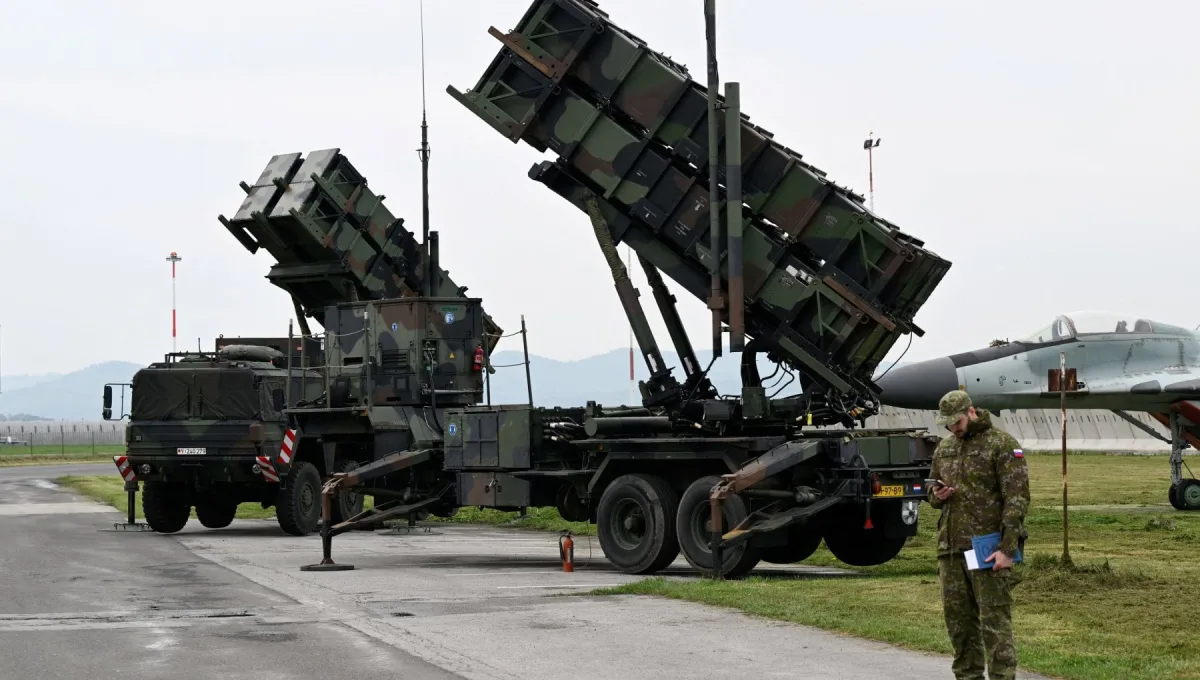

According to the latest reports released by the Ukrainian Ministry of Defense and widely covered by the Anglo-Saxon press, March 2026 marked a technological turning point. Despite the intensification of Russian attacks with hypersonic missiles and drone swarms, the interception rate reached a record 90%. This success is not due to a single platform, but to the systematic integration of Western assets such as the Patriot PAC-3 and the Italian-French SAMP/T, coordinated by an artificial intelligence-based command and control architecture. The ability to process real-time data from heterogeneous sensors has allowed the neutralization of threats that until a few months ago were considered almost unstoppable.

Political tensions over Patriot batteries in Poland
While Ukraine celebrates technical successes, a significant diplomatic rift has opened between Warsaw and Washington. In the last 24 hours, outlets like Defense News have highlighted Poland's firm refusal to transfer additional Patriot batteries to the Middle East or Ukraine. The Polish Deputy Prime Minister stated that national defense needs along NATO's eastern flank are a priority and non-negotiable. This friction highlights the paradox of European defense: the growth in production (thanks to agreements between the Pentagon and Boeing to triple PAC-3 seekers) still cannot keep pace with the global demand generated by simultaneous crisis hotspots in Europe and Asia.

Towards the future: Lasers and interceptor drones
Beyond traditional missile defense, the focus of specialist sites has shifted to the final tests of directed energy weapons. The United Kingdom has confirmed that the DragonFire laser system will be operational on Type 45 destroyers by 2027, but advanced prototypes are already being field-tested. In parallel, Airbus has begun testing its new "Abfangdrohne" (interceptor drone) named Bird of Prey, designed to shoot down drone swarms at a drastically lower cost than traditional missiles. This transition to a "hybrid" air defense model promises to solve the cost-per-engagement problem, currently unsustainable for many European nations.




Comments
No comments yet. Be the first!