


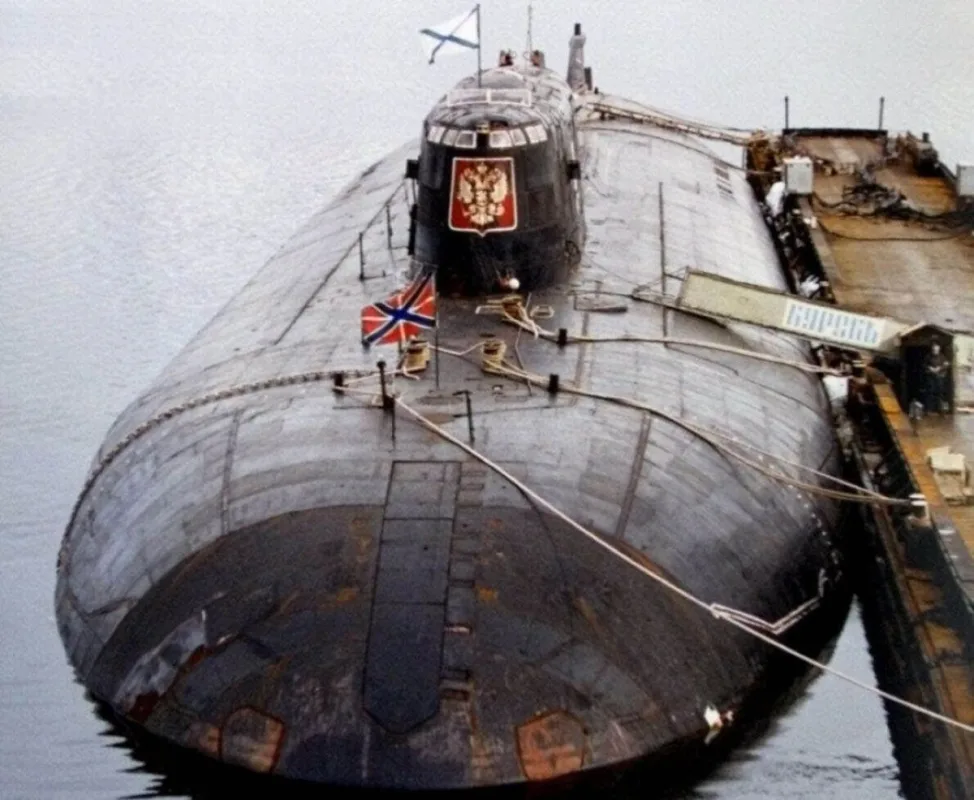

On August 12, 2000, in the icy Barents Sea, one of the most serious naval tragedies of modern history occurred: the sinking of the Russian nuclear submarine K-141 Kursk, with the death of all 118 crew members. A disaster that, besides the pain, left unanswered questions, accusations of cover-up, and a severe blow to the image of the Russian Navy.
A giant of the depths
The Kursk, launched in 1994 and commissioned the following year, belonged to the Oscar II class and was one of the prides of the Russian submarine fleet. Over 150 meters long, with a displacement of 18,000 tons and powered by two nuclear fission reactors, it could reach 32 knots (about 60 km/h) underwater. Its main mission was to neutralize enemy aircraft carriers thanks to an impressive arsenal of cruise missiles and torpedoes.
However, behind this power lay structural and organizational weaknesses. Post-Soviet Russia, in the 1990s, was going through a deep economic crisis: maintenance, training, and safety were often sacrificed due to lack of funds.

The day of the disaster
On August 12, 2000, during an exercise that involved the simulated launch of torpedoes against the nuclear cruiser Pietro il Grande, the first explosion occurred on board. According to official investigations, the cause was a defect in a liquid-fueled torpedo, which generated a hydrogen leak and an explosion equivalent to 100 kg of TNT.
Two minutes later, a second explosion — 40 times more powerful — tore through the submarine's bow, causing the immediate death of most of the crew. At least 23 men managed to take refuge in the aft section, where they held out for about eight hours before dying from carbon monoxide poisoning.
The emergency management was marked by delays and questionable choices. The Russian government made the news public only two days later and initially refused international aid. The first rescue attempts started with great delay, hampered by technical problems and bad weather.
Only on August 17, five days after the incident, did Russia accept British and Norwegian assistance. On August 19, the British submersible LR5 reached the wreck, confirming the absence of survivors. Meanwhile, the victims' families were denouncing the lack of information and the authorities' lack of transparency.

Recovery and investigation
In October 2001, in one of the most complex recovery operations ever carried out, much of the hull was lifted and transported to the Roslyakovo base. The bow, severely damaged, was blown up on the seabed for safety reasons — officially to avoid environmental risks, unofficially to prevent other powers from analyzing the technology used.
The Russian investigation, concluded in 2002, blamed a defective torpedo and did not identify personal responsibilities. Prosecutor General Ustinov stated that there were no real chances of rescuing the 23 men who survived the explosions.
The absence of definitive evidence and the opaque handling of the incident fueled alternative theories: among them, the hypothesis that the Kursk was hit by a US torpedo during a close encounter with a US submarine. Although never confirmed, this theory continues to circulate in military and journalistic circles.
A political blow for Putin
The incident was a difficult test for Vladimir Putin, president for only a few months. His decision to remain on vacation in Sochi in the days immediately following the sinking cost him heavy criticism, even internationally. Famous, and controversial, was his response to journalist Larry King, who asked him what happened to the submarine: "It sank," he said with a smile.
The Kursk has become the symbol of a transitional era for Russia, where military power and national pride coexisted with serious technical and managerial limitations. The incident prompted the Russian Navy to review safety procedures, crew training, and emergency protocols.
Today, a memorial commemorates the 118 men who died in what remains the most serious tragedy of the Russian Navy in peacetime. Their story, like that of the Kursk, is a warning about the fragility of certainties and the human cost paid when technical errors, delays, and secrecy combine in a highly dangerous context.



Comments
No comments yet. Be the first!