


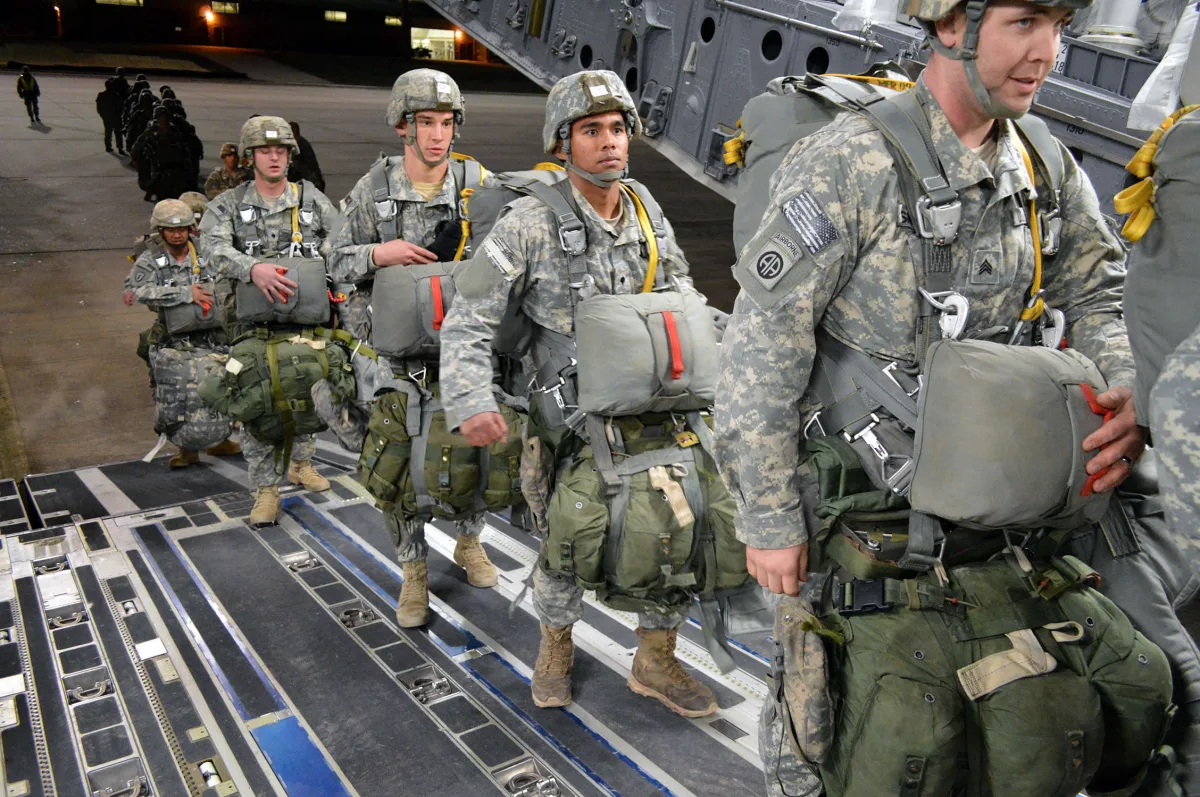

The United States is preparing to further strengthen its military presence in the Middle East with the deployment of new soldiers from the 82nd Airborne Division, one of the fastest and most symbolic rapid deployment units of the American army. According to PBS News, which cites a source familiar with the plan referred to the Associated Press, Washington is ready to send about 1,000 troops to the region in the coming days.
The contingent, according to this account, would include a battalion from the 1st Brigade Combat Team, along with the division commander, Maj. Gen. Brandon Tegtmeier, and part of his staff. The choice to mobilize the 82nd Airborne is not accidental: it is indeed the rapid response force of the US army, trained to intervene in very short times and to operate even in hostile or contested areas, including the capture and securing of airports and strategic infrastructures.
The role of the 82nd Airborne
The move represents a new step in the American military escalation in the area. In recent days, Reuters had already reported the deployment to the Middle East of thousands of Marines and sailors aboard US naval units, in addition to an American presence in the region that already exceeds 50,000 units.
On the tactical level, the difference between Marines and airborne units is significant. The Marines sent in recent days are typically employed in embassy protection missions, civilian evacuations, and responses to sudden crises. The soldiers of the 82nd, on the other hand, are specialized in more offensive operations and rapid entries into hostile territory, also through airdrops, to capture logistical nodes and ensure operational corridors for subsequent forces.

Strategic message to Tehran
The military reinforcement occurs while the conflict with Iran continues to have effects on the entire region and while Washington alternates signals of military pressure with diplomatic attempts. In this context, the potential arrival of new units of the 82nd Airborne takes on a value that goes beyond mere numerical reinforcement.
On one hand, it offers the White House a broader and more immediate intervention capability; on the other, it sends a political and military deterrence message to regional rivals. However, it remains to be seen whether the deployment will mainly serve to consolidate the American defensive posture or to prepare more aggressive operational options, at a time when every movement on the ground is read as a possible prelude to a further escalation of the crisis.



Comments
No comments yet. Be the first!