




The failure of negotiations and the end of all diplomatic options bring back to the center of the global debate the nightmare of a closure of the Strait of Hormuz. For the Pasdaran (the Islamic Revolutionary Guard Corps), controlling this corridor is not just a defense mission, but a lever of global blackmail. Without a peace agreement, the doctrine of "asymmetric defense" becomes the only operational scenario. Here's how, technically, Iran is preparing to seal the passage.
The Primacy of the Pasdaran: The IRGC Navy
Unlike the regular Iranian navy (Artesh), the Pasdaran navy is designed for fast, brutal, and unconventional combat. Their strategy is based on the concept of area denial (A2/AD): preventing access to anyone.
1. The Carpet of Smart Mines
The first act of the blockade would be invisible. The Pasdaran have thousands of naval mines of Russian, Chinese, and indigenous manufacture.
- Bottom mines: Placed on the shallow seabeds of the strait, they are difficult to detect even for the most advanced minesweepers.
- Selective activation: Many of these mines can be programmed to ignore small fishing boats and activate only at the passage of units with a specific magnetic or acoustic signature, such as supertankers (VLCC).

2. The "Wasps" of the Gulf: Swarms of Small Boats
The Pasdaran have transformed civilian and sports speedboats into war machines.
- Speed and numbers: They can launch hundreds of small boats armed with twin-tube rocket launchers or light missiles.
- Swarm tactics: By attacking a warship from thirty different directions, they saturate defense systems (like the Phalanx or RAM), which cannot engage so many targets simultaneously.
3. The "Steel Coast": Missiles and Drones
Along the entire Iranian coast and on fortified islands (Abu Musa, Greater and Lesser Tunb), the Pasdaran have dug tunnels and bunkers.
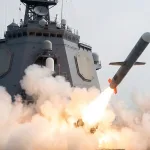
- Mobile cruise missiles: Systems like the Khalij Fars (supersonic anti-ship ballistic missile) can hit targets throughout the strait with extreme precision.
- Suicide drones (Loitering Munitions): The Shahed-136 drones, cheap and lethal, would be used as "flying artillery" to hit enemy ship radars, blinding them before the main attack.

The Logistic Challenge and the "Point of No Return"
The effectiveness of the Iranian blockade is based on a coordinated combination of three key assets operating on different levels.
Firstly, the role of the Ghadir-class midget submarines is crucial for concealment: these units are specifically designed to ambush in shallow waters, where the large sonars of destroyers struggle to distinguish the hull from the rocky seabed, allowing for covert torpedoing of passing ships.
In parallel, the Pasdaran employ sophisticated electronic warfare systems to manipulate GPS signals and automatic identification systems (AIS). This allows for "silent" hijacking, leading merchant ships off course or forcing them into Iranian territorial waters without the crew immediately realizing it.
Finally, physical control of the transit channel is guaranteed by coastal artillery. Positioned in fortified bunkers, these batteries create a true barrage fire that makes safe navigation through the strait impossible, turning the entire area into a "death zone" for any unauthorized vessel.

Why is the Risk Higher Today?
Without a peace agreement, Iran sees the Strait of Hormuz as its only real insurance policy against sanctions or a direct attack. The Pasdaran are not seeking a classic naval victory against the United States Navy; their goal is to make the insurance risk unacceptable.
If a single tanker were sunk, insurance premiums would make the transport of crude oil from the Persian Gulf economically impossible. In this scenario, the strait would be "closed" in fact, even without a permanent physical blockade, triggering an unprecedented energy shock that would instantly affect the economies of Europe and Asia.



Comments
No comments yet. Be the first!