


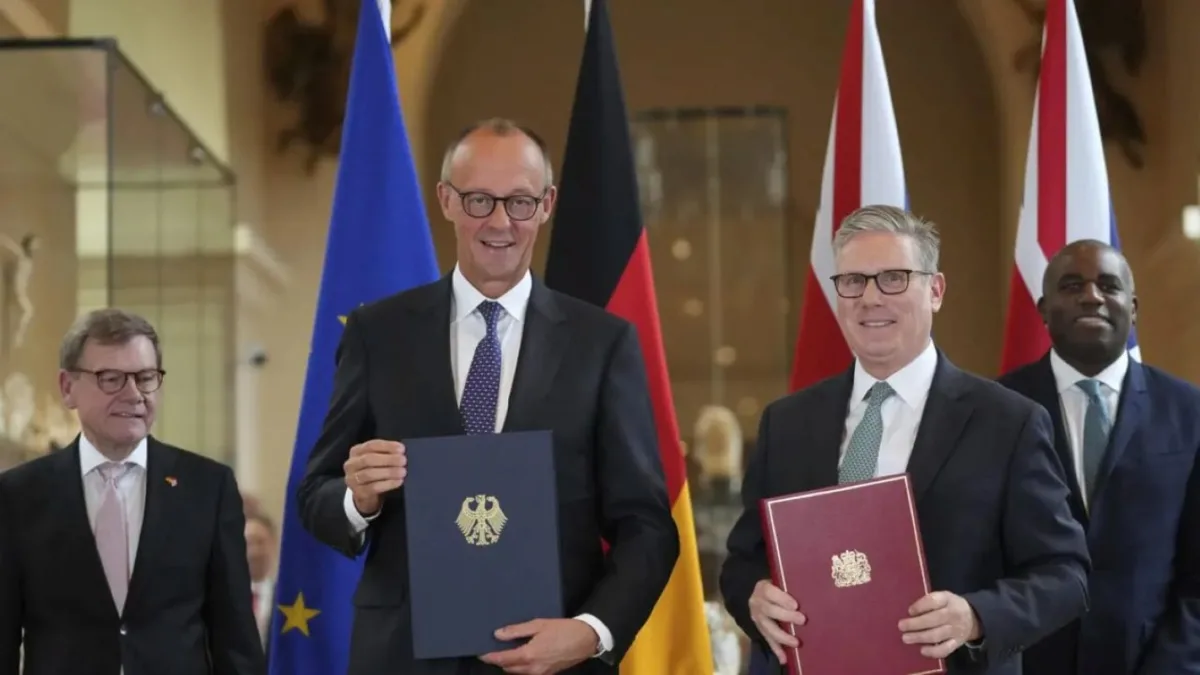

On July 17, 2025, the British capital witnessed the signing of the "Kensington Treaty," a historic agreement between Great Britain and Germany that marks a turning point in post-war international relations and addresses current security challenges. This treaty, signed by German Chancellor Friedrich Merz and British Prime Minister Keir Starmer, consolidates cooperation between the two countries in terms of mutual defense, creating a solid foundation for a strategic alliance. The signing takes place a week after Macron's meeting in London, completing a "triangle" that unites Great Britain, France, and Germany in a shared defense project.

The treaty provides, among other things, the joint development of a new long-range missile system and commitments at the level of collective defense, where an attack on one of the signatories will be considered an attack on all. Although this agreement does not intend to replace NATO's defense system, the uncertainty left by the Trump administration regarding the continuity of the Atlantic Alliance has pushed the three main European powers to take a more active role in protecting the continent. The signing at the Victoria & Albert Museum in London, a symbolic place of Anglo-German relations, underscores the historical relevance of the agreement, uniting two nations with a long history of alliances, also reflected in the bond between Queen Victoria and Prince Albert of Saxe-Coburg and Gotha.
The response to hybrid threats and the war in Ukraine
The agreement signed between Great Britain and Germany fits into the context of a Europe increasingly exposed to hybrid threats, such as cyberattacks and attacks on energy systems, often attributed to Russia. Chancellor Merz reiterated the importance of joint action against these threats, emphasizing how cooperation between the two countries also extends to crucial sectors such as artificial intelligence, quantum technology, and cybersecurity. Germany and the United Kingdom have also discussed the need to strengthen energy infrastructure in the North Sea and even a possible direct railway line between London and Berlin, indicating a long-term strategic vision.

Meanwhile, the situation in Ukraine dominated the talks. Chancellor Merz announced that Kyiv will soon receive long-range missiles to enhance its defense capabilities against Russia. This move follows the United States' decision to send similar support. Ukraine, in fact, needs to strengthen its offensive capabilities to defend itself and deter Russian incursions. Merz also assured that Germany will significantly contribute to the financing of weapons, with logistics planned among various European allies. Starmer, for his part, confirmed the commitment to send troops on the ground to strengthen the "coalition of the willing" in support of Ukraine, a move that responds to the growing need for concrete and direct support.
Political implications and Brexit
Despite the centrality of the defense treaty, domestic policy issues were not overlooked. During the talks, Merz referred to Brexit, emphasizing the importance of rebuilding strong ties between the United Kingdom and Europe. The signing of the treaty marks a return of London as a crucial player in European security, even outside the European Union. Although the United Kingdom is no longer part of the EU, it has regained a fundamental position thanks to its irreplaceable role in defense matters.
With the strengthening of bilateral relations between London, Paris, and Berlin, Europe is redesigning its strategic balance, focusing on more autonomous and solid cooperation, capable of responding to global challenges without relying exclusively on non-European powers.
In conclusion, the "Kensington Treaty" represents a significant step towards a more integrated European defense and a new vision of continental security, in which collaboration between Great Britain, France, and Germany is fundamental. Although some internal issues such as immigration and youth mobility remain open, the treaty lays the foundation for a new era of cooperation in Europe, with security as the primary goal.






Comments
No comments yet. Be the first!