


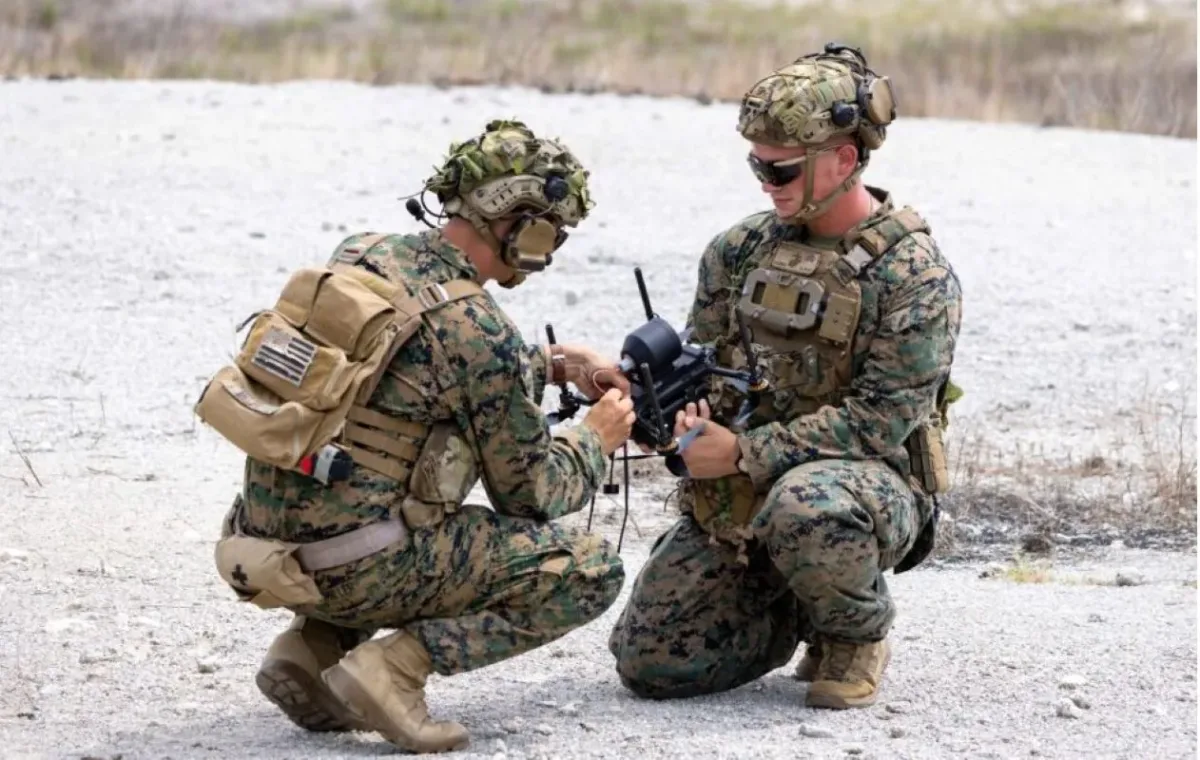

There is a precise moment when old military doctrines become obsolete, and for the United States, that moment has arrived now. The conflicts in Ukraine and Iran have torn the veil on contemporary warfare, demonstrating that swarms of small, inexpensive aircraft can dismantle the most sophisticated defenses. Faced with this reality, even Washington had to capitulate and admit the evidence: in modern defense, drones have become the absolute priority.
To fill what officials call a "dramatic gap" in its arsenal, the Trump administration has made an unprecedented shift. The Pentagon has decided to bypass traditional aerospace giants to launch Drone Dominance: an intense 18-month competition to enlist startups founded by former hobbyists, programmers, and gamers.
The immediate goal is an initial tranche of $1.1 billion in contracts to produce 300,000 assault drones (low-cost flying bombs). But it is the long-term plan that certifies the total change in priority: next year's defense budget includes the allocation of a whopping $54.6 billion for a mega-division entirely dedicated to drone warfare.

The Paradigm Shift: Disposable Hardware
For decades, American strategy has relied on stealth fighters and billion-dollar aircraft carriers. Today, the priority is radically opposite: to produce enormous volumes of drones with a unit cost of less than $5,000. In Pentagon jargon, they are called "attritable", meaning economical and lethal systems that can be destroyed en masse without financial concerns.
Ukrainian soldiers have paved the way, showing how technology derived from the drone racing world allows them to zip through trenches and hit Russian tanks in their blind spots. A millimetric responsiveness that Soren Monroe-Anderson, 23 years old and founder of the Californian startup Neros, has decided to industrialize for the American army: "The maneuverability needed to make hairpin turns in a race is the same required to place an explosive exactly in a thirty-centimeter area above an armored vehicle".
The Challenge for Leadership of the New Arsenal
The Pentagon wants to narrow the circle around very few mass suppliers. At the moment, the race is a two-way challenge:
| Company | Origin / Partnership | Strategy | Current Status in the Contest |
| Skycutter | British (partnered with Ukrainian Skyfall) | Adapted the "Shrike" drone already tested on the Ukrainian front | Winner of the first phase (order for 2,560 drones) |
| Neros | American (Torrance, California) | Founded by drone racing champions, raised $120M | First to deliver drones of the initial order |
The Military "Reality Show" at Fort Benning
That drones are the priority is also evident from the spectacle with which the army is managing the project. During the first phase of the Drone Dominance Gauntlets (the field challenges) at Fort Benning, Georgia, 26 companies competed in an atmosphere halfway between a military exercise and a television reality show, complete with a public scoreboard and promotional videos in Star Wars style.
The companies had only two hours to train army pilots (from Navy SEALs to nineteen-year-old recruits) in the use of their systems before launching them on attack missions against targets six miles away or inside buildings. The enthusiasm spread through the base: the British team of Skycutter even mounted a TV on the roof of the launch station to show the first-person view (FPV) of their drones, attracting a crowd of spectators.
The Industrial Knot: From Basement to Assembly Line
This sudden transition to drones is not without obstacles. Some experts, like retired helicopter pilot Crispin Burke, raise logistical doubts: "If you're a rapidly moving army, where do you transport hundreds of thousands of drones?".
Moreover, many of the creative companies enlisted by the Pentagon are not yet ready for mass production. GreenSight, a company that transitioned from monitoring golf courses to military drones, scored well in flight tests but received a zero in industrial capacity evaluation. "We need to raise capital and build a real factory for the next round", admitted COO Joel Pedlikin.
Time is running out. With the second phase of the contest approaching in Michigan and billion-dollar budgets already approved, the United States has realized that technological supremacy is no longer defended only in the sealed labs of aerospace giants, but by converting entertainment companies and hobbyist garages into assembly lines for the new global strategic priority.






Comments
No comments yet. Be the first!