


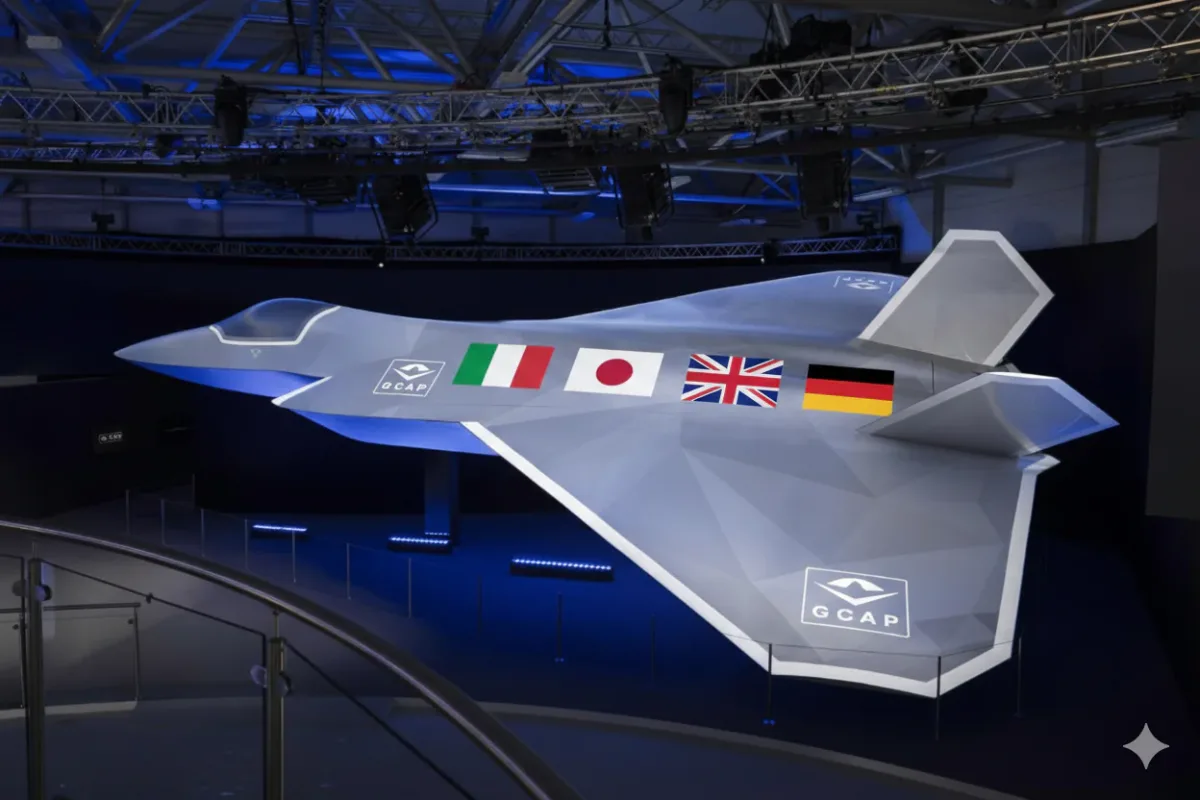

After years of tensions, announcements, and false starts, the Franco-German-Spanish project for the sixth-generation fighter has reached its end. The collapse of the FCAS (Future Combat Air System) is not just the end of a hundred-billion-euro industrial program, but represents a severe blow to the strategic autonomy of the Old Continent. It sends an unequivocal warning to the other major ongoing project, the GCAP: without a common European effort, cohesive and financially solid, no program of this magnitude can hope to survive.
The curtain falls on the FCAS
Rumors had been circulating for months, but confirmation came during the recent EU-Balkans summit in Montenegro. German Chancellor Friedrich Merz and French President Emmanuel Macron acknowledged an industrial reality that has become unsustainable: the divisions between the French Dassault and the Airbus group (representing German and Spanish interests) are irreconcilable.
The key points of the divorce:
- Stop to the piloted fighter: The main platform of the project will not be built jointly. The program had stalled at the technological study phase without being able to progress.
- Partial salvage: Paris, Berlin, and Madrid will continue to collaborate exclusively on the development of a drone system and the related data network (the so-called "combat cloud").
- Each for themselves: France will likely move towards a new national fighter produced solo by Dassault, retracing the steps of the past. Germany, with a Defense budget set to reach 153 billion euros annually by 2029, will look elsewhere.
The GCAP in the balance: funding uncertainty and employment alarm
While the Franco-German axis breaks, the alternative driven by Italy, the UK, and Japan—the GCAP (Global Combat Air Programme)—is experiencing days of deep uncertainty, demonstrating how fragile the aerospace defense ecosystem is when fragmented.
The crucial issue is in London: the bridge contract worth 686 million pounds awarded to the Edgewing joint venture (BAE Systems, Leonardo, and Japan Aircraft Industrial Enhancement) expires on June 30. By that date, the British Ministry of Defense must approve the Defence Investment Plan (DIP).
The risks of a stall are enormous:
- Brain drain: Over 4,000 engineers and technicians risk being reassigned to other projects.
- Impact on Italy: Of these, about 3,000 are Italian professionals employed at Leonardo sites in Turin, Rome, and other locations.
Although sources close to the dossier express confidence in the last-minute British approval, the episode highlights a structural problem: the dependence of colossal programs on the internal political agendas of individual countries.
The lesson: why a true European synergy is needed
The collapse of the FCAS and the chills over the GCAP converge towards a single, inescapable conclusion: building a sixth-generation fighter requires financial and technological resources that no nation—and perhaps not even a small, heterogeneous coalition—can sustain in the long term without hitches.
Without a broader common European effort, even the GCAP will struggle to stay on course. However, the announcement of the end of the Franco-German project could paradoxically turn into an opportunity for consolidation for the GCAP itself.
As Alessandro Marrone, head of "Defense, Security and Space" at the Istituto Affari Internazionali (IAI), points out:
"If, as seems likely, London keeps its commitments […], the GCAP becomes more attractive to potential partners like Canada and Germany, who do not want to be dependent in the future on a made-in-USA aircraft and recognize the benefits of cooperation with like-minded and reliable countries."
Germany's entry into the GCAP (a hypothesis already discussed months ago between Chancellor Merz and Prime Minister Meloni) could be the keystone. Combining the decades of experience gained on programs like Tornado and Eurofighter would finally create the critical European mass needed to compete globally.
Fragmentation has just killed the FCAS. If the GCAP truly wants to soar into the skies of the future, it must stop being just a three-party agreement and become the cornerstone of a true, integrated, and indispensable common European effort.



Comments
No comments yet. Be the first!