


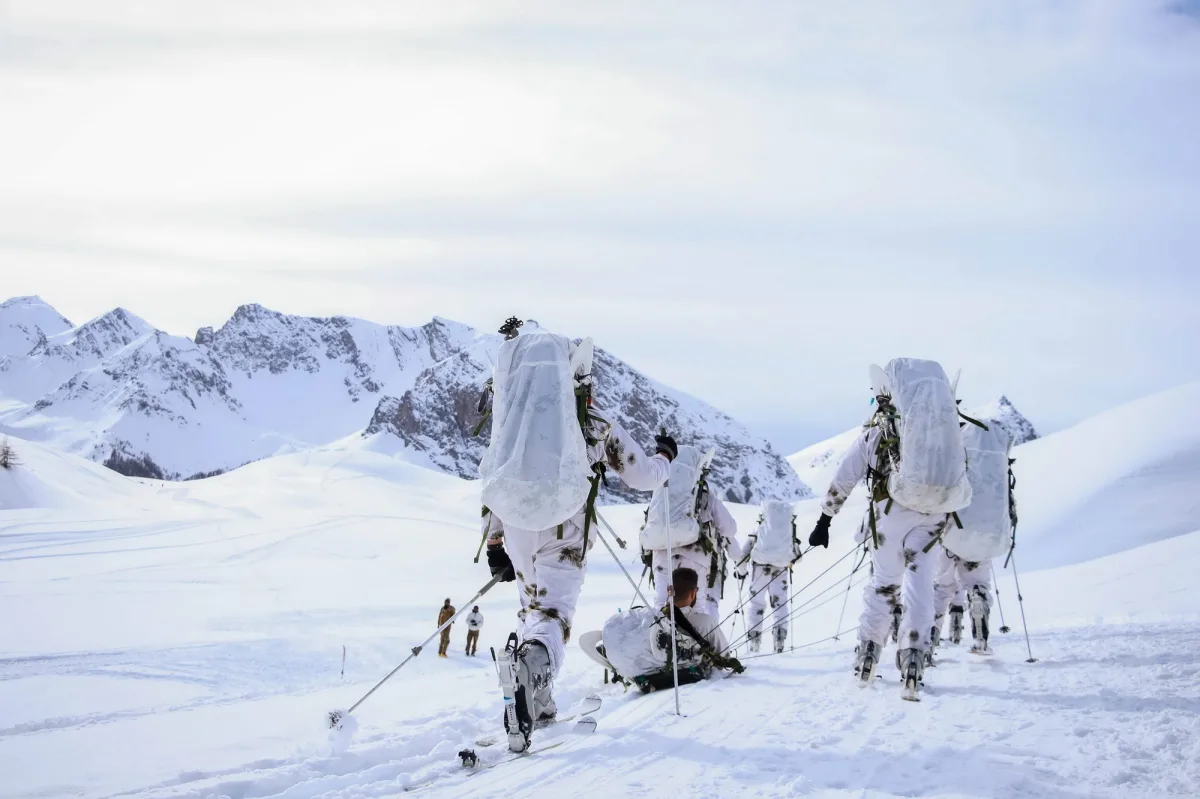

Nuuk and the icy fjords have suddenly returned to the center of geopolitics. Greenland – an autonomous territory of the Kingdom of Denmark – has become a symbol of a larger game: maritime routes opening with the retreat of the ice, strategic infrastructures, mineral resources, and above all, the competition of powers in an area where military presence matters even when numbers are small.
Why everyone is looking at the island of ice
In Greenland, there is the Pituffik Space Base (formerly Thule), the main U.S. military installation on the island: a key outpost for surveillance and missile warning and, more generally, for the security architecture of the North Atlantic.
On the Danish side, however, the defense of the vast Arctic territory relies on a combination of surveillance, patrolling, and presence: among the most iconic units is the Sirius Dog Sled Patrol, a patrol with dog sleds that operates for months in remote areas of Northeast Greenland.

“Arctic Endurance”: few soldiers, huge message
In recent days, some European countries have begun sending small contingents and planning staff for a Danish initiative of training and presence, often referred to as Operation/Exercise “Arctic Endurance”: not a “massive” deployment, but a political and military signal of solidarity and deterrence in an increasingly sensitive area.
Denmark itself, through its Arctic command, has reiterated that the operational priority remains monitoring Russian activity (and prospectively also the growing Chinese attention), rather than imagining internal frictions within the Western alliance.
Italy between political caution and “extreme climate” capability
And here comes the point that interests Rome: Italy, at the moment, does not send military personnel to Greenland. The government line, also reported by La Stampa, is not to consider an immediate Italian contribution on the island “necessary”, instead focusing on a NATO framework and a diplomatic management of the dossier.
But the Italian absence has itself become news: because, if there is a unit that in the imagination (and in practice) is associated with snow, altitude, and cold, it is the Alpini universe.
In recent years, the Army has indeed accelerated the development of a true “Arctic capability”: for example, the 2nd Alpini Regiment of the Taurinense Brigade has been engaged in training cycles in cold environments, even in Norway, precisely to adapt procedures, equipment, and operational resilience to extreme conditions.
This fits into a broader framework: Italy, an observer of the Arctic Council since 2013, is updating Arctic tools and policy, while the Armed Forces and the scientific community work on research, logistics, and “know-how” in high latitude.

The Alpini: “the most suitable”, but not (yet) deployed
The public discussion, also highlighted in the pages of La Stampa, revolves around a contradiction: precisely because Italy has units trained for mountains and cold, the lack of deployment is seen by some as a missed opportunity in terms of image and political weight.
On the other hand, Palazzo Chigi and the Farnesina seem to want to avoid gestures that could be interpreted as “flag missions” outside of a broader coordination, especially in a phase where every symbol in Greenland is amplified.
What to expect now
Much will depend on two factors:
- If Denmark and the allies will turn the current phase into a more stable/recurring presence, even on a rotational basis.
- If Italy wants to “count” in the Arctic dossier not only with diplomacy and research, but also with an operational component, where the Alpini (and units specialized in mountain-Arctic environments) would have a natural profile.
For now, the picture is this: European soldiers arriving and Arctic training underway; Italy outside the Greenland perimeter, but with units that – on paper – would be among the most credible for that theater.



Comments
No comments yet. Be the first!