


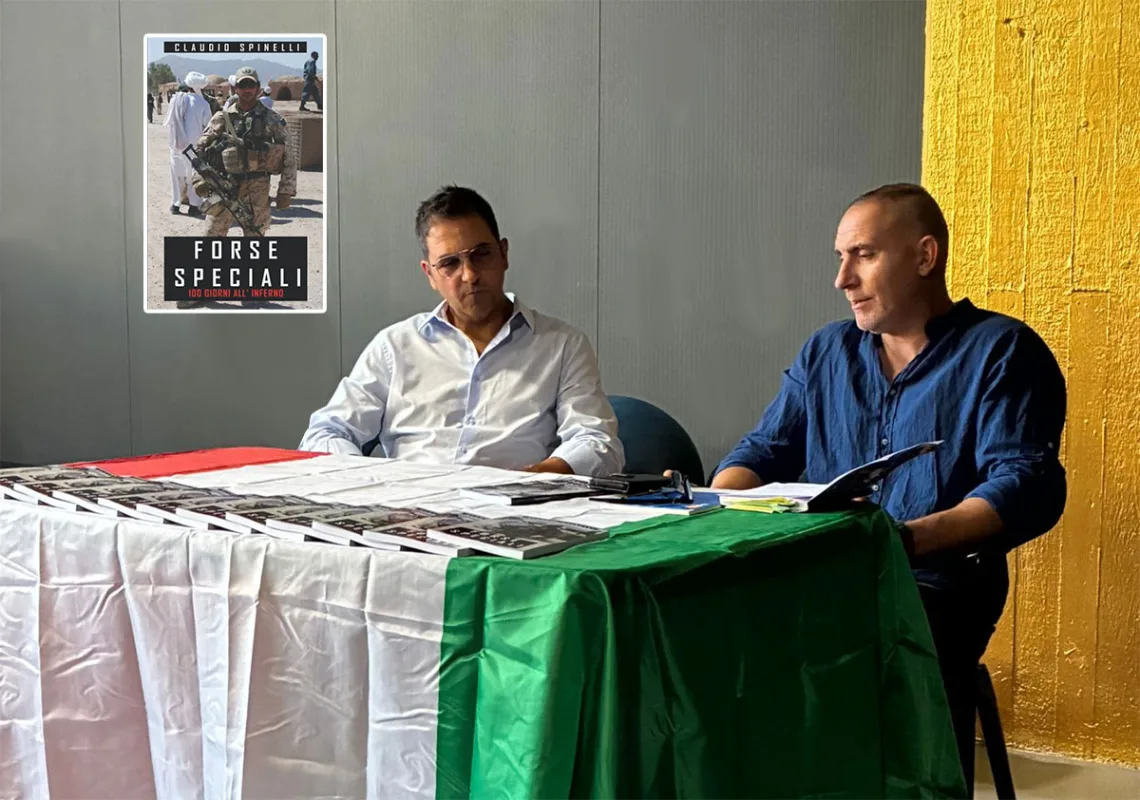

At the GluteSculpt Center in Sassari the presentation of the book “Forse Speciali – 100 giorni all’inferno”, written by Claudio Spinelli, former raider of the 9º Reggimento d’Assalto “Col Moschin”, took place on Saturday.
Spinelli, who volunteered for the Folgore in 1998 and later became an Army raider, retraces in his pages the experience in Afghanistan with the legendary Task Force 45: high-intensity operations, firefights, wounded and fallen find space in a direct and unfiltered narrative, capable of conveying to the reader both the harshness of combat and the human aspect of those who served on the front line.
Moderating the meeting was our friend Retired Paratrooper Raffaele Sestilli, who gathered some questions for the author. This led to an intense dialogue, rich in insights and reflections that go far beyond the pages of the book, considered by many – and also by us – one of the best biographies ever written by an Italian raider.
Technology and the role of man
The first question concerns a very current topic: drones and new technologies are taking on an increasingly central role on the battlefields of the future. But one wonders if the human being will really remain at the center of special operations or if, progressively, they will be replaced by machines and autonomous systems.
Spinelli has no doubts:
The human being has an essential role that cannot be replaced. They have the ability to distinguish what needs to be done in a reasoned way. No matter how much is invested in technology and artificial intelligence, the machine cannot replace, at the moment, the mind and intuition of man, especially in the technical-tactical approach on the ground.
A reflection that puts the soldier back at the center, confirming how, at least for now, technology remains a support and not a substitute.
Afghanistan: twenty years for nothing?
The second topic addressed is among the most delicate: Afghanistan. After twenty years of sacrifices, the commitment of the international community ended with the return of the Taliban to power. A strategic failure?
Spinelli responds with realism:
We Italians were among those who paid the lowest human price. Other countries counted hundreds, even thousands of fallen. The real question is: was it worth it?
Humanly, the answer is not simple. From a tactical and geopolitical point of view, these evaluations are up to the experts. We operators on the ground did not have the opportunity to measure the results. We certainly contributed to democracy and freedom of expression, but today those achievements no longer exist.
Words that convey not only bitterness but also the weight of those who have seen up close the human costs of such a long and controversial conflict.
An extraordinary experience: training astronauts
When asked about the most significant moment of his career, Spinelli surprises. He does not mention a combat operation, but a different experience that enriched him on a human and professional level:
Here we play easy, it is not written in the book, but I had the fortune to collaborate and act as an instructor for ESA astronauts in 2008. I had relations with them until 2010, when a format called CAVES was homologated.
We secured and equipped a cave in Su Bentu, here in Sardinia, and from then on this format was born. The astronauts traverse it and thus live in the cave, where they simulate an alien environment, Martian in this case. There they develop particular skills, live in confined, lightless environments.
It was a beautiful thing because it had nothing to do with firearms, with war, but it was something scientifically incredible. Very, very beautiful. I believe the CAVES module is still active, so astronauts still do it. I don't know if in Sardinia, but those who are curious can go to the ESA website and find all this information. For me, it was a fascinating experience.
Italian Special Forces today
Spinelli then took stock of the evolution of the Italian Special Forces over the last twenty years:
There has been an evolution, especially after 2009-2010. Previously, potentially strong people were selected, and the training was tough from a physical point of view. Psychologically you prepared yourself, learned in the field.
Now, however, with the help of technology and new equipment, it has become easier to be an operator. We were a bit more “donkeys” at the time: backpack on and off we went, like beasts. When there was a need to do two plus two, you reasoned it out, even if it was a simple operation.
Today, the tendency is to have the thinking operator. Not that it wasn't before, but before you had to invent anything and adapt. Now technology gives an incredible hand and makes everything much simpler from a support point of view.
A transformation that reflects geopolitical changes and the increasing complexity of missions.
Advice for young aspiring raiders
Finally, a question dedicated to those who dream of joining the Special Forces: what qualities are indispensable?
Spinelli does not limit himself to talking about physical preparation:
First of all, the body must always be very trained, because there you are called to extraordinary efforts, out of the ordinary. It's not enough to be a bodybuilder: you have to train 360 degrees. I recommend bodyweight exercises, because if you break down first, you arrive already destroyed. You must arrive in shape, then they destroy you on the spot. A triathlete is fine, but especially those who do bodyweight exercises. Running is always trained.
And then you have to study military subjects. Today there are no more secrets: with an internet search, you find the technical parameters of anything, from weapons to viewers, from radios to equipment. If someone arrives already prepared, they have an edge. The training path makes a natural selection: if you don't have the aptitude to become a raider, there's nothing you can do. The evolution of technology has made everything more accessible, but the mind remains fundamental.
In my opinion, the Special Forces sector should also open up to direct civilian paths, thus giving the opportunity to those who are truly motivated to enlist without too long intermediate steps.
Spinelli's reasoning opens up an interesting topic: the idea of allowing motivated civilians to access the raider path. It wouldn't be an absolute novelty: the British SAS already recruit civilians, even over 40 without military experience. A model that, if adapted to Italy, could represent a strategic opportunity for our country, focusing on motivation, aptitude, and psychophysical resilience.
Conclusion
The meeting with Claudio Spinelli confirmed the value of a book that does not just tell military missions but provides an authentic portrait of an Italian raider. Among war memories, critical reflections, and unexpected memories like the experience with ESA, “Forze Speciali – 100 giorni all’inferno” is a work that deserves to be read by anyone who wants to truly understand what it means to serve in the elite of the Italian Armed Forces.


Comments
No comments yet. Be the first!