


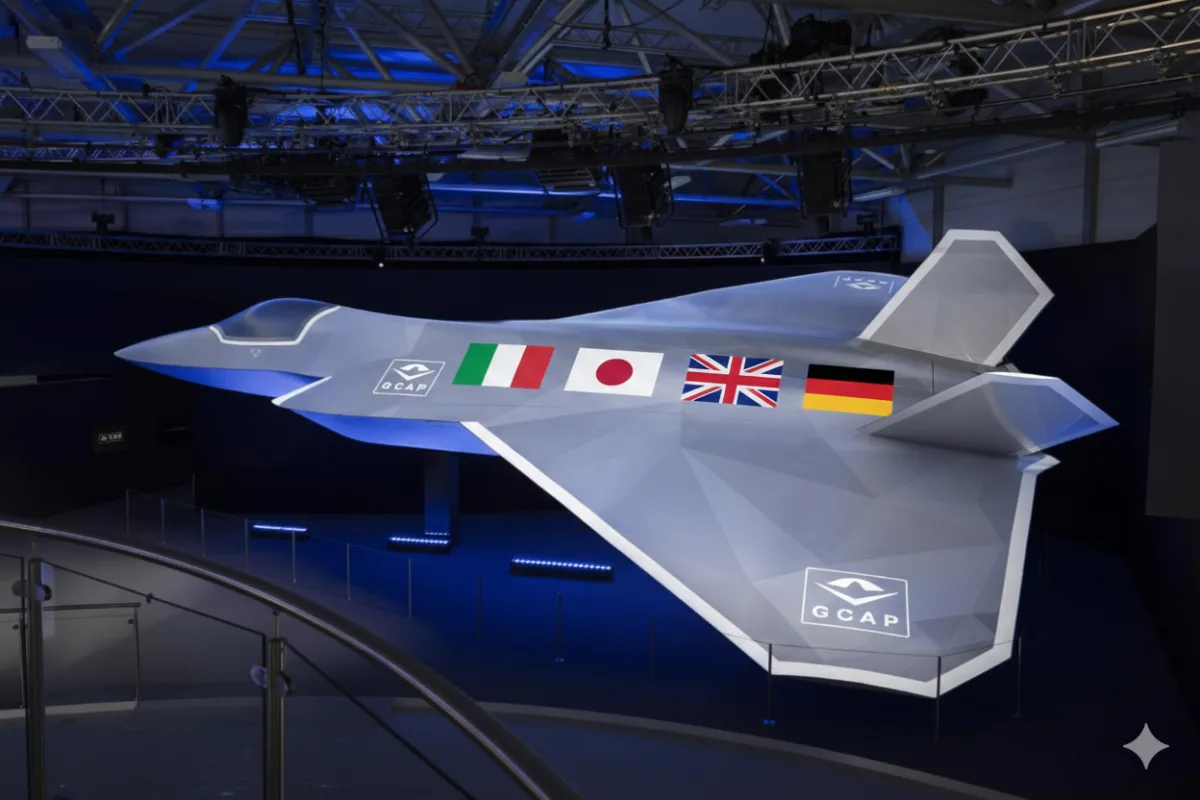

Berlin is considering joining the joint venture between Italy, the United Kingdom, and Japan developing the Gcap, the “fighter of the future” of the sixth generation. The hypothesis emerged strongly after a significant political move: Friedrich Merz reportedly discussed it directly with Giorgia Meloni, finding availability on the Italian side. A signal that, if realized, would have a dual impact: industrial and symbolic. Because the Gcap is described as the most important military project under development in Europe, and because a potential German shift towards the Italian-British-Japanese program would sound like a blow to the defensive architecture built in recent years around the Paris–Berlin axis.

Not “just a plane”: the Gcap as a “system of systems”
The central point is that the Gcap is not presented as a simple fighter. It is a “system of systems”: an integrated platform where the piloted aircraft interacts with drones, satellites, combat cloud networks, and advanced command-control capabilities. In other words, superiority no longer depends solely on aerodynamic performance or armaments, but on the digital and operational ecosystem that connects sensors, weapons, and decisions in real-time.
The industrial joint venture, as reported, involves Leonardo, BAE Systems, and Mitsubishi: a triangle that combines European and Japanese capabilities, with direction and a center of gravity also passing through the United Kingdom (headquarters in England, in an area linked to BAE).
The Fcas issue: separation from Paris is no longer taboo
German interest in the Gcap intertwines with the crisis of the other major European project: the Fcas, born in 2017 around the Dassault–Airbus consortium (later joined by Indra). The history of the Fcas is marked by industrial clashes over division of labor, governance, subcontracting, and decision-making processes. And here lies the political crux: the discussion is no longer so much about whether to separate, but how to do it without exploding the relationship with France at a time of friction on multiple fronts.
In this context, Berlin seems interested in saving at least part of the Fcas program: the combat cloud, that is, the network, combat, and control layer that could remain interoperable with other platforms and become a reusable European asset. But on the “common jet” the air has changed: the hypothesis that Europe ends up with two new-generation fighters, one “Franco-centric” and one “Gcap-centric”, no longer seems like science fiction.

What changes if Germany joins: scale, money, and bargaining power
A potential German entry into the Gcap would not be a simple “expansion”. It would be a transformation of scale. If Berlin were to order dozens (or even “a hundred”) of aircraft, it would change:
- Economy of the program: more numbers, greater distribution of fixed costs.
- Negotiating power in supply chains, components, and common standards.
- Political weight of the project: it would effectively become the backbone of future non-American European combat aviation.
And there is a determining factor: the funds. In the cited framework, the Gcap program has entered the development phase and the estimated costs have increased significantly: from an initial setup of 6 billion to an updated estimate of 18.6 billion, with a portion still to be secured amounting to 7.831 billion. In this context, a new “large” partner would have an immediate advantage: absorbing part of the increases and making the spending curve more sustainable.
The political-industrial price: what will Rome ask and what will London ask
If Berlin knocks, however, it is not certain that it will enter “for free”. The implicit question is: what will Italy ask in return? In the circulated hypotheses, exchanges and fits in other domains are glimpsed:
- land platforms (tanks, vehicles, and components),
- naval (with names recalling Italian industrial capacity in the sector),
- space and satellites, today central to any “multi-domain” military architecture.
But the “decisive word” would not be only Italian: it would also pass through the United Kingdom, which hosts the program's command structure and has specific strategic interests. London, on one hand, wants to have more influence in European common procurement mechanisms and access to continental financial instruments; on the other hand, it is pushing to include other actors in the program (there is talk of the British request to open to the Saudis). This adds a delicate level: geopolitical balances, export control, technological standards, and political consensus among partners.

A signal for European defense: integration or “two speeds”?
The Gcap–Germany–Fcas affair tells an uncomfortable truth: European defense is entering a phase of redesign that does not proceed by slogans (“strategic autonomy”), but by concrete industrial programs, money, supply chains, and alliance choices. If Germany were to really shift, even gradually and “after the divorce” with Paris, the message would be clear: Europe would not have a single “champion”, but an internal competition between models, governance, and national interests.
For Italy, however, the game is also an opportunity: to transform its role from partner to pivot of a major technological program, with impacts on skilled employment, supply chain, and sovereign capability. For France, on the other hand, the risk is twofold: losing centrality in the “European” project conceived ten years ago and facing a competitor that, by expanding the base, can become more sustainable and more influential.
Ultimately, the “elephant in the room” is not just the fighter. It is the question that accompanies it: who will really lead European technological defense in the next twenty years, and with which alliances?



Comments
No comments yet. Be the first!