


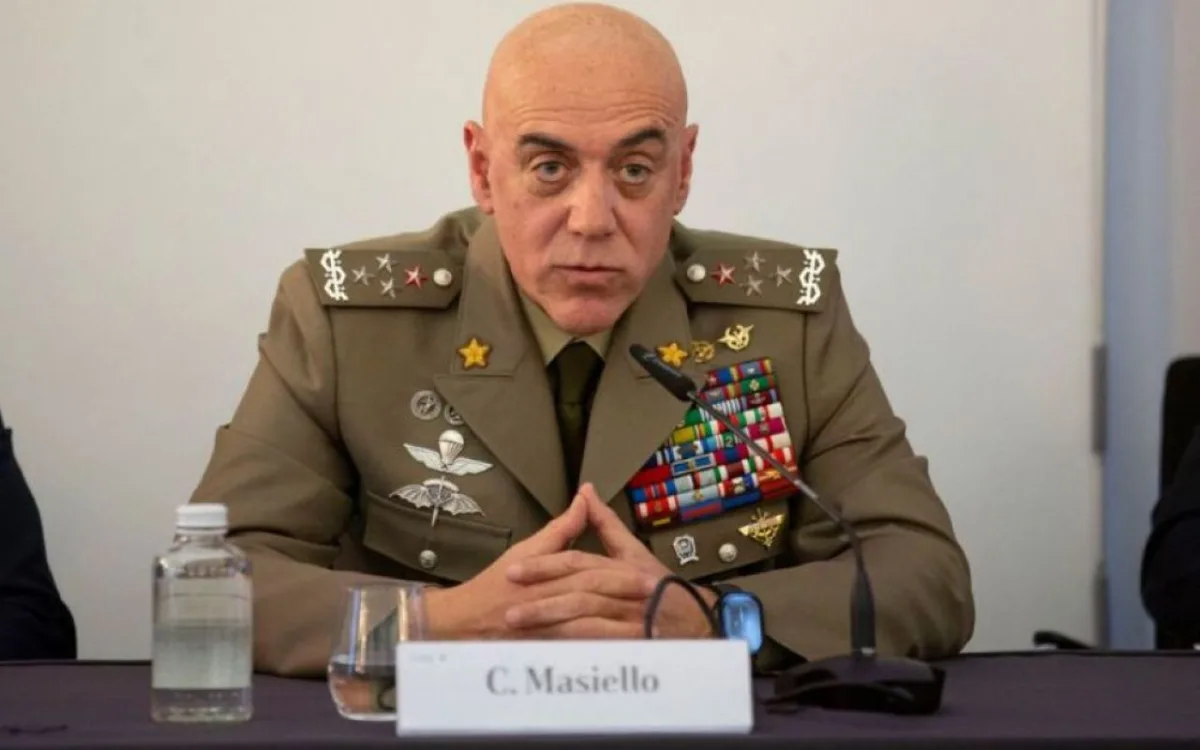

When General Masiello speaks of “frozen middle, the frozen middle part… those who don't want to change because they are comfortable in their comfort zone and want to enjoy positional rents”, he is not just provoking his world. He is naming something that exists in almost all organizations: companies, public administration, healthcare, schools, the third sector.
His strongest point is when he acknowledges that these words have made him unpopular with the intermediate hierarchy, “colonels and brigade generals,” that is, the level that should bring the ideas and energies of the young to the top but often blocks them instead. In managerial language, this level is the middle management, the famous frozen middle: the layer of people between those who decide the strategy and those who work on the front line.
They are the ones who receive orders from above and translate them into daily practices, procedures, changes in habits. When something gets stuck in the middle, the entire machine slows down: decisions remain on paper, reforms get bogged down, digital transformation becomes a slogan, and innovation is reduced to a few showcase projects that don't really change the way of working. It is almost never conscious sabotage; rather, it is a progressive freezing, the result of years in which culture, structure, and personal psychology add up and crystallize.

Why middle management freezes
On one side, there are pressures from the top: change quickly, achieve new objectives, reduce costs, digitalize, be more agile. On the other, there are the concrete difficulties of the teams, the daily problems, the reassuring “it has always been done this way”. In between, middle managers feel the responsibility for the result, often without having sufficient tools, time, and clarity.
Resistance often arises from a lack of meaning, rather than instructions. Circulars, slides, and documents are never lacking; what is missing is a credible answer to the question “why”. Why is this transformation indispensable? What happens if we don't do it? What impact will it have on me and my role? If the change appears as yet another managerial fad or the whim of those at the top, it becomes natural to view it with skepticism and proceed at the bare minimum.
There is also an issue of involvement: many middle managers do not participate in the design of changes, they are informed downstream, when everything has already been decided. They find themselves having to defend choices they did not contribute to and that often do not take into account real constraints. In these conditions, it is difficult to feel “owners” of the change; a passive adaptation is more likely, punctuated by small silent slowdowns.

Incentive systems also play their part. If careers reward those who don't cause problems, who don't make mistakes, who keep the status quo in balance, the implicit message is clear: don't take risks. Change always involves margins of error, experimentation, taking responsibility; if the organization continues to celebrate absolute caution, freezing becomes rational.
The more human dimension, that of fear, should not be overlooked. Every transformation questions identities and skills built over years of work. A new way of working, the introduction of technologies, the revision of processes and roles can be perceived as a threat: what if I am no longer up to it? What if my role shrinks? What if the young can do better than me? When these fears are not recognized, they turn into underground resistances.
Finally, there is a very concrete factor: overload. Middle management is often crushed between goals to achieve, bureaucratic requirements, people management, conflicts, and continuous emergencies. To all this is added change, which requires time, mental energy, and the ability to think medium to long term. Without freeing up space, the transformation project is experienced as an unmanageable “extra” and therefore postponed, diluted, watered down.
The paradox is that without this layer, no change really holds: middle management is the hinge between the top's vision and the base's energy. If the hinge gets stuck, the organizational fabric tears.

How to thaw the center: shared responsibility
So how do you “thaw” this frozen center General Masiello talks about? The first step is to change the approach to communication. It's not enough to announce that “project X is starting”: you need to build a clear and honest narrative that explains why change is necessary right now, what real problems it solves, what risks are involved in not doing it. This narrative must be grounded in the reality of the individual levels: what concretely changes for middle managers, what opportunities open up for them, what tools they will have at their disposal.
Next comes true involvement. Involving middle management doesn't mean asking “do you have questions?” about decisions already made, but having them participate in the design phase: gathering ideas, constraints, scenarios; using their operational knowledge to make plans more realistic; sharing drafts instead of presenting closed packages. Those who help build a decision are much more likely to defend it and make it work.
Then a real alignment between strategic objectives and evaluation systems is needed. If change is truly a priority, it must be included in the KPI, bonuses, and promotion criteria. We need to reward those who try new paths, who share mistakes as learning opportunities, who grow their team on future skills. The message to send is that blind caution is no longer the safest option, but the one that exposes the organization the most.

To support all this, serious investment in the updating of middle managers is needed. Transformative leadership, change management, digital skills, management of hybrid and multigenerational teams are not optional, but the minimum toolbox for those in the middle. Targeted and continuous training is also a message of trust: “we rely on you to build the future.”
An important part of the work is freeing up time and energy. Reducing unnecessary requirements, automating routine where possible, creating protected spaces to work on change projects without being sucked into the daily urgency is essential: we cannot expect innovation from those who live permanently in apnea.
All this finally requires strong consistency from the top. The leadership must be the first to change behaviors, tools, leadership style. Middle managers observe: if they see a gap between what is proclaimed and what is done, the freezing stiffens; if instead they see leaders who experiment, expose themselves, defend those who try and take responsibility for the inevitable mishaps, the message becomes powerful.
The generational theme can also be transformed from conflict to alliance. Bringing young talents and experienced managers to work together, creating reverse mentoring paths where the younger ones bring digital skills and a new perspective while the older ones offer experience and depth, building spaces for mutual listening: these are concrete ways to dissolve the opposition and transform it into common strength.

The words of General Masiello have the merit of tearing the veil on a taboo: often, what blocks the future is not an external enemy, but that “frozen middle” that guards positions and habits. The next step is for everyone to take a share of responsibility: the leaders, in creating the right conditions and incentives; the middle managers, in deciding whether to be content with managing the present or becoming builders of the future; the young, in transforming their ideas into concrete proposals and seeking allies instead of enemies.
Thawing the frozen middle is neither easy nor quick, but it is probably the only way to prevent our organizations from remaining prisoners of their own positional rents. And perhaps it is precisely from strong voices like that of General Masiello that the movement can start, which puts back into circulation energy, responsibility, and vision.



Comments
No comments yet. Be the first!