


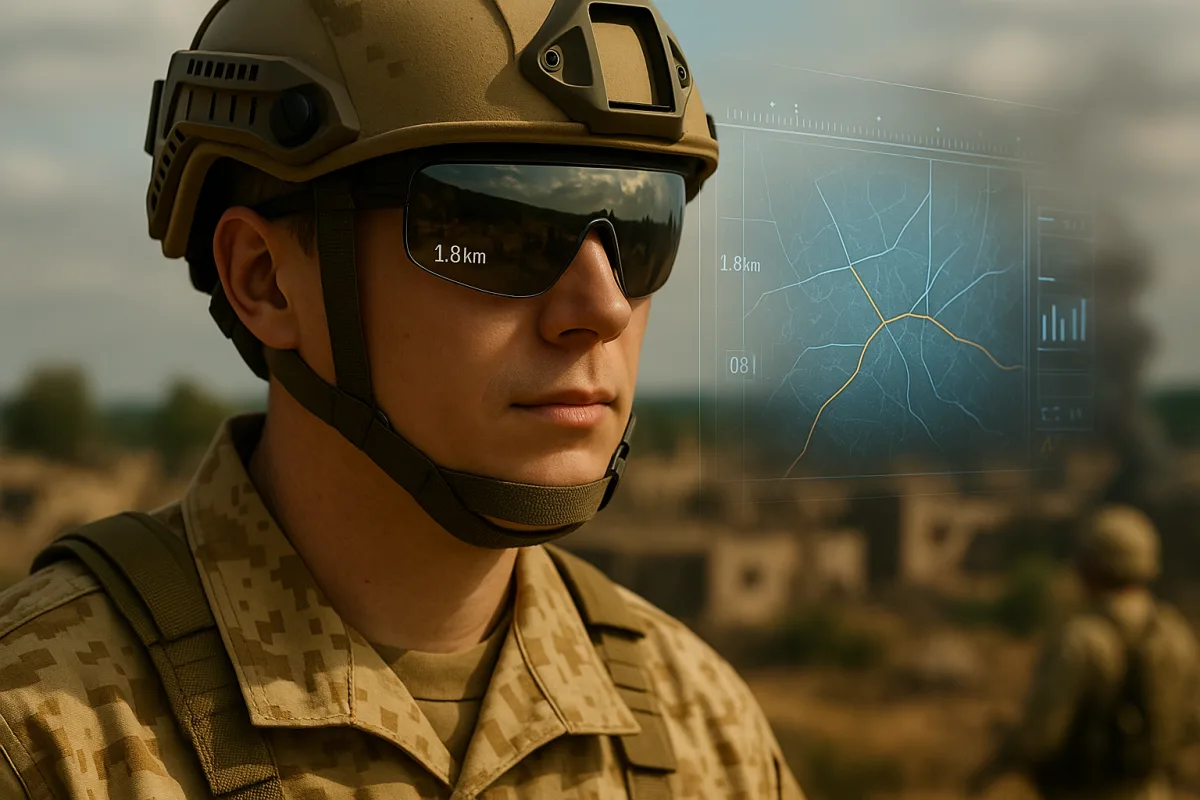

The United States Army has signed a $159 million contract (approximately €147 million) with Anduril Industries to develop an innovative mixed visor system intended for the military. The initiative is part of the Soldier Borne Mission Command (SBMC) program, designed to replace the previous IVAS project, developed with Microsoft but plagued by delays and technical limitations.
From the IVAS Lesson to a New Generation of Visors
The IVAS project, launched in 2018 with high expectations, stalled due to side effects such as headaches and nausea reported by soldiers, as well as technological integration difficulties. After Congress cut funding in 2022, the Army decided to rethink the entire approach, focusing on a more modular, open, and customizable platform.
SBMC was born from these needs: to provide each soldier with an integrated interface that combines night vision, augmented reality, thermal sensors, and AI-powered command tools.
“Superhero Abilities” on the Battlefield
Anduril describes the system as a technology capable of granting soldiers “superhero abilities”: seeing better, knowing more, and deciding faster. The new modular helmets will integrate advanced optical components with day, night, and thermal images, digital maps, and real-time data streams.
During field tests, soldiers even controlled drones over three kilometers away directly through the helmet, without resorting to external operators.
The heart of the system will be the SBMC-Architecture (SBMC-A), a software platform based on Lattice and derived from tests on IVAS 1.2. The hardware part involves giants like Meta, OSI, Qualcomm, and Gentex, while the project also involves leading companies such as Palantir, L3Harris, Persistent Systems, Sierra Nevada Corporation, and Maxar Intelligence.
A Revolution for American Infantry… and a Challenge for Italy
The initiative represents the largest operation ever launched by the US Army to equip every soldier with augmented perception tools. It's not just about improving night vision, but radically transforming the soldier's relationship with the operational environment, eliminating information fragmentation and accelerating the decision-making process.
According to US doctrine, the ability to decide faster than the enemy is a crucial advantage for the success of operations. With SBMC, the Pentagon aims to turn this ability into a systemic advantage.
For Italy, this issue cannot remain marginal. The light infantry units – Alpini, Paratroopers of the Folgore, Lagunari, and Airmobile Regiments – represent the vanguard of the national military instrument and are often the first to be deployed in the most complex operational theaters. These highly mobile and combat-ready components need a decisive technological leap: advanced augmented reality equipment, distributed command systems, and integrated sensors could multiply their effectiveness, increase the safety of units, and strengthen interoperability with NATO allies.
If the US Army sets the standard with SBMC, Rome will soon have to face the challenge: equipping its infantry units with the same augmented perception and real-time command capabilities, to avoid falling behind in the war of the future.






Comments
No comments yet. Be the first!