




On April 26, 2025, the French Navy conducted an important sea test using an explosive naval drone against a decommissioned cargo ship. The experiment took place off the coast of Toulon, France's main naval base, and involved the direct participation of an offshore patrol vessel from the fleet, from which the remotely controlled drone was launched.
According to the Ministry of the Armed Forces, the aim of the test was to assess the effectiveness of the new remotely controlled naval weapon systems, improving their guidance capabilities, safety, and explosive efficiency. In an official statement, the Ministry emphasized how the current international context, deemed increasingly unstable, requires the development and use of innovative tools for high-intensity naval combat.
“The objective of the experiment was to confirm the French Navy's ability to deploy a remotely controlled naval munition directly from the sea,” the ministry stated. “Given the worsening geopolitical context, we consider it essential to conduct operational experimental campaigns in the maritime environment.”
The drone used – an USV (Unmanned Surface Vehicle) equipped with an explosive charge – was directed towards an old cargo ship specially prepared for the test. Before the test, the target hull had been cleansed of fuels and hazardous liquids, and the impact area had been reinforced with metal plates and tires, to contain the damage and prevent sinking.
#Expérimentation |3️⃣,2️⃣,1️⃣:💥Impact ! Nouvelle expérimentation: un jetski dronisé porteur d’une charge explosive offensive a détoné contre la coque d’un CTM 🚢🎯Démontrer l’acquisition de nouveaux savoir-faire en combat naval, dont l’emploi de munitions navales téléopérées. pic.twitter.com/Q8iMFDc0dq
— Marine nationale (@MarineNationale) April 29, 2025
This test is part of a real exercise campaign that the French Navy is conducting to strengthen its combat capabilities. In December 2024, a nuclear attack submarine sank the former ship Premier-Maître L’Her with a heavy torpedo F21, while in February 2025 a shock test was conducted on the frigate Courbet, detonating a naval mine nearby during navigation in full operational mode.
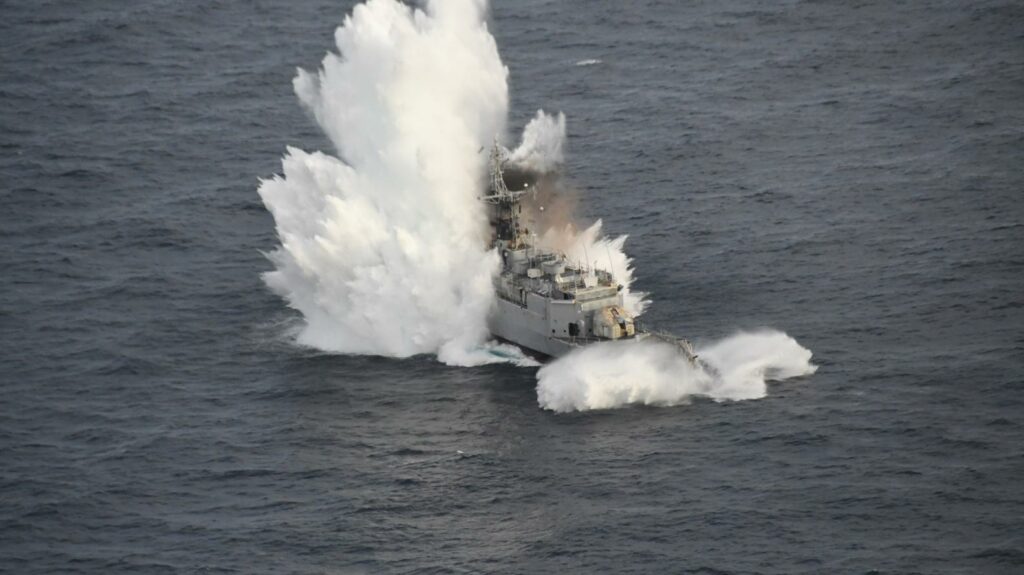
Interest in explosive naval drones has grown significantly following the conflict in Ukraine, where Ukrainian forces used kamikaze marine drones to strike and sink Russian ships in the Black Sea. The effectiveness of this strategy has caught the attention of armed forces worldwide, prompting the United States to develop similar solutions: the American company Maritime Tactical Systems recently presented its own naval drone designed for one-way attack missions.
The French initiative thus confirms a global trend: naval forces are rapidly evolving, introducing autonomous weapon systems that are more economical, less exposed to human risk, and capable of operating in complex and high-intensity theaters. With these tests, Paris demonstrates its willingness to enhance its maritime defense tools, in line with the growing instability of international balances.



Comments
No comments yet. Be the first!