


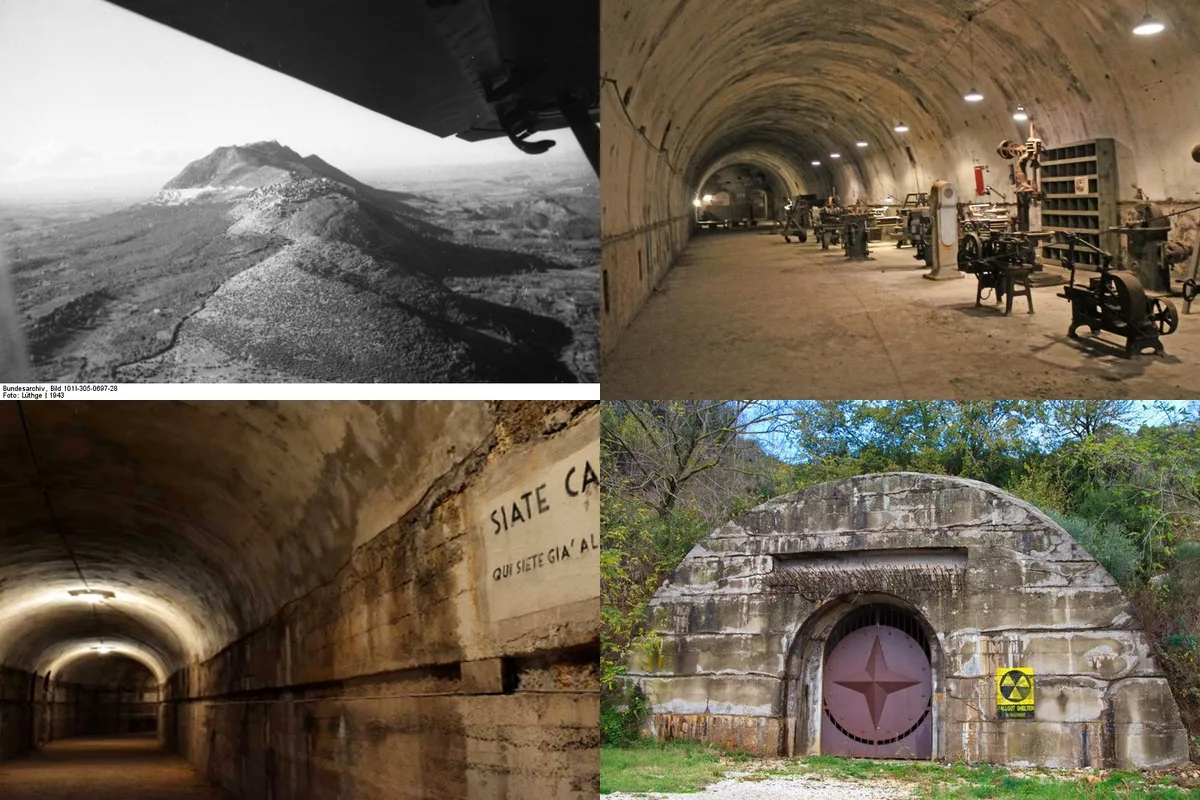

In an era where global military doctrine is rapidly rewriting the concepts of protection and survival of Command and Control (C2) centers, the analysis of the great underground infrastructures of the past becomes relevant again. Recent technological evolutions – from "loitering" drones to hypersonic missiles capable of penetrating reinforced concrete – pose a crucial question: do the "old" fortified mountains, like the Monte Soratte bunker, still offer protection?
The Engineering Legacy: A Structure Proof Against History
To understand the resilience of Soratte, one must look at how it was built. It is not a simple refuge, but a work of high mining engineering.
Born in 1937 at Mussolini's behest and built by the company "Giovanni Perucchetti" under the direction of the Military Engineering Corps, the complex was dug into the limestone heart of the mountain. The workforce employed was impressive: thousands of workers labored in three eight-hour shifts, using mixed techniques of mines and pneumatic hammers.
The result was an "underground city" that, although only a third of the 14 km planned in the original project was completed, boasts 4 km of tunnels and caverns arranged in a semicircle.

Resistance to Conventional Bombing
The first "stress test" of the structure occurred during the Nazi occupation. In 1943, Field Marshal Albert Kesselring established the Supreme Command of the South there.
On May 12, 1944, two squadrons of Allied B-17s dropped a heavy bombardment on the mountain.
- Outcome: The internal structure held perfectly. This demonstrates that for conventional gravity threats and standard artillery, the rocky cover of Soratte is, even today, impenetrable.
The "Double Shell" Technology: The Leap into the Atomic Era
What makes Soratte interesting for modern analysis is not just the thickness of the rock, but the structural upgrade that occurred during the Cold War (1967-1972). Under NATO's aegis, part of the complex was transformed into an anti-atomic bunker to host the Italian Government.
From a technical point of view, an advanced solution for habitability and protection was implemented:
- First layer: Concrete adhering to the living rock.
- Air gap: An empty space of about one meter for drainage and insulation.
- Second layer: Reinforced and waterproofed concrete (the habitable shell).
This "box-in-a-box" configuration is crucial not only for humidity but to partially decouple the internal structure from shock waves transmitted through the rock in case of nearby external explosions.

Analysis of Modern Threats: Drones and Hypersonic Missiles
We come to the heart of the matter: would Soratte hold up today?
The Drone Threat (UAV and Loitering Munitions)
Protection Level: VERY HIGH
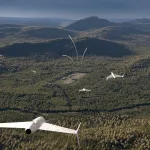
Modern drones (such as FPV quadcopters or kamikaze drones like Shahed) are devastating against surface targets, vehicles, and infantry.
- Against Soratte: A drone cannot penetrate meters of limestone rock. The threat is limited to entrances and air intakes.
- Mitigation: With the original 22 entrances (many of which are sealed or protected by wooden and metal armored doors), physical protection is simple. Anti-drone grates, electronic jamming systems, and airtight doors would make the complex invulnerable to drones, which do not have the kinetic mass to break through the mountain.
The Threat of Hypersonic Missiles and "Bunker Busters"
Protection Level: MEDIUM-HIGH (with reservations)
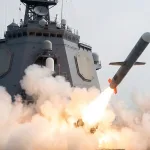
Here the scenario changes. A hypersonic missile (e.g., Kinzhal or Zircon) travels at speeds exceeding Mach 5, generating frightening kinetic energy upon impact. There are also "Bunker Buster" bombs (like the American GBU-57 MOP) designed to penetrate up to 60 meters of reinforced concrete or 40 meters of moderately hard rock.
The geological factor of Soratte:
Monte Soratte is a limestone island. Limestone is a hard sedimentary rock.
- Cover: The deep tunnels have hundreds of meters of rock overhead. No conventional or hypersonic missile existing today can pierce 200-300 meters of solid rock in one strike.
- Shock wave: The real danger is not direct penetration into the command room, but the seismic wave generated by the impact. A hypersonic strike on the mountain's peak could collapse parts of the rocky vault or damage internal electronic equipment due to shock (spalling effect).
- Precision: Modern technology allows for precise targeting of an entrance or ventilation duct. If a missile enters a tunnel before exploding, the devastation would be total.

Conclusions: A Possible Refuge Still?
If we were to reactivate Monte Soratte today as a command post:
- Yes, it protects against drones: It would be totally immune to surveillance and attacks by drone swarms, provided the entrances are protected.
- Yes, it protects against tactical nuclear attacks: The depth and anti-atomic structure of '67 (if maintained with new NBC filters) still offer excellent protection against radiation and heat.
- Perhaps, against the latest generation of penetrating missiles: While the deep structure would survive, the lateral entrances are the Achilles' heel.
Monte Soratte remains, engineering-wise, one of Italy's most resilient works. While the external barracks would be pulverized in minutes, the heart of the mountain, painstakingly excavated by the miners of 1937, still offers protection today that very few modern buildings can boast.




Comments
No comments yet. Be the first!